Reinhard Heckel Assistant Professor, Technical University of Munich - - PDF document

reinhard heckel
SMART_READER_LITE
LIVE PREVIEW

Reinhard Heckel Assistant Professor, Technical University of Munich - - PDF document

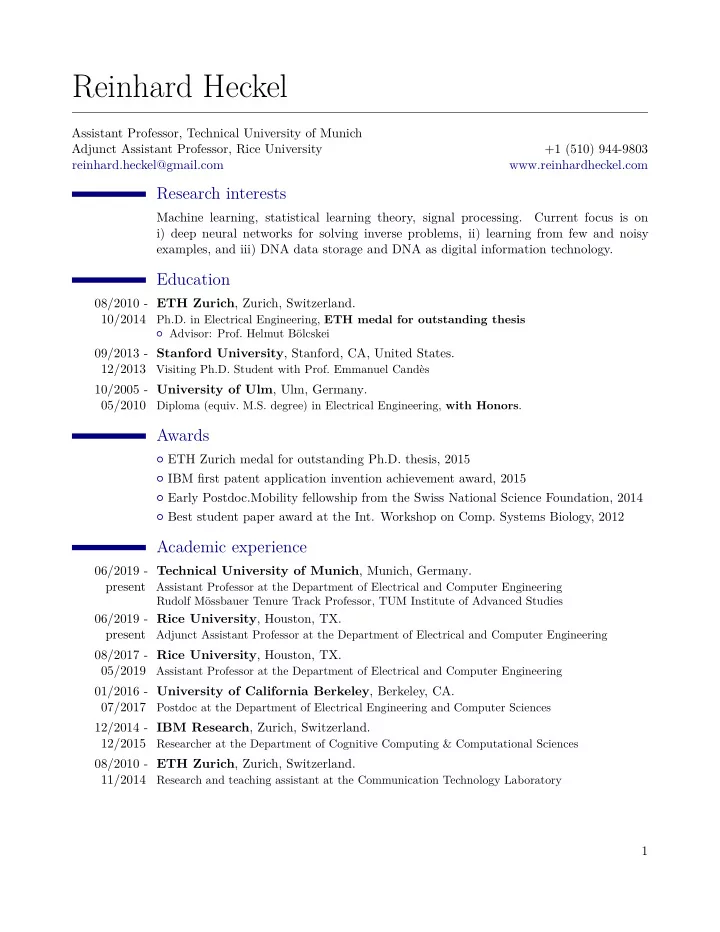
Reinhard Heckel Assistant Professor, Technical University of Munich Adjunct Assistant Professor, Rice University +1 (510) 944-9803 reinhard.heckel@gmail.com www.reinhardheckel.com Research interests Machine learning, statistical learning


slide-1
SLIDE 1

Reinhard Heckel

Assistant Professor, Technical University of Munich Adjunct Assistant Professor, Rice University +1 (510) 944-9803 reinhard.heckel@gmail.com www.reinhardheckel.com

Research interests

Machine learning, statistical learning theory, signal processing. Current focus is on i) deep neural networks for solving inverse problems, ii) learning from few and noisy examples, and iii) DNA data storage and DNA as digital information technology.

Education

08/2010 - 10/2014 ETH Zurich, Zurich, Switzerland.

Ph.D. in Electrical Engineering, ETH medal for outstanding thesis Advisor: Prof. Helmut Bölcskei

09/2013 - 12/2013 Stanford University, Stanford, CA, United States.

Visiting Ph.D. Student with Prof. Emmanuel Candès

10/2005 - 05/2010 University of Ulm, Ulm, Germany.

Diploma (equiv. M.S. degree) in Electrical Engineering, with Honors.

Awards

ETH Zurich medal for outstanding Ph.D. thesis, 2015 IBM first patent application invention achievement award, 2015 Early Postdoc.Mobility fellowship from the Swiss National Science Foundation, 2014 Best student paper award at the Int. Workshop on Comp. Systems Biology, 2012

Academic experience

06/2019 - present Technical University of Munich, Munich, Germany.

Assistant Professor at the Department of Electrical and Computer Engineering Rudolf Mössbauer Tenure Track Professor, TUM Institute of Advanced Studies

06/2019 - present Rice University, Houston, TX.

Adjunct Assistant Professor at the Department of Electrical and Computer Engineering

08/2017 - 05/2019 Rice University, Houston, TX.

Assistant Professor at the Department of Electrical and Computer Engineering

01/2016 - 07/2017 University of California Berkeley, Berkeley, CA.

Postdoc at the Department of Electrical Engineering and Computer Sciences

12/2014 - 12/2015 IBM Research, Zurich, Switzerland.

Researcher at the Department of Cognitive Computing & Computational Sciences

08/2010 - 11/2014 ETH Zurich, Zurich, Switzerland.

Research and teaching assistant at the Communication Technology Laboratory

1

slide-2
SLIDE 2

Teaching

At TUM

Summer 2020: Introduction to machine learning Summer 2020: Seminar on the foundation of deep learning in imaging science Winter 2019: Theory of modern machine learning Summer 2019: Introduction to machine learning

At Rice

Spring 2019: ELEC 577 Optimization for data science Fall 2018: ELEC 578 Introduction to machine learning Spring 2018: ELEC 631 Deep networks for inference and estimation, jointly taught with Richard Baraniuk Fall 2017: ELEC 577 Optimization for data science

Funding

Awarded

NSF IIS Small “Actively learning from the crowd”, awarded 2018 as a single PI: $474,322.

Pending

D-A-CH DFG Grant: “Towards next generation DNA storage systems: Photolitho- graphic Synthesis and Advanced Information Reconstruction and Error Correction”, joint with Robert Grass from ETH, 2020.

Current group

Fatih Furkan Yilmaz, 3rd year PhD student at Rice Mohammad Zalbagi Darestani, 2nd year PhD student at Rice Zhenwai Dai, 2nd year PhD student at Rice, co-advised with Anshumali Shrivastava Tobit Klug, 1st year PhD student at TUM (starting Summer 2020)

Service

Organization of workshops/conferences

Co-chair of the NeurIPS 2020 workshop “Deep Learning and Inverse Problems” Technical Area Chair for Adaptive Systems, Machine Learning, Data Analytics at the 2019 Asilomar conference Co-chair of the NeurIPS 2019 workshop “Solving inverse problems with deep networks: New architectures, theoretical foundations, and applications” 2

slide-3
SLIDE 3

Departmental service at Rice University

Founded, acquired $20.000 funding for, and co-running (with students from ECE, CS, and Stats) a weekly machine learning lunch series that averages more than 70 participants per week Member of the graduate committee Member of the ECE search committee for the faculty search in “Embedded Machine Learning”

Member in PhD and Master committees

Souptik Barua, PhD in ECE, Rice University, 2019 Babhru Joshi, PhD in Applied Mathematics, Rice University, 2019 Chris Metzler, PhD in ECE, Rice University, 2018 CJ Barberan, Masters in ECE, Rice University, 2019 Oscar Leong, Master in Applied Mathematics, Rice University, 2018 Akash Kumar Maity, Masters in ECE Rice University, 2018 Qiang Zhang, Masters in Applied Mathematics, Rice University, 2018

Publications

3 representative papers marked with *

Preprints

P1

  • M. Zalbagi Darestani and R. Heckel

Can un-trained neural networks compete with trained neural networks at image recon- struction? arXiv:2007.02471, Jul. 2020. P2

  • R. Heckel and F. F. Yilmaz

Early stopping in deep networks: Double descent and how to eliminate it arXiv:2007.10099, Jul. 2020. P3

  • F. F. Yilmaz and R. Heckel

Image recognition from raw labels collected without annotators arXiv:1910.14634, Oct. 2019. P4

  • I. Shomorony and R. Heckel

DNA-Based Storage: Models and Fundamental Limits under review at Transactions of Information Theory, arXiv:2001.06311, Dec. 2019 P5

  • W. Huang, R. Heckel, P. Hand, V. Voroninski,

A provably convergent scheme for compressive sensing under random generative priors under review at Foundations of Computational Mathematics, arXiv:1812.04176, 2018.

Journal articles

J1

  • P. L. Antkowiak, J. Lietard, M. Zalbagi Darestani, M. Somoza, W. J. Stark, R. Heckel*,
  • R. N. Grass*

Low cost DNA data storage using photolithographic synthesis and advanced information 3

slide-4
SLIDE 4

reconstruction and error correction Nature Communications, 2020, to appear (*=corresponding authors). J2

  • R. Heckel, W. Huang, P. Hand, V. Voroninski,

Deep denoising: Rate-optimal recovery of structured signals with a deep prior Information and Inference: A Journal of the IMA, 2020. J3

  • E. Bostan, R. Heckel, M. Chen, M. Kellman, L. Waller

Deep Phase Decoder: Self-calibrating phase microscopy with an untrained deep neural network Optica, 2020. J4

  • R. Grass, R. Heckel, C. Dessimoz, W. J. Stark,

Genomic encryption of digital data stored in synthetic DNA Angewandte Chemie International Edition, 2020. J5

  • L. Meiser, P. Antkowiak, J. Koch, W. Chen, A. X. Kohll, W. J. Stark, R. Heckel*
  • R. N. Grass* (*=corresponding authors)

Reading and writing digital data in DNA Nature Protocols, 2019, featured on the cover of the January 2020 issue. J6

  • R. Heckel, G. Mikutis, and R. N. Grass

A Characterization of the DNA Data Storage Channel Scientific Reports, 2019. J7

  • W. Chen, A. Kohll, B. Nguyen, J. Koch, R. Heckel, W. J. Stark, L. Ceze, K. Strauss,
  • R. N. Grass

Combining data longevity with high storage capacity–layer-by-layer DNA encapsulated in magnetic nanoparticles Advanced Functional Materials, 2019. J8 *

  • R. Heckel, N. B. Shah, K. Ramchandran, and M. J. Wainwright

Active ranking from pairwise comparisons and when parametric assumptions don’t help Annals of Statistics, 2019. J9

  • R. Heckel

An archive written in DNA Nature Biotechnology, 2018. J10

  • M. Vlachos, C. Duenner, R. Heckel, V.G. Vassiliadis, T. Parnell, K. Atasu

Addressing interpretability and cold-start in matrix factorization for recommender sys- tems IEEE Trans. on Knowl. and Data Eng., 2018. J11

  • N. Antipa, G. Kuo, R. Heckel, B. Mildenhall, E. Bostan, R. Ng, L. Waller

DiffuserCam: Lensless single-exposure 3D imaging Optica, 2018. J12

  • R. Heckel and M. Soltanolkotabi

Generalized line spectral estimation via convex optimization IEEE Trans. Inf. Theory, 2018. 4

slide-5
SLIDE 5

J13

  • R. Heckel, M. Tschannen, and H. Bölcskei

Dimensionality-reduced subspace clustering Information and Inference: A Journal of the IMA, 2017. J14

  • M. Vlachos, V.G. Vassiliadis, R. Heckel, A. Labbi

Toward interpretable predictive models in B2B recommender systems IBM Journal of Research and Development, 2016. J15

  • R. Heckel, V. I. Morgenshtern, M. Soltanolkotabi

Super-resolution radar Information and Inference: A Journal of the IMA, 2016. J16

  • R. Heckel and H. Bölcskei

Robust subspace clustering via thresholding IEEE Trans. Inf. Theory, 2015. J17

  • D. Paunescu, C. A. Mora, L. Querci, R. Heckel, M. Puddu, B. Hattendorf, D. Günther,

and R. N. Grass Detecting and number counting of single engineered nanoparticles by digital particle polymerase chain reaction ACS Nano, 2015, selected by ACS as Editors Choice. J18

  • R. Grass, R. Heckel, M. Puddu, D. Paunescu, and W. J. Stark

Robust chemical preservation of digital information on DNA in silica with error- correcting codes Angewandte Chemie International Edition, 2015, featured in Nature as research highlight, press coverage by BBC, CNN, and IEEE Spectrum. J19

  • R. Heckel and H. Bölcskei

Identification of sparse linear operators IEEE Trans. Inf. Theory, 2013. J20

  • R. Heckel, S. Schober, and M. Bossert

Harmonic analysis of Boolean networks: Determinative power and perturbations EURASIP J. Bioinform. Syst. Biol., 2013. J21

  • J. Klotz, R. Heckel, and S. Schober,

Bounds on the average sensitivity of nested canalizing functions PLoS ONE, 2013. J22

  • S. Schober, D. Kracht, R. Heckel, and M. Bossert

Detecting controlling nodes of Boolean regulatory networks EURASIP J. Bioinform. Syst. Biol., 2011.

Long papers in highly selective conferences

L1

  • R. Heckel and M. Soltanolkotabi

Compressive sensing with un-trained neural networks: Gradient descent finds the smoothest approximation ICML 2020 5

slide-6
SLIDE 6

L2 *

  • R. Heckel and M. Soltanolkotabi

Denoising and regularization via exploiting the structural bias of convolutional generators ICLR 2020 L3 *

  • R. Heckel and P. Hand

Deep decoder: Concise image representations from untrained non-convolutional networks ICLR 2019 L4

  • D. LeJeune, R. Baraniuk, and R. Heckel

Adaptive estimation for approximate k-nearest-neighbor computations AISTATS 2019 L5

  • R. Heckel, M. Simchowitz, K. Ramchandran, and M. Wainwright

Approximate ranking from pairwise comparisons AISTATS 2018 L6

  • R. Heckel and K. Ramchandran

The sample complexity of online one-class collaborative filtering ICML 2017 L7

  • R. Heckel, M. Vlachos, T. Parnell, and C. Dünner

Scalable and interpretable product recommendations via overlapping co-clustering ICDE 2017 L8

  • R. Heckel and M. Vlachos, “Private and right-protected big data publication: An

analysis SIAM Data Mining 2017

Refereed conference proceedings

C1

  • S. Shin, R. Heckel, I. Shomorony “Capacity of the Erasure Shuffling Channel”,

ICASSP, 2020. C2

  • R. Heckel “Signal recovery with un-trained convolutional neural networks”,

NeurIPS medical imaging workshop, 2019. C3

  • Z. Dai and R. Heckel “Channel Normalization in Convolutional Neural Network avoids

Vanishing Gradients”, ICML Deep Phenomena Workshop, 2019 C4

  • I. Shomorony and R. Heckel “Capacity Results for the Noisy Shuffling Channel”,

ISIT, 2019 C5

  • F. Ong, R. Heckel, K. Ramchandran “A fast and robust paradigm for Fourier com-

pressed sensing based on coded sampling” ICASSP, 2019 C6

  • C. Metzler, A. Mousavi, R. Heckel, R. Baraniuk “Unsupervised Learning with Stein’s

Unbiased Risk Estimator”, International Biomedical and Astronomical Signal Processing (BASP) Frontiers work- shop, 2019, best contribution award. 6

slide-7
SLIDE 7

C7

  • R. Heckel⋆, I. Shomorony⋆, K. Ramchandran, and D. Tse “Fundamental Limits of DNA

Storage Systems,” ISIT, 2017 (⋆ denotes equal contribution). C8

  • R. Heckel and M. Soltanolkotabi, “Generalized Line Spectral Estimation for Radar and

Localization,” CoSeRa, 2016, invited paper. C9

  • R. Heckel, “Super-resolution MIMO radar,”

ISIT, 2016. C10

  • R. Heckel, M. Tschannen, and H. Bölcskei, “Subspace clustering of dimensionality

reduced data,” ISIT, 2014. C11

  • A. Jung, R. Heckel, H. Bölcskei, and F. Hlawatsch, “Compressive nonparametric graph-

ical model selection for time series,” ICASSP, 2014. C12

  • R. Heckel, E. Agustsson, and H. Bölcskei, “Neighborhood selection for thresholding

based subspace clustering,” ICASSP, 2014. C13

  • R. Heckel and H. Bölcskei, “Noisy subspace clustering via thresholding,”

ISIT, 2013. C14

  • R. Heckel and H. Bölcskei, “Subspace clustering via thresholding and spectral cluster-

ing,” ICASSP, 2013. C15

  • R. Heckel and H. Bölcskei, “Joint sparsity with different measurement matrices,”

Allerton, 2012, invited paper. C16

  • R. Heckel, S. Schober, and M. Bossert, “Determinative power and tolerance to pertur-

bations in Boolean networks,” WCSB, 2012, best student paper award. C17

  • R. Heckel and H. Bölcskei, “Compressive identification of linear operators,”

ISIT, 2011. C18

  • S. Schober, R. Heckel, and D. Kracht, “Spectral properties of a Boolean model of the
  • E. coli genetic network and its implication on network inference,”

WCSB, 2010. C19

  • R. Heckel, S. Schober, and M. Bossert, “On random Boolean threshold networks,”

SCC, 2010. C20

  • R. Heckel and S. Schober, “A Boolean genetic regulatory network created by whole

genome duplication,” WCSB, 2009. 7

slide-8
SLIDE 8

Patents

P1

  • R. Heckel, V. Vasileiadis, and M. Vlachos, “Method and system for identifying depen-

dent components”, US Patent 20,160,063,392, 2016. P2

  • R. Heckel and M. Vlachos, “The obfuscation and protection of data rights”, US Patent

9,916,472, 2015.

Book Chapters

B1

  • R. Heckel, “Super-resolution radar imaging via convex optimization”, Chapter “Com-

pressed Sensing based Radar Signal Processing”, 2019.

Recent invited talks

2020 “Image recovery with untrained convolutional neural networks”, Stanford SCIEN Collo- quium “Image recovery and recognition via exploiting the structural bias of neural networks”, Math FLDS / CPS seminar, University of Southern California (USC) 2019 “Denoising and regularization via exploiting the structural bias of convolutional genera- tors”, Berkeley, Computational Imaging Lunch “Denoising and regularization via exploiting the structural bias of convolutional genera- tors”, Stanford, Information Systems Lab Colloquium “Image recovery and restoration with neural networks and robust storage of information

  • n DNA”, ETH, Institute for Chemical and Bioengineering Seminar

“Denoising and regularization with untrained neural networks”, Asilomar Conference on Signals, Systems, and Computers “Denoising and regularization via exploiting the structural bias of convolutional genera- tors”, Allerton Conference on Communication, Control, and Computing “Deep Decoder: Concise image representations from untrained networks”, Math+X sym- posium on inverse problems and deep learning in space exploration “Regularizing inverse problems with untrained neural networks”, Machine Learning in Solid Earth Geoscience Workshop, Los Alamos “Deep Decoder: Concise image representations from untrained networks”, Information Theory and Applications Workshop, San Diego “Deep Decoder: Concise image representations from untrained networks”, University of Washington, Machine learning seminar 2018 “Deep Decoder: Concise image representations from untrained networks”, UIUC, Coor- dinate Science Lab, SINE Seminar “Deep Decoder: Concise image representations from untrained networks”, Winedale workshop, Windedale, Texas “Deep Decoder: Concise image representations from untrained networks”, Rice Univer- sity, CAAM colloquium “Robust storage of information in DNA molecules”, Microsoft Research Redmond “Robust storage of information in DNA molecules”, EPFL, IC talk 8

slide-9
SLIDE 9

“Robust storage of information in DNA molecules”, Berkeley, Berkeley Laboratory for Information and System Sciences (BLISS) Seminar “Approximate ranking from pairwise comparisons”, Information Theory and Applica- tions Workshop 2017 “Robust preservation of digital information on DNA with error-correcting codes”, UT Austin, DNA23 conference “Robustness and complexity tradeoffs in inference and learning”, Rice University “Robustness and complexity tradeoffs in inference and learning”, Cornell “Collection and preserving information efficiently and reliably”, Cornell Tech “Algorithms and theory for efficient data collection, information extraction, and preser- vation”, TU Munich “Super-resolution and resolution limits of computational imaging systems”, Berkeley, Computational Imaging Lunch “Active ranking from pairwise comparisons and when parametric models don’t help”, Berkeley, Berkeley Laboratory for Information and System Sciences (BLISS) Seminar “Active ranking from pairwise comparisons and when parametric models don’t help”, Information Theory and Applications Workshop 2016 Super-resolution radar, USC

Press coverage

  • Oct. 2018

We stored Massive Attack’s music album Mezzanine on DNA. This was the first commer- cial application of DNA storage and received press coverage by Weired “Massive Attack are releasing an album in a new format: DNA”, and Fortune “Scientists are coding an electronic music masterpiece into DNA so it can last forever”, amongst others.

  • Nov. 2015

BBC featured a video about us and the DNA storage project in the science news se- ries “the genius behind”, the video was broadcasted at BBC worlds news, the chan- nel with the largest audience of any channel: http://www.bbc.com/future/story/ 20151122-this-is-how-to-store-human-knowledge-for-eternity.

  • Jan. 2015

Our work on robust DNA data storage was featured in Nature as research highlight and received press coverage by BBC, CNN, and IEEE Spectrum 9