Regularization Regularization is a general approach to add a - - PowerPoint PPT Presentation

regularization
SMART_READER_LITE
LIVE PREVIEW

Regularization Regularization is a general approach to add a - - PowerPoint PPT Presentation

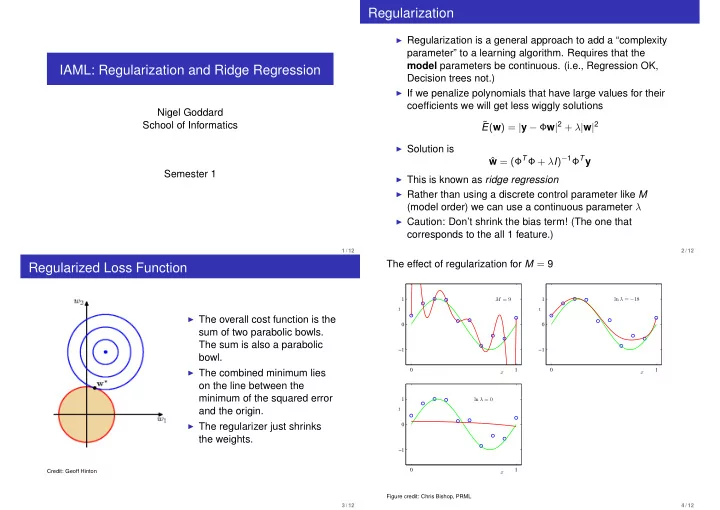
Regularization Regularization is a general approach to add a complexity parameter to a learning algorithm. Requires that the model parameters be continuous. (i.e., Regression OK, IAML: Regularization and Ridge Regression Decision trees


slide-1
SLIDE 1

IAML: Regularization and Ridge Regression

Nigel Goddard School of Informatics Semester 1

1 / 12

Regularization

◮ Regularization is a general approach to add a “complexity

parameter” to a learning algorithm. Requires that the model parameters be continuous. (i.e., Regression OK, Decision trees not.)

◮ If we penalize polynomials that have large values for their

coefficients we will get less wiggly solutions ˜ E(w) = |y − Φw|2 + λ|w|2

◮ Solution is

ˆ w = (ΦTΦ + λI)−1ΦTy

◮ This is known as ridge regression ◮ Rather than using a discrete control parameter like M

(model order) we can use a continuous parameter λ

◮ Caution: Don’t shrink the bias term! (The one that

corresponds to the all 1 feature.)

2 / 12

Regularized Loss Function

◮ The overall cost function is the

sum of two parabolic bowls. The sum is also a parabolic bowl.

◮ The combined minimum lies

  • n the line between the

minimum of the squared error and the origin.

◮ The regularizer just shrinks

the weights.

Credit: Geoff Hinton 3 / 12

The effect of regularization for M = 9

x t M = 9 1 −1 1 x t ln λ = −18 1 −1 1 x t ln λ = 0 1 −1 1 Figure credit: Chris Bishop, PRML 4 / 12

slide-2
SLIDE 2

M = 9

ERMS ln λ −35 −30 −25 −20 0.5 1 Training Test

Chris Bishop, PRML 5 / 12

For standard linear regression, we had

◮ Define the task: regression ◮ Decide on the model structure: linear regression model ◮ Decide on the score function: squared error (likelihood) ◮ Decide on optimization/search method to optimize the

score function: calculus (analytic solution)

6 / 12

But with ridge regression we have

◮ Define the task: regression ◮ Decide on the model structure: linear regression model ◮ Decide on the score function: squared error with

quadratic regularizaton

◮ Decide on optimization/search method to optimize the

score function: calculus (analytic solution) Notice how you can train the same model structure with different score functions. This is the first time we have seen

  • this. This is important.

7 / 12

A Control-Parameter-Setting Procedure

◮ Regularization was a way of adding a “capacity control”

parameter.

◮ But how do we set the value? e.g., the regularization

parameter λ

◮ Won’t work to do it on the training set (why not?) ◮ Two choices to consider:

◮ Validation set ◮ Cross-validation 8 / 12

slide-3
SLIDE 3

Using a validation set

◮ Split the labelled data into a training set, validation set, and

a test set.

◮ Training set: Use for training ◮ Validation set: Tune the “control parameters” according to

performance on the validation set

◮ Test set: to check how the final model performs ◮ No right answers, but for example, could choose 60%

training, 20% validation, 20% test

9 / 12

Example of using a validation set

Consider polynomial regression:

  • 1. For each m = 1, 2, . . . M (you choose M in advance
  • 2. Train the polynomial regression using

φ(x) = (1, x, x2, . . . , xm)T on training set (e.g., by minimizing squared error). This produces a predictor fm(x).

  • 3. Measure the error of fm on the validation set
  • 4. End for
  • 5. Choose the fm with the best validation error.
  • 6. Measure the error of fm on the test set to see how well you

should expect it to perform

10 / 12

Continuous Control Parameters

◮ For a discrete control parameter like polynomial order m

we could simply search all values.

◮ What about a quadratic regularization parameter λ. What

do we do then?

11 / 12

Continuous Control Parameters

◮ For a discrete control parameter like polynomial order m

we could simply search all values.

◮ What about a quadratic regularization parameter λ. What

do we do then?

◮ Pick a grid of values to search. In practice you want the

grid to vary geometrically for this sort of parameter. e.g., Try λ ∈ {0.01, 0.1, 0.5, 1.0, 5.0, 10.0}. Don’t bother trying 2.0, 3.0, 7.0.

12 / 12