ENS Pierre-Gilles de Gennes, Gabriel Lipp- mann, Louis Nel, - - PowerPoint PPT Presentation

ens
SMART_READER_LITE
LIVE PREVIEW

ENS Pierre-Gilles de Gennes, Gabriel Lipp- mann, Louis Nel, - - PowerPoint PPT Presentation

cole Normale Suprieure (ENS) Challenges in Abstract Interpretation for Software Safety Patrick Cousot cole normale suprieure, Paris, France cousot ens fr www.di.ens.fr/~cousot Franco-Japanese Workshop on Security Keio University,


slide-1
SLIDE 1

Challenges in Abstract Interpretation for Software Safety Patrick Cousot École normale supérieure, Paris, France

cousot ens fr www.di.ens.fr/~cousot Franco-Japanese Workshop on Security Keio University, Mita Campus, September 5–7, 2005

— 1 —

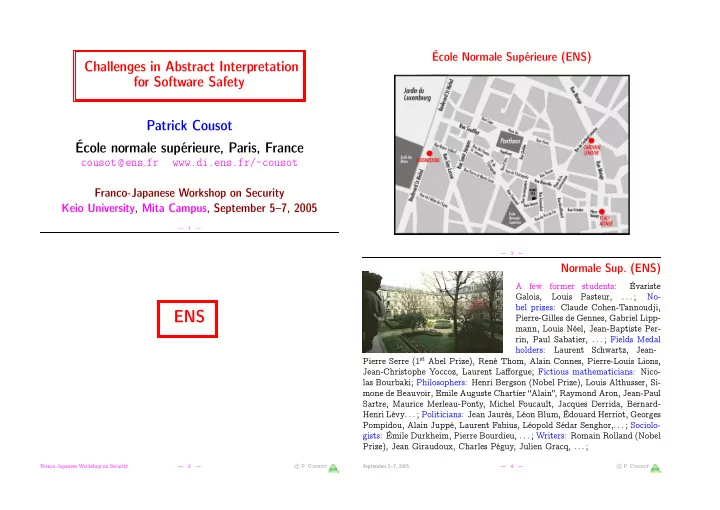
ENS

École Normale Supérieure (ENS)

— 3 —

Normale Sup. (ENS)

A few former students: Évariste Galois, Louis Pasteur, . . . ; No- bel prizes: Claude Cohen-Tannoudji, Pierre-Gilles de Gennes, Gabriel Lipp- mann, Louis Néel, Jean-Baptiste Per- rin, Paul Sabatier, . . . ; Fields Medal holders: Laurent Schwartz, Jean- Pierre Serre (1st Abel Prize), René Thom, Alain Connes, Pierre-Louis Lions, Jean-Christophe Yoccoz, Laurent Lafforgue; Fictious mathematicians: Nico- las Bourbaki; Philosophers: Henri Bergson (Nobel Prize), Louis Althusser, Si- mone de Beauvoir, Emile Auguste Chartier “Alain”, Raymond Aron, Jean-Paul Sartre, Maurice Merleau-Ponty, Michel Foucault, Jacques Derrida, Bernard- Henri Lévy. . . ; Politicians: Jean Jaurès, Léon Blum, Édouard Herriot, Georges Pompidou, Alain Juppé, Laurent Fabius, Léopold Sédar Senghor,. . . ; Sociolo- gists: Émile Durkheim, Pierre Bourdieu, . . . ; Writers: Romain Rolland (Nobel Prize), Jean Giraudoux, Charles Péguy, Julien Gracq, . . . ;

ľ P. Cousot September 5–7, 2005 Franco-Japanese Workshop on Security — 2 — — 4 — ľ P. Cousot

slide-2
SLIDE 2

State of Practice in Software Engineering

— 5 —

An example among many others (Matlab code)

» h=get(gca,’children’); apple.awt.EventQueueExceptionHandler Caught Throwable : java.lang.ArrayIndexOutOfBoundsException: 2 >= 2 java.lang.ArrayIndexOutOfBoundsException: 2 >= 2 at java.util.Vector.elementAt(Vector.java:431) at com.mathworks.mde.help.IndexItem.getFilename(IndexItem.java:100) at com.mathworks.mde.help.Index.getFilenameForLocation(Index.java:706) at com.mathworks.mde.help.Index.access$3100(Index.java:29) at com.mathworks.mde.help.Index$IndexMouseMotionAdapter.mouseMoved(Index.java:768) at java.awt.AWTEventMulticaster.mouseMoved(AWTEventMulticaster.java:272) at java.awt.AWTEventMulticaster.mouseMoved(AWTEventMulticaster.java:271) at java.awt.Component.processMouseMotionEvent(Component.java:5211) at javax.swing.JComponent.processMouseMotionEvent(JComponent.java:2779) at com.mathworks.mwswing.MJTable.processMouseMotionEvent(MJTable.java:725) at java.awt.Component.processEvent(Component.java:4967) at java.awt.Container.processEvent(Container.java:1613) at java.awt.Component.dispatchEventImpl(Component.java:3681) at java.awt.Container.dispatchEventImpl(Container.java:1671) at java.awt.Component.dispatchEvent(Component.java:3543) at java.awt.LightweightDispatcher.retargetMouseEvent(Container.java:3527) at java.awt.LightweightDispatcher.processMouseEvent(Container.java:3255) at java.awt.LightweightDispatcher.dispatchEvent(Container.java:3172) at java.awt.Container.dispatchEventImpl(Container.java:1657) at java.awt.Window.dispatchEventImpl(Window.java:1606) at java.awt.Component.dispatchEvent(Component.java:3543) at java.awt.EventQueue.dispatchEvent(EventQueue.java:456) at java.awt.EventDispatchThread.pumpOneEventForHierarchy(EventDispatchThread.java:234) at java.awt.EventDispatchThread.pumpEventsForHierarchy(EventDispatchThread.java:184) at java.awt.EventDispatchThread.pumpEvents(EventDispatchThread.java:178) at java.awt.EventDispatchThread.pumpEvents(EventDispatchThread.java:170) at java.awt.EventDispatchThread.run(EventDispatchThread.java:100) »

The software safety challenge for next 10 years

  • Present-day software engineering is almost exclusively

manual, with very few automated tools;

  • Trust and confidence in specifications and software can

no longer be entirely based on the development process (e.g. DO178B in aerospace software);

  • In complement, quality assurance must be ensured by

new design, modeling, checking, verification and certi- fication tools based on the product itself.

— 7 —

Abstract Interpretation

Reference [POPL ’77]

  • P. Cousot and R. Cousot. Abstract interpretation: a unified lattice model for static analysis of

programs by construction or approximation of fixpoints. In 4th ACM POPL. [Thesis ’78] P. Cousot. Méthodes itératives de construction et d’approximation de points fixes d’opérateurs monotones sur un treillis, analyse sémantique de programmes. Thèse ès sci. math. Grenoble, march 1978. [POPL ’79]

  • P. Cousot & R. Cousot. Systematic design of program analysis frameworks. In 6th ACM POPL.

ľ P. Cousot September 5–7, 2005 Franco-Japanese Workshop on Security — 6 — — 8 — ľ P. Cousot

slide-3
SLIDE 3

Syntax of programs X

variables X 2 X

T

types T 2 T

E

arithmetic expressions E 2 E

B

boolean expressions B 2 B

D ::= T X; j T X ; D0 C ::= X = E;

commands C 2 C

j while B C0 j if B C0 else C00 j { C1 . . . Cn }, (n – 0) P ::= D C

program P 2 P

— 9 —

Postcondition semantics x(t) t

  • R

SPR

States Values of given type: VT : values of type T 2 T Vint

def

= fz 2 Z j min_int » z » max_intg Program states ˚P 1: ˚D C

def

= ˚D ˚T X;

def

= fXg 7! VT ˚T X; D

def

= (fXg 7! VT) [ ˚D

— 11 —

Concrete Semantic Domain of Programs Concrete semantic domain for reachability properties: DP

def

= }(˚P) sets of states i.e. program properties where „ is implication, ; is false, [ is disjunction.

1 States  2 ˚P of a program P map program variables X to their values (X)

ľ P. Cousot September 5–7, 2005 Franco-Japanese Workshop on Security — 10 — — 12 — ľ P. Cousot

slide-4
SLIDE 4

Concrete Reachability Semantics of Programs

SX = E; R

def

= f[X EE] j  2 R \ dom(E)g [X v](X)

def

= v; [X v](Y )

def

= (Y ) Sif B C0R

def

= SC0(BBR) [ B:BR BBR

def

= f 2 R \ dom(B) j B holds in g Sif B C0 else C00R

def

= SC0(BBR) [ SC00(B:BR) Swhile B C0R

def

= let W = lfp

„ ; –X . R [ SC0(BBX)

in (B:BW) SfgR

def

= R SfC1 : : : CngR

def

= SCn ‹ : : : ‹ SC1 n > 0 SD CR

def

= SC(˚D) (uninitialized variables) Not computable (undecidability).

— 13 —

Abstract Semantic Domain of Programs hD]P; v; ?; ti such that: hD; „i ` ` `! ` ! ` ` ` `

¸ ‚

hD]P; vi hence hD]P; v; ?; ti is a complete lattice such that ? = ¸(;) and tX = ¸([ ‚(X)) Reduced Product of Abstract Domains To combine abstractions hD; „i ` ` ` ! ` ` `

¸1 ‚1

hD]

1; v1i and hD; „i `

` ` ! ` ` `

¸2 ‚2

hD]

2; v2i

the reduced product is ¸(X)

def

= ufhx; yi j X „ ‚1(X) ^ X „ ‚2(X)g such that v

def

= v1 ˆ v2 and hD; „i ` ` ` ` ` `! ` ! ` ` ` ` ` ` `

¸ ‚1ˆ‚2

h¸(D); vi Example: x 2 [1; 9] ^ x mod 2 = 0 reduces to x 2 [2; 8] ^

x mod 2 = 0

— 15 —

Approximate Fixpoint Abstraction

F F Concrete domain Abstract domain F F F F F F F

F

F

F

Approximation relation ⊥ ⊥

]

F ‹ ‚ v ‚ ‹ F ] ) lfp F v ‚(lfp F ])

ľ P. Cousot September 5–7, 2005 Franco-Japanese Workshop on Security — 14 — — 16 — ľ P. Cousot

slide-5
SLIDE 5

Abstract Reachability Semantics of Programs

S]X = E; R

def

= ¸(f[X EE] j  2 ‚(R) \ dom(E)g) S]if B C0R

def

= S]C0(B]BR) t B]:BR B]BR

def

= ¸(f 2 ‚(R) \ dom(B) j B holds in g) S]if B C0 else C00R

def

= S]C0(B]BR) t S]C00(B]:BR) S]while B C0R

def

= let W = lfp

v ? –X . R t S]C0(B]BX)

in (B]:BW) S]fgR

def

= R S]fC1 : : : CngR

def

= S]Cn ‹ : : : ‹ S]C1 n > 0 S]D CR

def

= S]C(>) (uninitialized variables)

— 17 —

Convergence Acceleration with Widening

F Concrete domain Abstract domain F F F F F F Approximation relation ⊥ ⊥

]

♯ ▽

F

F

♯ ▽

F

F

Abstract Semantics with Convergence Acceleration 2

S]X = E; R

def

= ¸(f[X EE] j  2 ‚(R) \ dom(E)g) S]if B C0R

def

= S]C0(B]BR) t B]:BR B]BR

def

= ¸(f 2 ‚(R) \ dom(B) j B holds in g) S]if B C0 else C00R

def

= S]C0(B]BR) t S]C00(B]:BR) S]while B C0R

def

= let F] = –X . let Y = R t S]C0(B]BX) in if Y v X then X else X

  • Y

and W = lfp

v ? F]

in (B]:BW) S]fgR

def

= R S]fC1 : : : CngR

def

= S]Cn ‹ : : : ‹ S]C1 n > 0 S]D CR

def

= S]C(>) (uninitialized variables)

— 19 —

Applications of Abstract Interpretation

2 Note: F] not monotonic!

ľ P. Cousot September 5–7, 2005 Franco-Japanese Workshop on Security — 18 — — 20 — ľ P. Cousot

slide-6
SLIDE 6

Applications of Abstract Interpretation (Cont’d)

  • Static Program Analysis [POPL ’77], [POPL ’78], [POPL ’79]

including Dataflow Analysis [POPL ’79], [POPL ’00], Set- based Analysis [FPCA ’95], Predicate Abstraction [Manna’s festschrift ’03], . . .

  • Syntax Analysis [TCS 290(1) 2002]
  • Hierarchies of Semantics (including Proofs) [POPL ’92],

[TCS 277(1–2) 2002]

  • Typing & Type Inference [POPL ’97]

— 21 —

Applications of Abstract Interpretation (Cont’d)

  • (Abstract) Model Checking [POPL ’00]
  • Program Transformation [POPL ’02]
  • Software Watermarking [POPL ’04]
  • Bisimulations [RT-ESOP ’04]

All these techniques involve sound approximations that can be formalized by abstract interpretation

Static Analysis

Reference [1]

  • P. Cousot and R. Cousot. Static determination of dynamic properties of programs. In Proceedings of the

Second International Symposium on Programming, pages 106–130. Dunod, Paris, France, 1976.

— 23 —

State of the Art in Automatic Static Program Analysis

ľ P. Cousot September 5–7, 2005 Franco-Japanese Workshop on Security — 22 — — 24 — ľ P. Cousot

slide-7
SLIDE 7

Static analysis tools

  • Determine automatically from the program text pro-

gram properties of a certain class that do hold at run- time (e.g. absence of runtime error);

  • Based on the automatic computation of machine repre-

sentable abstractions 3 of all possible executions of the program in any possible environment;

  • Scales up to hundreds of thousands lines;
  • Undecidable whence false alarms are possible 4

— 25 —

Degree of specialization

  • Specialization for a class of runtime properties (e.g. ab-

sence of runtime errors)

  • Specialization for a programming language (e.g. PolySpace

Suite for Ada, C or C++)

  • Specialization for a programming style (e.g. C Global

Surveyor)

  • Specialization for an application type (e.g. ASTRÉE for

embedded real-time synchronous 5 autocodes) ) The more specialized, the less false alarms 6!

3 sound but (in general) uncomplete approximations. 4 cases when a question on the program runtime behavior cannot be answered automatically for sure 5 deterministic 6 but the less specialized, the larger commercial market (and the less client satisfaction)!

The ASTRÉE static analyzer (www.astree.ens.fr)

  • ASTRÉE is a static program analyzer aiming at proving

the absence of Run Time Errors (started Nov. 2001)

  • C programs, no dynamic memory allocation and recur-

sion

  • Encompass many (automatically generated) synchronous,

time-triggered, real-time, safety critical, embedded soft- ware

  • automotive, energy and aerospace applications

) e.g. No false alarm on the electric flight control codes for the A340 (Nov. 2003) and A380 (Nov. 2004) gener- ated from SAO/SCADE.

— 27 —

Ellipsoid Abstract Domain for Filters

2d Order Digital Filter:

j

Switch
  • a

b i z-1

Unit delay

z-1 B

+ + +

t x(n)

Unit delay Switch Switch
  • Computes Xn =

 ¸Xn`1 + ˛Xn`2 + Yn In

  • The concrete computation is bounded, which

must be proved in the abstract.

  • There is no stable interval or octagon.
  • The simplest stable surface is an ellipsoid.

X U F(X) X F(X) F(X) X X U F(X)

execution trace unstable interval stable ellipsoid

ľ P. Cousot September 5–7, 2005 Franco-Japanese Workshop on Security — 26 — — 28 — ľ P. Cousot

slide-8
SLIDE 8

Filter Example

typedef enum {FALSE = 0, TRUE = 1} BOOLEAN; BOOLEAN INIT; float P, X; void filter () { static float E[2], S[2]; if (INIT) { S[0] = X; P = X; E[0] = X; } else { P = (((((0.5 * X) - (E[0] * 0.7)) + (E[1] * 0.4)) + (S[0] * 1.5)) - (S[1] * 0.7)); } E[1] = E[0]; E[0] = X; S[1] = S[0]; S[0] = P; /* S[0], S[1] in [-1327.02698354, 1327.02698354] */ } void main () { X = 0.2 * X + 5; INIT = TRUE; while (1) { X = 0.9 * X + 35; /* simulated filter input */ filter (); INIT = FALSE; } }

Reference see http://www.astree.ens.fr/

— 29 —

Arithmetic-geometric progressions

  • Abstract domain: (R+)5

7

  • Concretization (any function bounded by the arithmetic-

geometric progression): ‚ 2 (R+)5 7` ! }(N 7! R) ‚(M; a; b; a0; b0) = ff j 8k 2 N : jf(k)j » “ –x . ax + b ‹ (–x . a0x + b0)k” (M)g

Reference see http://www.astree.ens.fr/ 7 here in R

Arithmetic-Geometric Progressions (Example 1)

% cat count.c typedef enum {FALSE = 0, TRUE = 1} BOOLEAN; volatile BOOLEAN I; int R; BOOLEAN T; void main() { R = 0; while (TRUE) { __ASTREE_log_vars((R)); if (I) { R = R + 1; } else { R = 0; } T = (R >= 100); __ASTREE_wait_for_clock(()); }} % cat count.config __ASTREE_volatile_input((I [0,1])); __ASTREE_max_clock((3600000)); % astree –exec-fn main –config-sem count.config count.c|grep ’|R|’ |R| <= 0. + clock *1. <= 3600001.

potential overflow!

— 31 —

Arithmetic-geometric progressions (Example 2)

% cat retro.c typedef enum {FALSE=0, TRUE=1} BOOL; BOOL FIRST; volatile BOOL SWITCH; volatile float E; float P, X, A, B; void dev( ) { X=E; if (FIRST) { P = X; } else { P = (P - ((((2.0 * P) - A) - B) * 4.491048e-03)); }; B = A; if (SWITCH) {A = P;} else {A = X;} } void main() { FIRST = TRUE; while (TRUE) { dev( ); FIRST = FALSE; __ASTREE_wait_for_clock(()); }} % cat retro.config __ASTREE_volatile_input((E [-15.0, 15.0])); __ASTREE_volatile_input((SWITCH [0,1])); __ASTREE_max_clock((3600000));

|P| <= (15. + 5.87747175411e-39 / 1.19209290217e-07) * (1 + 1.19209290217e-07)ˆclock

  • 5.87747175411e-39 /

1.19209290217e-07 <= 23.0393526881

ľ P. Cousot September 5–7, 2005 Franco-Japanese Workshop on Security — 30 — — 32 — ľ P. Cousot

slide-9
SLIDE 9

Towards System Verification Tools

Reference [2]

  • P. Cousot. Proving Program Invariance and Termination by Parametric Abstraction, Lagrangian Relaxation

and Semidefinite Programming, invited paper. In Sixth International Conference on Verification, Model Checking and Abstract Interpretation (VMCAI’05), pages 1–24, Paris, France, January 17-19, 2005. Lecture Notes in Computer Science, volume 3385, Springer, Berlin. [APLAS ’06]

  • P. Cousot. Integrating Physical Systems in the Static Analysis of Embedded Control Software.,

invited talk In APLAS’06, Tokyo, Nov. 2005, to appear (LNCS).

— 33 —

Computer controlled systems Approximations: program ! precise, system ! precise Software test Abstractions: program ! none, system ! precise

— 35 —

  • Very expensive
  • Not exhaustive
  • Extended during flight test period
  • Late discovery of errors can delay the program by months

(the whole software development process must be rechecked)

ľ P. Cousot September 5–7, 2005 Franco-Japanese Workshop on Security — 34 — — 36 — ľ P. Cousot

slide-10
SLIDE 10

Software analysis & verification with ASTRÉE

  • Abstractions: program ! precise, system ! coarse

— 37 —

  • Exhaustive
  • Can be made precise by specialization 8 to get no false

alarm

  • No specification of the controlled system (but for ranges
  • f values of a few sensors)
  • Impossible to prove essential properties of the controlled

system (e.g. controlability, robustness, stability)

8 To specific families of properties and programs

System analysis & verification by control engineers Abstractions: program ! imprecise, system ! precise

— 39 —

  • The controler model is a rough abstraction of the con-

trol program:

  • Continuous, not discrete
  • Limited to control laws
  • Does not take into account fault-tolerance to fail-

ures and computer-related system dependability.

  • In theory, SDP-based search of system invariants (Lyapunov-

like functions) can be used to prove reachability and inevitability properties

  • Problems to scale up (e.g. over long periods of time)
  • In practice, the system/controler model is explored by

discrete simulations (testing)

ľ P. Cousot September 5–7, 2005 Franco-Japanese Workshop on Security — 38 — — 40 — ľ P. Cousot

slide-11
SLIDE 11

Exploring new avenues in static analysis

— 41 —

System analysis & verification, Avenue 1 Abstractions: program ! precise, system ! precise

  • Exhaustive (contrary to current simulations)
  • Traditional abstractions (e.g.

polyhedral abstraction with widening) seem to be too imprecise

  • Currently exploring new abstractions (issued from con-

trol theory like ellipsoidal calculus using SDP)

  • Prototype implementation in construction!

— 43 —

System analysis & verification, Avenue 2 Abstractions: program ! precise, system ! precise

ľ P. Cousot September 5–7, 2005 Franco-Japanese Workshop on Security — 42 — — 44 — ľ P. Cousot

slide-12
SLIDE 12
  • Example of invariant translation: ellipsoidal `

! polyhedral 9

  • The static analysis is easier on the system/controller

model using continuous optimization methods

  • The translated invariants can be checked for the sys-

tem simulator/control program (easier than invariant discovery)

  • Should scale up since these complex invariants are rel-

evant to a small part of the control program only

— 45 —

System analysis & verification, Avenue 3 Abstractions: program ! precise, system ! precise

9 For which floating point computations can be taken into account

  • The invariant hypotheses on the controlled system are

assumed to be true

  • It remains to perform the control program analysis un-

der these hypothesis

  • The results can then be checked on the whole system

(as in case 2, but now using refined invariants on the control program!)

  • Iterating this process leads to static analysis by refine-

ment of specifications

— 47 —

Conclusion

ľ P. Cousot September 5–7, 2005 Franco-Japanese Workshop on Security — 46 — — 48 — ľ P. Cousot

slide-13
SLIDE 13

Scientific and technologic objective To develop formal tools to answer questions about soft- ware:

  • from control model design to software implementation,
  • for a wide range of design and software properties,

which would be general enough to benefit all software- intensive industries, and can be adapted to specific ap- plication domains.

— 49 —

THE END, THANK YOU

More references at URL www.di.ens.fr/~cousot www.astree.ens.fr.

References

[3] www.astree.ens.fr [5, 6, 7, 8, 9, 10, 11, 12] [4]

  • P. Cousot. Méthodes itératives de construction et d’approximation de points fixes d’opérateurs mono-

tones sur un treillis, analyse sémantique de programmes. Thèse d’État ès sciences mathématiques, Université scientifique et médicale de Grenoble, Grenoble, France, 21 March 1978. [5]

  • B. Blanchet, P. Cousot, R. Cousot, J. Feret, L. Mauborgne, A. Miné, D. Monniaux, and X. Ri-

val. Design and implementation of a special-purpose static program analyzer for safety-critical real-time embedded software. The Essence of Computation: Complexity, Analysis, Transformation. Essays Dedi- cated to Neil D. Jones, LNCS 2566, pp. 85–108. Springer, 2002. [6]

  • B. Blanchet, P. Cousot, R. Cousot, J. Feret, L. Mauborgne, A. Miné, D. Monniaux, and X. Rival.

A static analyzer for large safety-critical software. PLDI’03, San Diego, pp. 196–207, ACM Press, 2003. [POPL ’77]

  • P. Cousot and R. Cousot.

Abstract interpretation: a unified lattice model for static analysis of programs by construction or approximation of fixpoints. In Conference Record of the Fourth Annual ACM SIGPLAN-SIGACT Symposium on Principles of Programming Languages, pages 238–252, Los Angeles, California, 1977. ACM Press, New York, NY, USA. [PACJM ’79]

  • P. Cousot and R. Cousot. Constructive versions of Tarski’s fixed point theorems. Pacific Journal
  • f Mathematics 82(1):43–57 (1979).

[POPL ’78]

  • P. Cousot and N. Halbwachs.

Automatic discovery of linear restraints among variables of a pro-

  • gram. In Conference Record of the Fifth Annual ACM SIGPLAN-SIGACT Symposium on Principles of

Programming Languages, pages 84–97, Tucson, Arizona, 1978. ACM Press, New York, NY, U.S.A.

— 51 —

[POPL ’79]

  • P. Cousot and R. Cousot. Systematic design of program analysis frameworks. In Conference Record
  • f the Sixth Annual ACM SIGPLAN-SIGACT Symposium on Principles of Programming Languages, pages

269–282, San Antonio, Texas, 1979. ACM Press, New York, NY, U.S.A. [POPL ’92]

  • P. Cousot and R. Cousot. Inductive Definitions, Semantics and Abstract Interpretation. In Con-

ference Record of the 19th ACM SIGACT-SIGMOD-SIGART Symposium on Principles of Programming Languages, pages 83–94, Albuquerque, New Mexico, 1992. ACM Press, New York, U.S.A. [FPCA ’95] P. Cousot and R. Cousot. Formal Language, Grammar and Set-Constraint-Based Program Analysis by Abstract Interpretation. In SIGPLAN/SIGARCH/WG2.8 7th Conference on Functional Programming and Computer Architecture, FPCA’95. La Jolla, California, U.S.A., pages 170–181. ACM Press, New York, U.S.A., 25-28 June 1995. [POPL ’97]

  • P. Cousot. Types as Abstract Interpretations. In Conference Record of the 24th ACM SIGACT-

SIGMOD-SIGART Symposium on Principles of Programming Languages, pages 316–331, Paris, France,

  • 1997. ACM Press, New York, U.S.A.

[POPL ’00]

  • P. Cousot and R. Cousot. Temporal abstract interpretation. In Conference Record of the Twen-

tyseventh Annual ACM SIGPLAN-SIGACT Symposium on Principles of Programming Languages, pages 12–25, Boston, Mass., January 2000. ACM Press, New York, NY. [POPL ’02]

  • P. Cousot and R. Cousot. Systematic Design of Program Transformation Frameworks by Abstract
  • Interpretation. In Conference Record of the Twentyninth Annual ACM SIGPLAN-SIGACT Symposium on

Principles of Programming Languages, pages 178–190, Portland, Oregon, January 2002. ACM Press, New York, NY. [TCS 277(1–2) 2002] P. Cousot. Constructive Design of a Hierarchy of Semantics of a Transition System by Abstract Interpretation. Theoretical Computer Science 277(1–2):47–103, 2002.

ľ P. Cousot September 5–7, 2005 Franco-Japanese Workshop on Security — 50 — — 52 — ľ P. Cousot
slide-14
SLIDE 14

[TCS 290(1) 2002]

  • P. Cousot and R. Cousot. Parsing as abstract interpretation of grammar semantics. Theo-
  • ret. Comput. Sci., 290:531–544, 2003.

[Manna’s festschrift ’03]

  • P. Cousot. Verification by Abstract Interpretation. Proc. Int. Symp. on Verification –

Theory & Practice – Honoring Zohar Manna’s 64th Birthday, N. Dershowitz (Ed.), Taormina, Italy, June 29 – July 4, 2003. Lecture Notes in Computer Science, vol. 2772, pp. 243–268. ľ Springer-Verlag, Berlin, Germany, 2003. [7]

  • P. Cousot, R. Cousot, J. Feret, L. Mauborgne, A. Miné, D. Monniaux, and X. Rival. The ASTRÉE analyser.

ESOP 2005, Edinburgh, LNCS 3444, pp. 21–30, Springer, 2005. [8]

  • J. Feret. Static analysis of digital filters. ESOP’04, Barcelona, LNCS 2986, pp. 33—-48, Springer, 2004.

[9]

  • J. Feret. The arithmetic-geometric progression abstract domain. In VMCAI’05, Paris, LNCS 3385, pp. 42–

58, Springer, 2005. [10] Laurent Mauborgne & Xavier Rival. Trace Partitioning in Abstract Interpretation Based Static Analyzers. ESOP’05, Edinburgh, LNCS 3444, pp. 5–20, Springer, 2005. [11]

  • A. Miné. A New Numerical Abstract Domain Based on Difference-Bound Matrices. PADO’2001, LNCS

2053, Springer, 2001, pp. 155–172. [12] A. Miné. Relational abstract domains for the detection of floating-point run-time errors. ESOP’04, Barcelona, LNCS 2986, pp. 3—17, Springer, 2004. [POPL ’04]

  • P. Cousot and R. Cousot. An Abstract Interpretation-Based Framework for Software Watermarking.

In Conference Record of the Thirtyfirst Annual ACM SIGPLAN-SIGACT Symposium on Principles of Programming Languages, pages 173–185, Venice, Italy, January 14-16, 2004. ACM Press, New York, NY.

— 53 —

[DPG-ICALP ’05] M. Dalla Preda and R. Giacobazzi. Semantic-based Code Obfuscation by Abstract Interpretation. In Proc. 32nd Int. Colloquium

  • n

Automata, Languages and Pro- gramming (ICALP’05 – Track B). LNCS, 2005 Springer-Verlag. July 11-15, 2005, Lisboa, Portugal. To appear. [EMSOFT ’01]

  • C. Ferdinand, R. Heckmann, M. Langenbach, F. Martin, M. Schmidt, H. Theiling, S. Thesing,

and R. Wilhelm. Reliable and precise WCET determination for a real-life processor. ESOP (2001), LNCS 2211, 469–485. [RT-ESOP ’04]

  • F. Ranzato and F. Tapparo. Strong Preservation as Completeness in Abstract Interpretation.

ESOP 2004, Barcelona, Spain, March 29 - April 2, 2004, D.A. Schmidt (Ed), LNCS 2986, Springer, 2004,

  • pp. 18–32.

ľ P. Cousot September 5–7, 2005 Franco-Japanese Workshop on Security — 54 — ľ P. Cousot