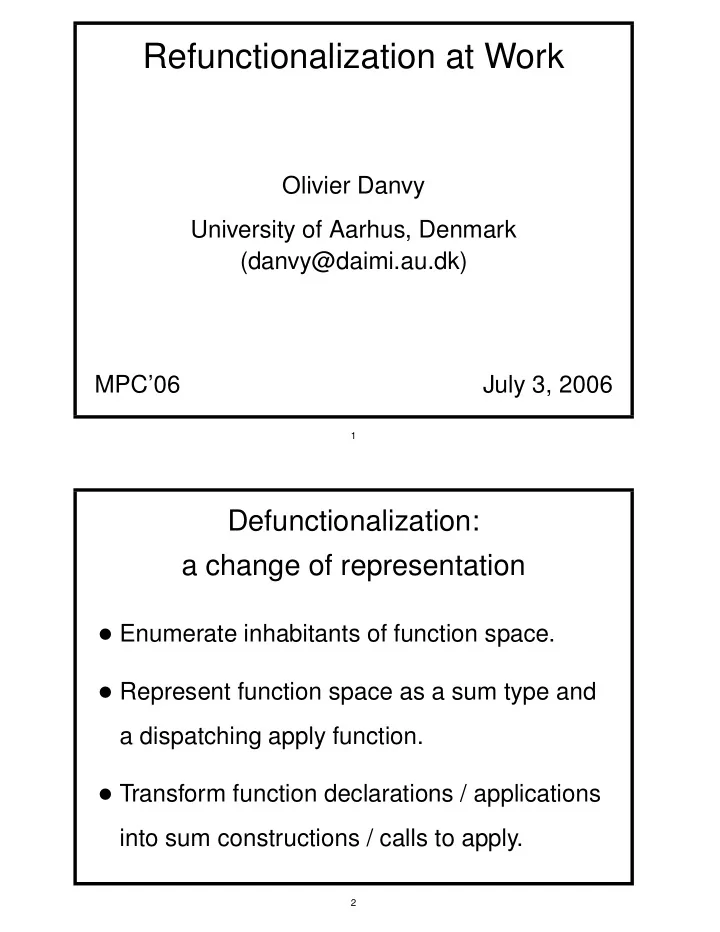
Refunctionalization at Work Olivier Danvy University of Aarhus, - - PDF document

refunctionalization at work
SMART_READER_LITE
LIVE PREVIEW

Refunctionalization at Work Olivier Danvy University of Aarhus, - - PDF document

Refunctionalization at Work Olivier Danvy University of Aarhus, Denmark (danvy@daimi.au.dk) MPC06 July 3, 2006 1 Defunctionalization: a change of representation Enumerate inhabitants of function space. Represent function space as


slide-1
SLIDE 1

Refunctionalization at Work

Olivier Danvy University of Aarhus, Denmark (danvy@daimi.au.dk) MPC’06 July 3, 2006

1

Defunctionalization: a change of representation

  • Enumerate inhabitants of function space.
  • Represent function space as a sum type and

a dispatching apply function.

  • Transform function declarations / applications

into sum constructions / calls to apply.

2

slide-2
SLIDE 2

Example: the factorial function in CPS

(* fac : int * (int -> ’a) -> ’a *) fun fac (0, k) = k 1 | fac (n, k) = fac (n - 1, fn v => k (n * v)) fun main n = fac (n, fn a => a)

3

Example: the factorial function in CPS

(* fac : int * (int -> ’a) -> ’a *) fun fac (0, k) = k 1 | fac (n, k) = fac (n - 1, fn v => k (n * v)) fun main n = fac (n, fn a => a)

4

slide-3
SLIDE 3

The continuation

(* fac : int * (int -> ’a) -> ’a *) fun fac (0, k) = k 1 | fac (n, k) = fac (n - 1, fn v => k (n * v)) fun main n = fac (n, fn a => a)

5

All calls are tail calls

(* fac : int * (int -> ’a) -> ’a *) fun fac (0, k) = k 1 | fac (n, k) = fac (n - 1, fn v => k (n * v)) fun main n = fac (n, fn a => a)

6

slide-4
SLIDE 4

All sub-computations are trivial

(* fac : int * (int -> ’a) -> ’a *) fun fac (0, k) = k 1 | fac (n, k) = fac (n - 1, fn v => k (n * v)) fun main n = fac (n, fn a => a)

7

The domain of answers

(* fac : int * (int -> ’a) -> ’a *) fun fac (0, k) = k 1 | fac (n, k) = fac (n - 1, fn v => k (n * v)) fun main n = fac (n, fn a => a)

8

slide-5
SLIDE 5

The factorial program as a whole

(* fac : int * (int -> int) -> int *) fun fac (0, k) = k 1 | fac (n, k) = fac (n - 1, fn v => k (n * v)) fun main n = fac (n, fn a => a)

9

Let us defunctionalize this factorial program.

10

slide-6
SLIDE 6

The function space to defunctionalize

(* fac : int * (int -> int) -> int *) fun fac (0, k) = k 1 | fac (n, k) = fac (n - 1, fn v => k (n * v)) fun main n = fac (n, fn a => a)

11

Inhabitants?

Who inhabits this function space?

12

slide-7
SLIDE 7

The constructors

(* fac : int * (int -> int) -> int *) fun fac (0, k) = k 1 | fac (n, k) = fac (n - 1, fn v => k (n * v)) fun main n = fac (n, fn a => a)

13

The consumers

(* fac : int * (int -> int) -> int *) fun fac (0, k) = k 1 | fac (n, k) = fac (n - 1, fn v => k (n * v)) fun main n = fac (n, fn a => a)

14

slide-8
SLIDE 8

The defunctionalized continuation

datatype cont = C0 | C1 of cont * int fun apply (C0, v) = v | apply (C1 (k, n), v) = apply (k, n * v)

15

Factorial in CPS, defunctionalized

fun fac (0, k) = apply (k, 1) | fac (n, k) = fac (n - 1, C1 (k, n)) fun main n = fac (n, C0)

16

slide-9
SLIDE 9

Correctness

By structural induction on n, using a logical relation over the original continuation and the defunctionalized continuation. (Those who like this kind of things etc.)

17

Defunctionalization

  • Introduced by John Reynolds in “Definitional

Interpreters” (1972) <www.brics.dk/∼hosc/vol11/>.

  • Generalizes Peter Landin’s notion of

closure conversion (1964).

  • Less used than closure conversion since.

18

slide-10
SLIDE 10

Our thesis

  • There is more to defunctionalization

than an encoding, a “firstification.”

  • Its left inverse, refunctionalization,

is interesting.

19

Our thesis

  • There is more to defunctionalization

than an encoding, a “firstification.”

  • Its left inverse, refunctionalization,

is interesting. Reference: Danvy and Nielsen, “Defunctionalization at work” at PPDP 2001.

20

slide-11
SLIDE 11

Our thesis

  • There is more to defunctionalization

than an encoding, a “firstification.”

  • Its left inverse, refunctionalization,

is interesting. Reference: Danvy and Nielsen, “Defunctionalization at work” at PPDP 2001.

21

Latent question

How does one construct programming or even semantic artifacts? (e.g., an abstract machine)

22

slide-12
SLIDE 12

Latent question

How does one construct programming or even semantic artifacts? (e.g., an abstract machine) Our point: Defunctionalization provides elements of answer.

23

The rest of this talk

  • A series of examples illustrating

defunctionalization and refunctionalization.

  • A characterization of “defunctionalized form.”
  • Hints for massaging a program

into defunctionalized form.

24

slide-13
SLIDE 13

Exercise: listing prefixes

Write a function mapping a list to the list of its prefixes whose last element satisfies a predicate. Example, for the “always true” predicate:

[1, 2, 3] − → [[1], [1, 2], [1, 2, 3]]

Example, for the “odd” predicate:

[1, 2, 3, 4, 5] − → [[1], [1, 2, 3], [1, 2, 3, 4, 5]]

25

On listing prefixes

  • finding the first prefix and

finding all prefixes

  • use a first-order accumulator and

use a functional accumulator

26

slide-14
SLIDE 14

find first prefix a (p, xs)

def

= letrec visit (nil, a) = nil | visit (x :: xs, a) = let a′ = x :: a in if p x rev (a′, nil) else visit (xs, a′) in visit (xs, nil)

27

find all prefixes a (p, xs)

def

= letrec visit (nil, a) = nil | visit (x :: xs, a) = let a′ = x :: a in if p x (rev (a′, nil)) :: (visit (xs, a′)) else visit (xs, a′) in visit (xs, nil)

28

slide-15
SLIDE 15

A functional accumulator hnil = λxs.xs hcons = λx.λxs.x :: xs

A novel representation of lists and its application to the function “reverse” John Hughes, IPL 22(3):141-144, 1986

29

find first prefix c1 (p, xs)

def

= letrec visit (nil, k) = nil | visit (x :: xs, k) = let k′ = k ◦ (hcons x) in if p x k′ nil else visit (xs, k′) in visit hnil

30

slide-16
SLIDE 16

find all prefixes c1 (p, xs)

def

= letrec visit (nil, k) = nil | visit (x :: xs, k) = let k′ = k ◦ (hcons x) in if p x (k′ nil) :: (visit (xs, k′)) else visit (xs, k′) in visit hnil

31

How related are the two solutions?

Answer #1: they are just different.

32

slide-17
SLIDE 17

How related are the two solutions?

Answer #2: one is the defunctionalized version

  • f the other.

Data type: list; apply function: reverse.

33

Almost in CPS

The functional accumulator is a delimited continuation.

34

slide-18
SLIDE 18

Almost in CPS

The functional accumulator is a delimited continuation. ...shift and reset.

35

find first prefix c0 (p, xs)

def

= letrec visit nil = S k.nil | visit (x :: xs) = x :: (if p x then nil else visit xs) in visit xs

  • 36
slide-19
SLIDE 19

find all prefixes c0 (p, xs)

def

= letrec visit nil = S k.nil | visit (x :: xs) = x :: if p x S k′. k′ nil :: k′ (visit xs)

  • else visit xs

in visit xs

  • 37

Connections

0CPS version CPS transf.

1CPS

version CPS transf.

  • defunctionalization
  • 2CPS

version accumulator-based version

38

slide-20
SLIDE 20

CPS transformation

  • Names intermediate results.
  • Sequentializes their computation.
  • Introduces first-class functions

(continuations).

39

A simple example (1/3) f x (g x)

40

slide-21
SLIDE 21

A simple example (2/3) f x (g x) let v1 = f x v2 = g x v3 = v1 v2 in v3

41

A simple example (3/3) f x (g x) let v1 = f x \k.f x (\v1. v2 = g x g x (\v2. v3 = v1 v2 v1 v2 (\v3. in v3 k v3)))

42

slide-22
SLIDE 22

The Fibonacci function (1/3) fib n = if n <= 1 then n else fib(n - 1) + fib(n - 2)

43

The Fibonacci function (2/3) fib n = if n <= 1 then n else let v1 = fib(n - 1) v2 = fib(n - 2) in v1 + v2

44

slide-23
SLIDE 23

The Fibonacci function (3/3) fib (n, k) = if n <= 1 then k n else fib(n - 1, \v1. fib(n - 2, \v2. k (v1 + v2)))

45

The Fibonacci function (4/3) fib n = let v0 = n <= 1 in if v then n else let n1 = n - 1 v1 = fib n1 n2 = n - 2 v2 = fib n2 in v1 + v2

46

slide-24
SLIDE 24

To CPS or not to CPS?

  • Q. When should we leave a function

in direct style?

47

To CPS or not to CPS?

  • Q. When should we leave a function

in direct style?

  • A. When it is pure and total.

48

slide-25
SLIDE 25

To a man with a hammer...

Given [x1, ..., xn] and [y1, ..., yn], compute [(x1, yn), ..., (xn, y1)].

n is unknown.

49

fun cnv1 (xs,ys) = let fun walk (nil,a) = continue (a,ys,nil) | walk (x::xs,a) = walk (xs,x::a) and continue (nil,nil,r) = r | continue (x::a,y::ys,r) = continue (a,ys,(x,y)::r) in walk (xs,nil) end

50

slide-26
SLIDE 26

fun cnv1 (xs,ys) = let fun walk (nil,a) = continue (a,ys,nil) | walk (x::xs,a) = walk (xs,x::a) and continue (nil,nil,r) = r | continue (x::a,y::ys,r) = continue (a,ys,(x,y)::r) in walk (xs,nil) end

51

fun cnv1 (xs,ys) = let fun walk (nil,a) = continue (a,ys,nil) | walk (x::xs,a) = walk (xs,x::a) and continue (nil,nil,r) = r | continue (x::a,y::ys,r) = continue (a,ys,(x,y)::r) in walk (xs,nil) end

52

slide-27
SLIDE 27

In defunctionalized form

  • the list is the data type
  • continue is apply

53

fun cnv2 (xs,ys) = let fun walk (nil,k) = k (ys,nil) | walk (x::xs,k) = walk (xs,fn (y::ys,r) => k (ys,(x,y)::r)) in walk (xs,fn (nil,r) => r) end ...CPS

54

slide-28
SLIDE 28

Direct style: fun cnv3 (xs,ys) = let fun walk nil = (ys,nil) | walk (x::xs) = let val (y::ys,r) = walk xs in (ys,(x,y)::r) end val (nil,r) = walk xs in r end

55

There and back again

joint work with Mayer Goldberg ICFP 2002 Fundamenta Informaticae 66(4):397-413, 2005

56

slide-29
SLIDE 29

Next: The SECD machine

  • Why: it is canonical.
  • What: a quadruple

(stack, environment, control, dump).

  • How: transitions.

57

State-transition function

  • Pre-abstract machine: a transition function

from non-accepting state to accepting or non-accepting state + a “trampoline” function.

  • Abstract machine: a tail-recursive transition

function (the transition function has been inlined in the trampoline function).

58

slide-30
SLIDE 30

The source language

type ide = string datatype term = LIT of int | VAR of ide | LAM of ide * term | APP of term * term type program = term (* closed *)

59

The environment

signature ENV = sig type ’a env val mt : ’a env val ext : ide * ’a * ’a env

  • > ’a env

val lookup : ide * ’a env -> ’a end

60

slide-31
SLIDE 31

Expressible and denotable values

datatype value = INT of int | SUCC | CLOSURE of ide * term * value env

61

Initial environment

val e_init = ext ("succ", SUCC, mt)

62

slide-32
SLIDE 32

The four components

  • stack : value list
  • environment : value env
  • control : directive list

datatype directive = TERM of term | APPLY

  • dump : (stack * environment *

control) list

63

Evaluation by iterated transition

run (v :: nil, e’, nil, nil) = v run (v :: nil, e’, nil, (s, e, c) :: d) = run (v :: s, e, c, d) run (s, e, (TERM (LIT n)) :: c, d) = run ((INT n) :: s, e, c, d)

64

slide-33
SLIDE 33

run (s,e,(TERM (VAR x)) :: c,d) = run ((lookup (x,e)) :: s,e,c,d) run (s,e,(TERM (LAM (x,t))) :: c,d) = run ((CLOSURE (x,t,e)) :: s,e,c,d) run (s,e,(TERM (APP (t0,t1))) :: c,d) = run (s,e, (TERM t1) :: (TERM t0) :: APPLY :: c, d)

65

run (SUCC :: (INT n) :: s, e, APPLY :: c, d) = run ((INT (n+1)) :: s, e, c, d) run ((CLOSURE (x, t, e’)) :: v :: s, e, APPLY :: c, d) = run (nil, ext (x, v, e’), (TERM t) :: nil, (s, e, c) :: d)

66

slide-34
SLIDE 34

Initialization of the SECD machine

fun evaluate0 t = run (nil, e_init, (TERM t) :: nil, nil)

67

Theorem (Plotkin, 1975)

It works.

68

slide-35
SLIDE 35

All in all

The SECD machine is a mouthful:

  • Are all cases accounted for?
  • Are there any redundant clauses?

69

Disentangling the SECD machine

run_c : S * E * C * D -> value run_d : value * D -> value run_t : term * S * E * C * D -> value run_a : S * E * C * D -> value

70

slide-36
SLIDE 36

Four run functions

  • Each function has one induction variable.
  • Correctness proven by fixed-point induction.

71

A quote

From Hardy’s “A Mathematician’s Apology.”

72

slide-37
SLIDE 37

“there is a very high degree of unexpectedness, combined with economy and inevitability. The ar- guments take so odd and surprising a form; the weapons used seem so childishly simple when compared with the far-reaching results; but there is no escape from the conclusion. There are no complications of detail—one line of attack is enough in each case;”

73

The disentangled SECD machine

run_c : S * E * C * D -> value run_d : value * D -> value run_t : term * S * E * C * D -> value run_a : S * E * C * D -> value

74

slide-38
SLIDE 38

And then a miracle happens

The disentangled definition is defunctionalized:

  • the control and the dump are two data types;
  • run c and run d are their apply function.

75

An higher-order counterpart

  • f the SECD machine

run_t : term * S * E * C * D -> value run_a : S * E * C * D -> value C = S * E * D -> value D = S -> value

76

slide-39
SLIDE 39

Guess what?

The refunctionalized SECD machine is in CPS.

77

Back to direct style

run_t : term * S * E * C -> S run_a : S * E * C -> S C = S * E -> S

78

slide-40
SLIDE 40

Guess what?

The DS’ed refunctionalized SECD machine uses a control delimiter. (The body of a lambda-abstraction is evaluated with an empty control stack.)

79

Back to direct style again

run_t : term * S * E -> S * E run_a : S * E -> S * E ...a big-step operational semantics.

80

slide-41
SLIDE 41

Another funny thing

Why is the interpreter threading a data stack?

81

Making do without a stack

run_t : term * E -> V * E run_a : V * V * E -> V * E ...another big-step operational semantics.

82

slide-42
SLIDE 42

Guess what?

The result is in closure-converted form (i.e., in defunctionalized form).

83

Higher-order counterpart

datatype value = INT of int | SUCC | FUN of value -> value

84

slide-43
SLIDE 43

Guess what?

The evaluator is compositional. ...the valuation function

  • f a denotational semantics.

85

Denotational content

  • f the SECD machine
  • Environment-based.
  • Callee-save.
  • With a control delimiter.

(Actually, an unnecessary control delimiter.)

86

slide-44
SLIDE 44

fun eval (LIT n, e) = (INT n, e) | eval (VAR x, e) = (lookup (x, e), e)

87

| eval (APP (t0, t1), e) = let val (v1, e) = eval (t1, e) val (v0, e) = eval (t0, e) in apply (v0, v1, e) end

88

slide-45
SLIDE 45

eval (LAM (x, t), e) = (FUN (fn v => #1 ( reset (fn () => eval (t, extend (x, v, e))))), e)

89

apply (SUCC, INT n, e) = (INT (n+1), e) apply (FUN f, v, e) = (f v, e)

90

slide-46
SLIDE 46

Assessment

  • All it took was to disentangle the SECD

transition function.

  • The rest (refunctionalization, direct-style

transformation, direct-style transformation with a control delimiter, data-stack elimination, and closure unconversion) was mechanical.

91

The essence of the SECD machine

Essential: environment-based and callee-save. Inessential: the stack, the control, and the dump.

92

slide-47
SLIDE 47

Remark

Hindsight is an exact science.

93

What about reversing the transformation?

We mechanically get back the SECD machine.

94

slide-48
SLIDE 48

What about reversing the transformation?

We mechanically get back the SECD machine. What about trying with variants?

95

  • de Bruijn indices.
  • Left-to-right evaluation.
  • Proper tail recursion.
  • Call by name (use thunks).
  • Call by need (thread heap of update thunks).

96

slide-49
SLIDE 49
  • An SEC machine (no control delimiter).
  • An SC machine (no environment).
  • A EC machine (no stack).
  • A C machine (no environment and no stack).

97

Assessment

evaluator closure conversion data-stack introduction CPS transformation defunctionalization

  • SECD machine
  • 98
slide-50
SLIDE 50

Scaling up

From evaluation function to abstract machine

99

A canonical evaluator (caller-save)

datatype term = IND of int (* de Bruijn index *) | ABS of term | APP of term * term datatype expval = FUN of denval -> expval withtype denval = expval

100

slide-51
SLIDE 51

fun eval (IND n, e) = List.nth (e, n) | eval (ABS t, e) = FUN (fn v => eval (t, v :: e)) | eval (APP (t0, t1), e) = let val (FUN f) = eval (t0, e) in f (eval (t1, e)) end

101

John Reynolds’s warning (1972)

Beware of the evaluation order

  • f the meta-language:
  • Call by name yields call by name.
  • Call by value yields call by value.

102

slide-52
SLIDE 52

fun eval (IND n, e) = List.nth (e, n) | eval (ABS t, e) = FUN (fn v => eval (t, v :: e)) | eval (APP (t0, t1), e) = let val (FUN f) = eval (t0, e) in f (eval (t1, e)) end

103

John Reynolds’s warning (1972)

Beware of the evaluation order

  • f the meta-language:
  • Call by name yields call by name.
  • Call by value yields call by value.

So we use thunks to simulate call by name.

104

slide-53
SLIDE 53

Experiment 1: CBN

canonical CBN evaluator for λ-terms closure conversion CPS transformation defunctionalization

  • abstract machine

105

Experiment 1: CBN

canonical CBN evaluator for λ-terms closure conversion CPS transformation defunctionalization

  • Krivine’s abstract machine

106

slide-54
SLIDE 54

Krivine’s abstract machine

The abstract machine

  • f theoreticians.

(see, eg, Chris Hankin’s textbook “Lambda calculi, a guide for computer scientists”,

  • r again Pierre-Louis Curien, Pierre Cr´

egut, etc.)

107

Experiment 2: CBV

canonical CBV evaluator for λ-terms closure conversion CPS transformation defunctionalization

  • abstract machine

108

slide-55
SLIDE 55

Experiment 2: CBV

canonical CBV evaluator for λ-terms closure conversion CPS transformation defunctionalization

  • Felleisen et al.’s CEK abstract machine

109

The CEK abstract machine

The simplest abstract machine

  • f programming-language people.

110

slide-56
SLIDE 56

Significance of the result

Krivine’s machine and the CEK machine:

  • Probably the two best-known

abstract machines for the λ-calculus.

  • Developed and presented independently.
  • Yet they are defunctionalized interpreters for

higher-order programming languages.

111

Flashback

John Reynolds’s warning about evaluation-order independence.

112

slide-57
SLIDE 57

Flashback

John Reynolds’s warning about evaluation-order independence. Let us use it constructively.

113

A factorization (Hatcliff & Danvy, 1992–1997) Λ

CBN CPS transf.

  • thunk transf.
  • CBV

CPS transf.

  • 114
slide-58
SLIDE 58

canonical evaluator closure conv.

  • CBN

CPS transf.

  • CBV

CPS transf.

  • defunct.
  • defunct.
  • 115

canonical evaluator closure conv.

  • CBN

CPS transf.

  • CBV

CPS transf.

  • defunct.
  • defunct.
  • Krivine’s machine

the CEK machine

116

slide-59
SLIDE 59

Consequence

Krivine’s machine and the CEK machine are not just discovered and invented. They are two sides of the same coin, which incidentally is the standard one.

117

canonical evaluator closure conv. (1964)

  • CBN

CPS transf. (1975)

  • CBV

CPS transf.

  • defunct.

(1972)

  • defunct.
  • Krivine’s machine

(1985) the CEK machine (1986)

118

slide-60
SLIDE 60

Piet Hein’s gentle reminder: T.T.T.

Put up in a place where it’s easy to see the cryptic admonishment T.T.T. When you feel how depressingly slowly you climb, it’s well to remember that Things Take Time.

119

Models of abstract machines

  • Eval-apply (CEK, etc.)
  • Push-enter (KAM, etc.)

120

slide-61
SLIDE 61

Models of abstract machines

  • Eval-apply (CEK, etc.)
  • Push-enter (KAM, etc.)

They appear naturally. (inline the apply function in CBN)

121

Call by need (built-in dynamic programming)

Call by need: Call by name + heap of updatable thunks. Result: A host of known implementation techniques and then some. (see BRICS RS-03-20, IPL 90(5):223-232)

122

slide-62
SLIDE 62

Computational effects

We build on Moggi’s insight as embodied in Wadler’s interpreters. One generic interpreter, parameterized by a monad. The style is in the monad.

123

The point

monadic evaluator + monad inlining (to make it ‘styled’) closure conversion CPS transformation defunctionalization

  • abstract machine

124

slide-63
SLIDE 63

Several detailed examples

Tech report BRICS RS-03-35:

  • The identity monad.

Result: the CEK machine.

  • A lifted state monad.

Result: the CEK machine with error and state.

125

Stack inspection

  • A security mechanism to allow code

with different levels of trust to interact in the same execution environment.

  • Before execution, the source code

is annotated with permissions.

  • During execution, the call stack is inspected

to check whether the required permissions are available.

126

slide-64
SLIDE 64

Stack inspection

  • See Section 6 in BRICS RS-03-35

(TCS 342(1):149-172, 2005)

  • See Section 7 in BRICS RS-05-38

(to appear in TCS)

127

Yet

Not all abstract machines are in defunctionalized

  • form. Examples:
  • The SECD machine with the J operator.
  • The CEK machine with dynamic delimited

continuations.

128

slide-65
SLIDE 65

Being in defunctionalized form

  • several constructions sites
  • one consumption site

129

Putting in defunctionalized form

No universal recipe. Handful of tricks:

  • introducing auxiliary (first-order) functions
  • delaying constructions
  • glueing

130

slide-66
SLIDE 66

The SECD machine with the J operator

  • Landin’s original version (1965)

is incomplete.

  • Burge’s complete version (1975)

is not in defunctionalized form.

  • Felleisen’s version (1987)

is in defunctionalized form.

131

Felleisen’s version

Refunctionalizing Felleisen’s version reveals a control delimiter (a “prompt”). See Danvy and Millikin, “A Rational Deconstruction of Landin’s J Operator”, IFL 2005 (extended version: BRICS RS-06-04).

132

slide-67
SLIDE 67

Dynamic delimited continuations

See Biernacki, Danvy and Millikin, “A Dynamic Continuation-Passing Style for Dynamic Delimited Continuations”, BRICS RS-05-16.

133

Conclusion

  • Defunctionalization, like the lambda-calculus,

has many applications.

  • So does its left-inverse, refunctionalization.

134

slide-68
SLIDE 68

Closing remarks

  • Evaluation contexts are

defunctionalized continuations.

  • 135

Closing remarks

  • Evaluation contexts are

defunctionalized continuations.

  • Reduction contexts are

defunctionalized continuations.

  • 136
slide-69
SLIDE 69

Closing remarks

  • Evaluation contexts are

defunctionalized continuations.

  • Reduction contexts are

defunctionalized continuations.

  • Most instances of the Zipper are

defunctionalized continuations.

137

Closing remarks

  • Evaluation contexts are

defunctionalized continuations.

  • Reduction contexts are

defunctionalized continuations.

  • Most instances of the Zipper are

defunctionalized continuations. Thank you.

138