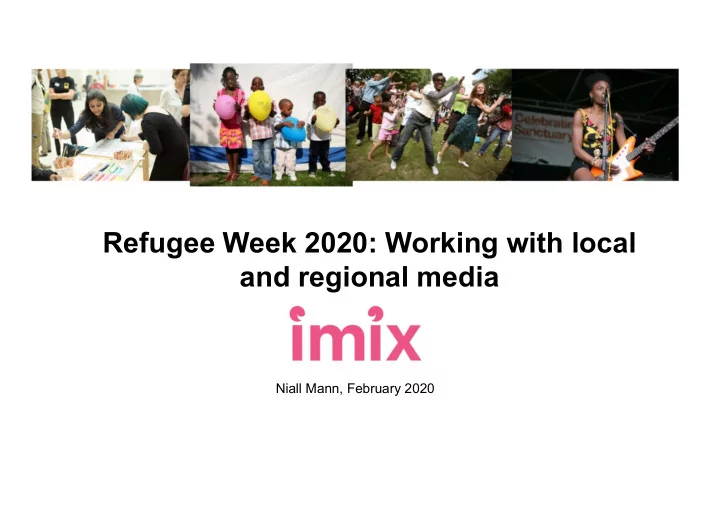
SLIDE 1 Refugee Week 2020: Working with local and regional media
Niall Mann, February 2020
SLIDE 2
Refugee Week coverage: 2018 and 2019
SLIDE 3 How we’ll spend our time together
- Introduction to local and regional media
- What journalists want
- Getting your story into the media
- Grabbing a journalists interest
- Pitching
- The press release
- Interview tips
- Storytellers and safeguarding
SLIDE 4
How can the media help you?
SLIDE 5 Local and regional media overview
Regional and local media
- Regional newspapers
- South Wales Argus, Gloucestershire Echo, Yorkshire Post, Manchester Evening News, Express and
Star, Evening Standard, Western Daily Press
- Local newspapers
- Carmarthan Journal, Coventry Telegraph, Tamworth Herald, Lichfield Mercury, Islington Gazette, Bristol
Post, Nottingham Post……
- Television
- BBC News regionals – Midlands Today, Spotlight, London, Look East, East Midlands Today…..
- ITV News regionals – Central, Anglia, Granada, Yorkshire, West Country……
- Commercial – London Live, Notts TV, Bristol TV, Birmingham TV……
- Radio
- BBC regional / local– WM, Radio Stoke, Coventry and Warwickshire, Radio Bristol, Cornwall, Wiltshire,
Radio London……
- Commercial – LBC, Heart, Free Radio…..
- Community – Hillz FM, Bolton FM, Radio Plus, Big City Radio…..
SLIDE 6 Local and regional media overview
- Thousands of local and regional outlets out there.
- Four main types – print, radio, TV and online.
- Each has slightly different requirements to cover a story.
- Podcasts, blogs, community stations, niche magazines – plenty of opportunity to secure coverage.
- Whatever outlet you secure coverage in, it will end up online.
SLIDE 7 Local and regional media overview
- Short staffed, under pressure and incredibly busy.
- Reporters need to produce 10 – 20 stories a day. Each also inundated with hundreds of emails and phone calls.
- Expected to know a little about everything. The reality can be different.
- Have a duty to be ‘balanced.’
- Imagine you are a local reporter or editor. By 10am in the morning, you have 30 new emails in your inbox.
Which ones stand out and why?
SLIDE 8
Why were these stories published?
SLIDE 9 What do local reporters want?
- Organisation holds event – not news! (usually…….)
- You need a ‘hook’ / story - one simple, short sentence
- ‘How would you explain it to your Grandma?’
- Connect with the audience. Why are they going to read, listen or watch?
- Potential hooks
- Human story
- Connection with local community
- Linked to a national news event
- Well known person / organisation involvement or a unique /unexpected collaboration
- Visually powerful
SLIDE 10 Pitching
- What is your aim?
- Do your research on the outlet or reporter you wish to approach.
- Simplicity, accuracy and punctuality are crucial.
- Tell your story in time. And follow it up.
- Avoid acronyms, jargon and complicated language e.g. ESOL versus learning English
- What is on offer? Interviews? Something great for photos or video?
SLIDE 11 The press release
What does the journalist need to know to cover the story? Covers all the essential information – who, what, where, when, how and why? A headline – your hook – this is also your subject line if emailing e.g. NEWS: …………………………….. The most important info at the top - opening line / headline – the hook A quote – event organiser, someone directly involved Your offer / invite, who is available for interviews and photos Contact details – if interested – links for further information
SLIDE 12
Interviews: Why are they important?
SLIDE 13
Interviews: Know your message.
SLIDE 14
Interviews: Confidence. You are the expert.
SLIDE 15
Interviews: Keep it simple.
SLIDE 16
Interviews: Connect with your audience ‘paint a picture.’
SLIDE 17
Interviews: Prepare and practice.
SLIDE 18 Interviews – other tips
Ask questions beforehand. Likely you won’t get asked the perfect question. Can’t print or use what you don’t say. Stay in ‘interview mode.’ Make sure you’re comfortable. Print versus broadcast.
SLIDE 19
- Storytelling. Why is it important?
SLIDE 20
Staying safe – things to consider.
SLIDE 21
Staying safe – boundaries.
SLIDE 22
The Refugee Week 2020 ambassador project
SLIDE 23 Any other business….
Any questions? Media packs – released on Refugee Week website – 31st March 2020 Interview tips Example press release and pitch Press release template Refugee Week information Stay in touch! - niall.mann@imix.org.uk / 07526 915978 / www.imix.org.uk / Twitter: @IMIX_UK