Is there an Association between Refugee Flows and International - - PowerPoint PPT Presentation

is there an association between refugee flows and
SMART_READER_LITE
LIVE PREVIEW

Is there an Association between Refugee Flows and International - - PowerPoint PPT Presentation

Is there an Association between Refugee Flows and International Trade Patterns? Qu Ques estion on Is there an association between refugee flight patterns and international trade? What determines refugee flight patterns? - What is the


slide-1
SLIDE 1

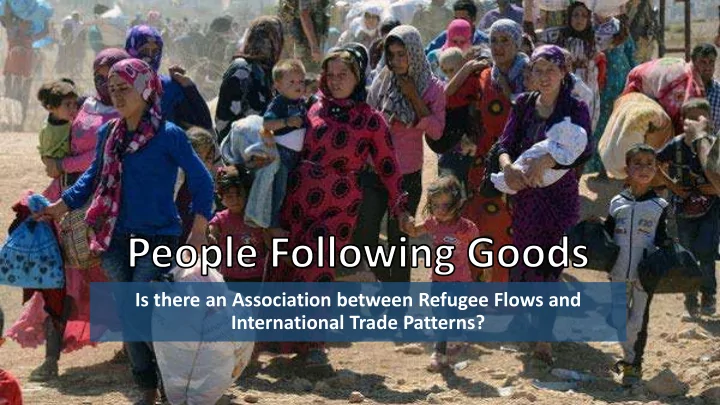
Is there an Association between Refugee Flows and International Trade Patterns?

slide-2
SLIDE 2

Is there an association between refugee flight patterns and international trade?

Qu Ques estion

  • n

What determines refugee flight patterns?

  • What is the distinction between refugee flows and migration?
  • Where do refugees flee and why?
  • Is there a way to predict refugee flight patterns when a crisis breaks out?
  • Are there certain factors that influence the decision-making process or is it

more random?

slide-3
SLIDE 3

Hyp ypothesis

Previous studies have shown a relationship between migration and trade: does this relationship hold with refugee flows? Strong trade ties may decrease certain costs of migration for refugees

  • lower transportation costs
  • increased information

Strong trade ties could indicate a strong economy in potential asylum country

  • increased economic opportunity

When a refugee crisis breaks out, refugees will flee from their country of origin to those countries with which their country’s economic ties are strongest.

slide-4
SLIDE 4

Motivation

«Today, we are experiencing the largest refugee and migrant crisis since World War II and the highest numbers of displacement on record»

  • Washington Post

«There are close to 65.3 million forcibly displaced people worldwide, 31.3 million refugees registered with the UNHCR and 33,972 people a day are forced to flee their homes because of conflict and persecution»

  • UNHCR
slide-5
SLIDE 5

*Source: UNHCR

slide-6
SLIDE 6

Motivation

The topic of refugee flows has been widely studied by anthropologists, political scientists, sociologists, historians and lawmakers BUT… There is a marked lack of empirical studies/economic analysis on the topic of refugee flows THOUGH… Economists have the unique ability to contribute quantitative/empirical results that could help direct policy or influence the way refugee crises are addressed How can we as economists contribute?

slide-7
SLIDE 7

Econ

  • nom
  • mic T

Theor eory

Refugee Fundamental Cost-Benefit Analysis (Deciding where to flee) Refugee Initial Decision (Whether or not to flee) Gravity Model of Immigration Wj – Cj + εj> Wi – Ci - εi

Wage potential in asylum country – cost of fleeing > wages in origin country – cost of violence/disaster

Uj = µj - Cj + εj (Uj = potential utility from fleeing to country i) Uk = µk - Ck +εk (Uk = potential utility from fleeing to country j) If Uj > Uk refugee will flee to country j Immij = B0 + B1(popi x popj) + B2(relyij) +B3(distij)

slide-8
SLIDE 8

Data ta

United Nations High Commissioner on Refugees (UNHCR) Database: total refugee population by country of asylum, 1960-2013 and total refugee population by origin, 1960-2013 The Refugee Project: narrative, temporal map of refugee migration since 1975 ITC Trade Map: International Trade Centre (trade by commodity statistics, value in thousands of US dollars) World Bank: population data as well as GDP per capita data Human Freedom Index: political rights and civil liberties in country of asylum Google Maps: distance between capitals of sending and receiving countries

slide-9
SLIDE 9

Data ta

slide-10
SLIDE 10

Analysis

Multivariate Regression of Panel Data Set (1) Log(Rij/Pi) = B0 + ac + at + B1log(IMji) + B2log(EXij) + B3log(Dij) + B4log(GDPi) + B5log(GDPj) + B6(PRj) (2) Log(Rij10) = B0 + ac + at + B1log(IMij) + B2log(EXij) + B3log(Dij) + B4log(GDPi) + B5log(GDPj) + B6(PRj)

slide-11
SLIDE 11

Empirical R Results ts

Dependent Variable: Refugees/Origin Population (1) (2) (3) Log Distance (km)

  • 0.810***

(0.042) Log Imports (US$) 0.056** (0.023) 0.078*** (0.021) 0.075*** (0.020) Log Exports (US$)

  • 0.237***

(0.018) 0.0 (0.015) 0.001 (0.015) Log Per Capita GDP Origin (US$)

  • 0.489***

(0.026)

  • 0.211**

(0.070)

  • 0.437***

(.092) Log Per Capita GDP Asylum (US$) 0.096* (0.053) 0.673*** (0.111) 0.390*** (0.145) Political Rights 0.113** (0.048) Constant 2.271*** (0.634) Fixed Effects None Origin + Asylum Origin + Asylum + Time R^2: .2999 Adjusted R^2: .299 Observations: 4952 R^2: 0.9897 Adjusted R^2: 0.9892 Observations: 4952 R^2: 0.9899 Adjusted R^2: 0.9893 Observations 4952

The symbols *, **, and *** following the coefficients denote that the estimator is significant at a 10, 5, and 1% significance level, respectively. Country and Time dummies not reported. Source: own calculations

slide-12
SLIDE 12

Top T

  • p Ten

en R Refugee ee-Producing C Countries an and Nu Number r of

  • f Refugees

es (2001-2013)

Country Number of Refugees

  • 1. Afghanistan

13,557,819

  • 2. Iraq

11,208,290

  • 3. Somalia

6,269,188

  • 4. Sudan

5,552,576

  • 5. Vietnam

4,260,960

  • 6. Burundi

3,608,974

  • 7. Syria

2,841,887

  • 8. Eritrea

2,322,329

  • 9. Croatia

1,601,592

  • 10. Azerbaijan

1,427,430

Source: own calculations, data from UNHCR: Total Refugee Population by Origin, 1960-2013

Note: Number of Syrian refugees relative to other nations is low compared to what might be expected on the basis of the last three years because the available data only includes up to 2013

slide-13
SLIDE 13

Dependent Variable: Refugees (1) (2) (3) Log Distance (km)

  • 1.409***

(0.215) Log Imports (US$) 0.532*** (0.099) 0.298** (0.137) 0.299** (0.142) Log Exports (US$)

  • 0.217***

(0.067)

  • 0.409***

(0.075)

  • .444***

(0.079) Log Per Capita GDP Origin (US$) 0.323* (0.164)

  • 0.001

(0.175)

  • 0.099

(0.187) Log Per Capita GDP Asylum (US$)

  • 1.022***

(0.194) 0.979** (0.448) 0.223* (0.750) Political Rights 0.156 (0.030) Constant

  • 1.272

(2.160) Fixed Effects None Origin + Destination Origin + Destination + Time R^2: .3258 Adjusted R^2: .3076 Observations: 230 R^2: 0.977 Adjusted R^2: 0.9739 Observations: 230 R^2: .9777 Adjusted R^2: .9732 Observations: 230

The symbols *, **, and *** following the coefficients denote that the estimator is significant at a 10, 5, and 1% significance level, respectively. Country and Time dummies not reported. Source: own calculations

Empirical R Results ts

(Top T p Ten n Refug ugee-Produ ducing C Coun untries)

slide-14
SLIDE 14

Conclusions/Policy I Implicati tions

  • Those countries from which a country imports the most are most likely to be the

most important asylum countries if a crisis breaks out.

  • Crisis management implications – so that asylum countries could be better-prepared
  • Distance remains a highly significant indicator, however more likely to predict first

asylum countries

  • Reiterates evidence that developing countries are most likely to produce the largest

refugee flows

  • Evidence that refugees, like migrants seek better economic opportunity as well as

stability when they flee (as seen with Syria today)

Imports may be a good indicator of refugee flight patterns during periods of conflict

slide-15
SLIDE 15

Furt rther R r Research

  • It is important to test underlying assumptions
  • Does trade correlate with the costs associated with fleeing to different countries
  • Understand how perception of economic opportunity factors into refugees decision of where to

flee

  • Include additional explanatory variables
  • Variable to indicate whether origin and destination countries share common language or a

variable to measure ethnic linkages between origin and destination country populations

  • Lagged variable to understand if past refugee flights affect future refugee flights
  • Variable to reflect asylum policy in receiving countries as well as investments and foreign aid
  • Test other indicators of trade
  • Variable to reflect the trade of services in addition to the trade of goods

Why does this link exist between trade and refugee flows?