Reducing Unplanned Admissions for Patients Receiving Radiation - - PowerPoint PPT Presentation

reducing unplanned admissions for patients receiving
SMART_READER_LITE
LIVE PREVIEW

Reducing Unplanned Admissions for Patients Receiving Radiation - - PowerPoint PPT Presentation

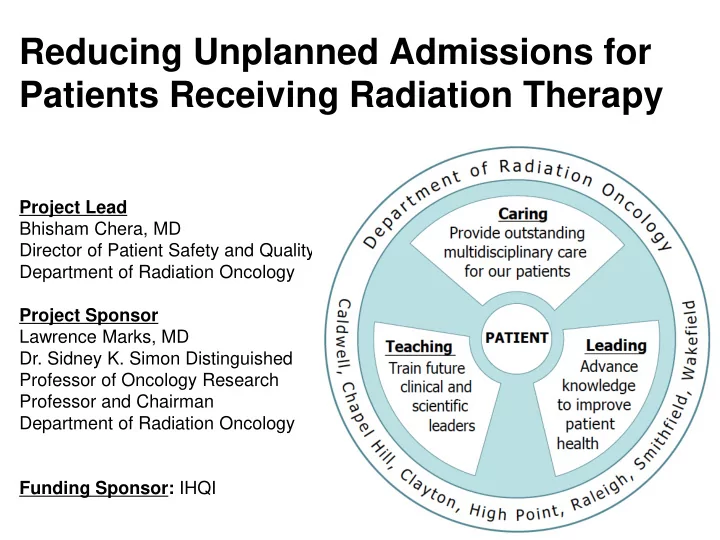
Reducing Unplanned Admissions for Patients Receiving Radiation Therapy Project Lead Bhisham Chera, MD Director of Patient Safety and Quality Department of Radiation Oncology Project Sponsor Lawrence Marks, MD Dr. Sidney K. Simon


slide-1
SLIDE 1

Reducing Unplanned Admissions for Patients Receiving Radiation Therapy

Project Lead Bhisham Chera, MD Director of Patient Safety and Quality Department of Radiation Oncology Project Sponsor Lawrence Marks, MD

  • Dr. Sidney K. Simon Distinguished

Professor of Oncology Research Professor and Chairman Department of Radiation Oncology Funding Sponsor: IHQI

slide-2
SLIDE 2

Disclosures

  • Specific to this work

– UNC Health Care System; UNC SOM Institute of Healthcare Quality Improvement

  • Departmental grants

– Elekta, Siemens, Accuray, NIH, CDC, AHRQ

slide-3
SLIDE 3

“I am bummed that I cannot do the presentation. I feel passionate about this topic.”

slide-4
SLIDE 4

Background

  • Unplanned hospital admissions costly
  • ~$12-$17 billion annually
  • Potentially preventable health care costs1
  • Cancer treatment
  • Multimodality (complicated/complex):

surgery, radiation, chemo

  • Intensive  severe acute toxicities/symptoms
  • Inpatient  Outpatient
  • 1. Jencks SF, Williams MV, Coleman EA. Rehospitalizations among patients in the

Medicare fee-for-service program. N Engl J Med. 2009;360: 1418-1428

slide-5
SLIDE 5
  • Retrospective Review of 1,116 patients treated at UNC-Hospitals
  • ~20% had unplanned hospitalizations within 90 days of starting radiation
  • 47% were seen in the clinic within 2 weeks of hospitalization
  • Hospitalization rates highest: head and neck, lung, GI, and palliative cases.

Waddle MR, Chen RC, Marks LB.. Practical Radiation Oncology. 2014.

Unanticipated hospital admissions during or soon after radiation therapy: Incidence and predictive factors. Practical Radiation Oncology 2014

% of Patients

20% 10% 0% 0 10 20 30 40 50 60 70 80 90

Days from the start of RT

slide-6
SLIDE 6
  • Aim: To reduce unplanned inpatient admissions 50% (from

20% to 10%) by improving outpatient monitoring & management of acute toxicities

  • Two-fold Strategy

1. Weekly Nurse Practitioner (NP) and Registered Nurse (RN)-lead symptom-management clinic 3

  • 3. Mason H, DeRubeis MB, Foster JC, Taylor JM, Worden FP. Outcomes evaluation of a weekly nurse practitioner-managed symptom management clinic for patients with head and neck

cancer treated with chemoradiotherapy. Oncol Nurs Forum. 2013 Nov;40(6):581-6. doi: 10.1188/13.ONF.40-06AP.

  • 4. Edgerly M, Fojo T. Is there room for improvement in adverse event reporting in the era of targeted therapies? Journal of the National Cancer Institute. Feb 20 2008;100(4):240-242.
  • 5. Basch E, Iasonos A, McDonough T, et al. Patient versus clinician symptom reporting using the National Cancer Institute Common Terminology Criteria for Adverse Events: results of a

questionnaire-based study. The lancet oncology. Nov 2006;7(11):903-909.

  • 6. Basch E, Jia X, Heller G, et al. Adverse symptom event reporting by patients vs clinicians: relationships with clinical outcomes. Journal of the National Cancer Institute. Dec 2

2009;101(23):1624-1632.

  • 2. Develop a mobile application for

pts to report symptoms in “real- time” (pt self-reporting is a reliable in assessing tx toxicities and correlated well with clinical

  • utcomes4-6)
slide-7
SLIDE 7

NP and RN Symptom-Management Clinic Team

Jayne Camporeale, ANP Lauren Terzo RN, BSN, OCN

Elaine Roth RN, OCN

Mary Fleming, ANP

slide-8
SLIDE 8

Mobile App for Symptom Reporting

Patients report severity of symptoms: 1) Tiredness/Fatigue 2) Pain 3) Nausea/Vomiting 4) Decreased Appetite 5) Anxiety/Worrying

slide-9
SLIDE 9

Example of Mobile App Data Available for Providers

  • Providers access via secure website to view pt-specific data
  • Reviewed with the patient in the Clinic
slide-10
SLIDE 10

Nurse Practioner 28 Nurse Practioner+App 19 Nurse 8 App 2 Nurse+App 6 None* 23

Type of Interventions Since Clinic Inception 8.20.2014

*22% (23/103) = of eligible clinic pts are not seen by a provider due to clinic volume 103 eligible pts with 2 NPs/2RNs each seeing 3-5 pts in additional to normal workload

slide-11
SLIDE 11

RadOnc Tablet 23% iPhone 4% iPad 3% None* 65% Personal Device, 5%

*22% (23/103) = of eligible clinic pts are not seen by a provider due to clinic volume

Mobile App Report Methods: Symptom-Management Clinic

slide-12
SLIDE 12

0% 9% 27% 5% 11% 7% 0% 13% 9%

0% 10% 20% 30% 40% Aug** (n=4) Sept (n=11) Oct (n=15) Nov (n=19) Dec (n=18) Jan (n=15) Feb (n=17) March (n=15 ) April (n=22 ) % Unplanned Hospital *Admissions

(n= # clinic pts/mo.)

Unplanned Hospital Admissions* Symptom Management Clinic Goal=10% Upper Limit, Historical Control

*does not include multiple admissions **Clinic began 2014-Aug-20

  • Renal failure x4
  • Pneumonia
  • Dysphagia
  • Shortness of

breath

  • Fever x3
  • Acute

pharyngitis

  • Hemoptysis
  • GI bleed x2
  • Small bowel
  • bstruction
  • Protein-calorie

malnutrition

slide-13
SLIDE 13

0% 9% 13% 11% 17% 13% 18% 0% 5%

0% 10% 20% 30% Aug** (n=4) Sept (n=11) Oct (n=15) Nov (n=19) Dec (n=18) Jan (n=15) Feb (n=17) Mar (n=15) Apr (n=22) % Unplanned ED *Visits

(n= # clinic pts/mo.

Unplanned Emergency Department Visits*: Symptom Management Clinic

*does not include multiple ED visits **Clinic began 2014-Aug-20

  • Altered mental

status

  • Hyponatremia x2
  • Chest pain x3
  • Hip pain
  • Urinary retention
  • Nausea/vomiting/d

ehydration x2

  • Sore throat
  • Respiratory tract

aspiration

  • Constipation
  • G-tube

dislodgement

  • Renal failure
  • Facial swelling
slide-14
SLIDE 14

Nurse Testimonial

“Participating in the clinic has enabled me to take a holistic and patient and family- centric approach to care.” “I enjoy being able to practice to the fullest of my scope, education, and training”

Lauren Terzo, RN, BSN, OCN

slide-15
SLIDE 15

Nurse Testimonial

“Our Symptom management clinic has given me a lot of professional

  • satisfaction. I forgot how much I

enjoy direct clinical care.” “Outpatient medicine has changed and it is now more difficult for nurses to focus on clinical care. Too many competing tasks (Epic, billing, etc.)”

Elaine Roth, RN, OCN

slide-16
SLIDE 16

Nurse Practitioner Testimonial

"I saw a patient in symptom management clinic 4:30 PM the day before Thanksgiving. He casually mentioned ankle swelling. He did not mention this to his medical oncologist on Monday or his Radiation oncologist on

  • Tuesday. The radonc nurse called ultrasound,

who were about to close. They graciously did bilateral lower extremity ultrasounds that showed bilateral DVT’s. I started him on lovenox. Had there been any delay, he likely would have gone to the ED and I was not leaning that way based on rather benign clinical

  • appearance. However, based on the studies, I

dread to think what would have happened had he not started treatment."

Mary Knowles, ANP

slide-17
SLIDE 17

Nursing Metrics

4% 16% 12% 12% 16% 40% 1-5 min. 6-10 min. 11-15 min. 16-20 min. 21-25 min. 25+ min. Time spent with pt includes:

 88% education on tx, symptoms, diabetes management  8% pt organization i.e. paperwork, other appts  4% support and encouragement

slide-18
SLIDE 18

Nurse Autonomy: Nurse vs NP?

  • Only 24% of RN visits required a NP or

Physician involvement

  • example: antibiotics for G-tube site infection, prescriptions,

refills

  • Thus, 76% of visits reasonable for nurse alone
slide-19
SLIDE 19

Patient perspective

  • The majority of pts ‘agree’ or ‘strongly

agree’ that

– reporting their symptoms helps their physician to better manage them – the mobile app is convenient to use daily

  • 100% of pts feel this initiative is

worthwhile and would recommend it to

  • ther cancer pts
slide-20
SLIDE 20

Sustainability/Spread Plan

  • Standard Work in Radiation Oncology

– Expand to other high risk patients (e.g. palliative) – Hire more advanced practitioners/nurses

  • Spread to other clinics?

– NC Cancer Hospital Operations Committee

slide-21
SLIDE 21

Lessons Learned

  • Patients seem to benefit most by the extra

clinical visit

  • Mobile App

– Many older pts are uncomfortable with the technology and/or forget to report if given a RadOnc tablet – Surprising how many patients do not have mobile phones/tablets – Limited departmental tablet loaners

slide-22
SLIDE 22

Acknowledgments

  • Patients
  • Mary Fleming, ANP
  • Jayne Camporeale, ANP
  • Rad Onc Nurses

– Lauren Terzo, RN, BSN, OCN – Elaine Roth, RN, OCN – Miriam Troxler, RN, BSN, OCN – Ken Neuvirth, RN, MSN, CNML

  • Lori Stravers, MPH, CHES
  • Aaron Falchook, MD
  • Lawrence Marks, MD

Project Team Members

  • Fran Collichio, MD
  • Jared Weiss, MD
  • Gregg Tracton, PhD
  • Kinley Taylor, MS

IHQI

  • Mike Pignone, MD, MPH
  • Tina Willis, MD
  • Laura Brown, MPH