Recommendations to the FAA Sky Posse Palo Alto June 4, 2016 1 - - PowerPoint PPT Presentation

recommendations to the faa
SMART_READER_LITE
LIVE PREVIEW

Recommendations to the FAA Sky Posse Palo Alto June 4, 2016 1 - - PowerPoint PPT Presentation

Recommendations to the FAA Sky Posse Palo Alto June 4, 2016 1 Introduction June 1, 2016 letter to Glen Martin 13 recommendations will cover some today (additional recommendations in backup slides) Design principles Eliminate


slide-1
SLIDE 1

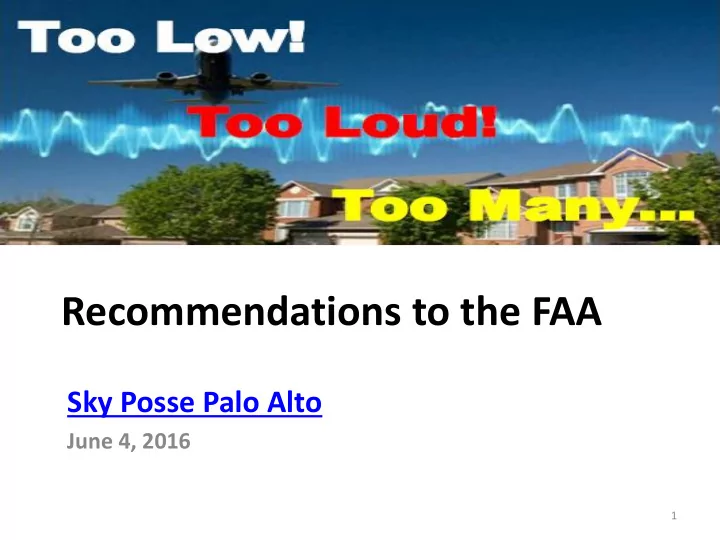
Recommendations to the FAA

Sky Posse Palo Alto

June 4, 2016

1
slide-2
SLIDE 2

Introduction

  • June 1, 2016 letter to Glen Martin

– 13 recommendations – will cover some today (additional recommendations in backup slides)

  • Design principles

– Eliminate noise for everyone as much as possible – Disperse residual noise in equitable manner

No “sacrificial noise corridor”

2

slide-3
SLIDE 3

Abandon the use of the MENLO waypoint

  • A 4000-foot waypoint over a

densely populated area is unacceptable, unsustainable, and unnecessary when a huge body of water is directly available less than 2 miles away.

  • Adopt one or more waypoints

east or southeast of MENLO to enable arrivals to fly at higher altitudes over residential areas and take full advantage of the length of the Bay.

MENLO waypoint

3

slide-4
SLIDE 4

Use Pt Reyes east leg as primary route for immediate relief

  • Direct Pt Reyes arrivals to use

primarily the Pt Reyes east leg (over the Bay) for immediate relief.

  • Then address concentration

issue of low altitude Pt Reyes west leg arrivals over Palo Alto.

4

slide-5
SLIDE 5

Take advantage of the full Bay 1/3

Approach the Bay from the southern shore to maximize distance

  • Much higher altitudes because distance is at least 23 Nautical Miles (from

industrial areas north of 101/237 to SFO).

  • Use scenario modeling to identify paths that would maximize altitudes over

populated areas and stay clear of departing SJC traffic.

SFO

5

slide-6
SLIDE 6

Take advantage of the full Bay 2/3

Guide arrivals through one or both traffic gaps to get to the Bay.

May 2015 radar pings for flights above 3000 feet. Gap areas are indicated by blue arrows.

6

slide-7
SLIDE 7

Guide arrivals from the south up the uninhabited or industrial areas east of the Santa Clara Valley/US 101 to avoid residential areas.

  • avoids many communities from Santa Cruz to East Palo Alto

Take advantage of the full Bay 3/3

7

slide-8
SLIDE 8

Route night arrivals over the full length of the Bay

  • SFO departures use full length of the Bay at night
  • forces night arrivals over mid-peninsula residents
  • Approach from south end of the Bay given the low volume of

SJC air traffic at night

8

slide-9
SLIDE 9

Use highest possible angle of descent

  • Current angle of 2.85° is quite conservative
  • Heathrow currently uses 3° but could use 3.2° for its existing runways and

proposed new runway in 2030

  • Per Heathrow, 3.5° would be feasible by 2040 (page 26, section 4.3.2 on steeper approaches of Heathrow’s

North-West Runway Air and Ground Noise Assessment).

  • Frankfurt airport is using a 3.2° slope on its Runway Northwest.

http://ec.europa.eu/transport/modes/air/ses/ses-award/projects/doc/internationalairportreview_2015_q4_frankfurtgbas.pdf

  • Hannover, Germany is testing 4.5° http://en.hannover-airport.tv/video.html?v=8B

9

slide-10
SLIDE 10

Reduce concentration over populated areas

Take advantage of NextGen’s precision navigation: consider ‘herringbone’ or ‘trident’ approach pattern to spread noise

Source: http://www.hacan.org.uk/resources/reports/flight.paths.report.pdf (page 17)

Source: https://publicapps.caa.co.uk/docs/33/CAP%201378%20APR16.pdf (page 88) 10

slide-11
SLIDE 11

Summary

  • Take advantage of the Bay and NextGen technology

– Enter airspace over the Bay at highest altitude possible

  • Maximize distance over the Bay
  • Use higher angles of descent

– Use east leg of Pt Reyes Arrival route – Route night arrivals over the Bay – Disperse traffic using multiple routes/entry points --no low-altitude concentration over populated areas

  • Review estimated impact before recommending proposals

– Feasible does not imply that it’s good or should be done. – Modeling tools must be used to estimate impact.

  • Require the FAA to propose changes and routes that provide

relief to the region and are sustainable

– Minor tweaks to a poor plan might help a few but will not provide relief to our region.

11

A regional solution can be found.

slide-12
SLIDE 12

ADDITIONAL RECOMMENDATIONS

12

slide-13
SLIDE 13

Address SJC operations that impact mid-peninsula

  • SJC on reverse flow much more often than SFO

– SJC arrivals over Palo Alto at 2000 feet while crossing arriving SFO flights above

  • Regular SJC oceanic departures over Palo Alto that thread under SFO arrivals

(SERFR or other routes)

Require airlines to install vortex generators on old Airbuses

  • Inexpensive fix (estimated at $5,000 by the SFO noise abatement office)

Use modeling tool (AEDT 2b) to evaluate noise impact and dispersion of air pollutants for various alternatives. Integrate noise abatement planning between SFO and SJC

  • Treating SFO and SJC as separate airports greatly diminishes options to reduce

noise

Implement continuous improvement program Sequence planes over the ocean or unpopulated areas

  • Do not sequence over residential communities --must minimize frequency of

disruptions on people

13