
SLIDE 1
Recombination of Vortex Loops in HeII and Theory of QuantumTurbulence
Sergey K. Nemirovskii Institute of Thermophysics, Novosibirsk, Russia;
Recombination of Vortex Loops in HeII and Theory of - - PowerPoint PPT Presentation
Recombination of Vortex Loops in HeII and Theory of QuantumTurbulence Sergey K. Nemirovskii Institute of Thermophysics, Novosibirsk, Russia; My talk will be very different from previous talks at this online conference. I had great doubts
Sergey K. Nemirovskii Institute of Thermophysics, Novosibirsk, Russia;
had great doubts and shared these doubts with Professor Andrei Vesnin. Andrey, in turn, shared his doubts with Professor L. Kauffman .
a network of vortex loops in He II and a theory of superfluid turbulence" by Sergey K. Nemirovskii* This is very geometric and would be of interest to everyone in the seminar. If he is willing to give more than
It is great that Sergey Nemirovskii is willing to speak in our seminar. I am very much looking forward to his talks.
separate talk, to combine the two talks today and present an extended Introduction, which will essentially be a small review on quantum
audience, and (secondly) will allow me to smoothly move on to the main problem of the role of reconnections in the formation of quantum turbulence
From the point of view of hydrodynamics, the new phase of helium, the so- called helium II (He II), can be represented as a mixture of two liquids
Vortex filaments in He II. Deterministic dynamics
turbulence, attractive for theoreticians, is that the theory of superfluid turbulence is an elegant and challenging statistical problem used for the study of the dynamics of a chaotic set of string-like objects, with nonlinear and nonlocal interactions plus reconnections resulting in the fusion or splitting of vortex loops. The latter feature allows one to classify quantum turbulence as a variant of string field theory.
Network of cosmic strings (D. Bennet, F. Bouchet,1989 )
Tangle of string-like defects in nematic liquid crystal I.Chuang, R. Durrer,
(“Science”, 1991)
Natural light fields are threaded by lines of darkness. They are optical vortices that extend as lines throughout the volume of the field.
Topological defects in Bose Gas (N. Berloff, B. Svistunov, 2001)
Tangle of vortex filaments obtained in turbulent flow at moderately high Reynolds (Vincent and Meneguzzi 1991).
Развитие квантовой турбулентности
Нуль параметра порядка (топологический дефект)
turbulent features as consequence of dynamics of vortex filaments
Idea of modeling turbulence by discrete vortices on experimental and numerical evidences of that the developed turbulence has the vortex filamentary structure.
in HeII and Theory of QuantumTurbulence
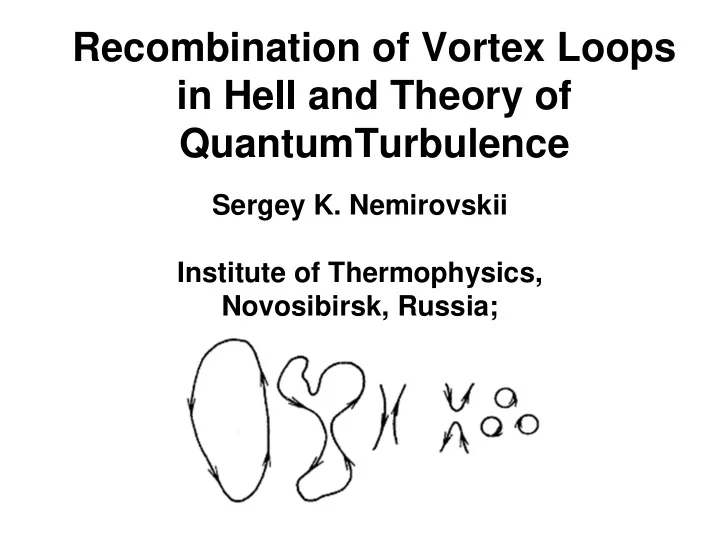
In general, the dynamics of the vortex tangle consists of two main ingredients. The first one (deterministic) is the motion of the elements of lines, due to equations of the motion (Biot-Savart law, mutual friction etc.). The second one is the (random) collisions (and merging), or self- intersections (and splitting) of the vortex loops.
Up to now the numerical results remain the main source of information about this process. The scarcity of analytic investigations is related to the incredible complexity of the
not have a fixed number of elements, they can be born and die. Thus, some analog of the secondary quantization method is required with the difference that the objects (vortex loops) themselves possess an infinite number of degree of freedom with very involved dynamics. Clearly this problem can hardly be resolved in the nearest future. Some approach crucially reducing a number of degree of freedom is required.
previous reconnections. Therefore any loop consists of small parts which "remember" previous collision. These parts are uncorrelated since deterministic Kelvin wave signals do not have a time to propagate far enough. Therefore loop has a structure of random walk (like polymer chain).
The only degree of freedom of random walk is the length l of loop. Let us introduce the distribution function n(l,t) of the density of a loop in the "space" of their
unit volume) with lengths lying between l and l+dl. Knowing quantity n(l,t) and statistics of each personal loop we are able to evaluate various properties of real vortex tangle
There are two main mechanisms for n(l,t) to be
deterministic motion (in fact to mutual friction shrinking or inflating loops). The second mechanism is related to random processes of recombination. We take that splitting of loop into two smaller loops
(number of events per unit time) B(l_1,l_2,l). The merging of loop occurs with the rate of collision A(l_1,l_2,l).
In view of what has been exposed above we can directly write out the master ”kinetic” equation for rate of change the function n(l,t)
Let us take vector S connecting two points of the loop. Event S=0 implies self-intersection of line with consequent reconnection and splitting of the loop. To find the rate
arguments vanishes. In other words we have to find number of zeroes of fluctuating function S.
By use of a special procedure (Zakharov ansatz) it can be shown that kinetic equation without "deterministic terms" has stationary power-like solution.
down of loops prevails and cascade-like process of generation of smaller and smaller loops forms. There exists a number of mechanisms of disappearance of rings on very small
collapse of lines, Kelvin waves etc.
Inverse cascade implies the cascade-like process of generation of larger and larger loops. Unlike previous case of direct cascade, there is no apparent mechanism for disappearance of very large loops. The probable scenario is that parts of large loops are pinned on the walls. Finally a state with few
lines stretching from wall to wall with poor dynamics and rare events is realized, this is a degenerated state of the vortex tangle.
satisfactorily described in language of the kinetics of reconnecting (splitting and merging) Brownian loops.
secondary in value.
characteristics of the Brownian loop, one can describe the variety of phenomena of quantum turbulence. The pessimistic point of view is that this is impossible and the full solution of the problem requires something like string field theory for nonlinear strings.