Recent Developments in the NAFTA Steel Industry NAFTA Industry - - PDF document

recent developments in the nafta steel industry
SMART_READER_LITE
LIVE PREVIEW

Recent Developments in the NAFTA Steel Industry NAFTA Industry - - PDF document

Recent Developments in the NAFTA Steel Industry NAFTA Industry Presentation to OECD Steel Committee Paris, France May 11, 2015 Most of NAFTA Region Economy Improving, but at Slower-than-Expected Rates Gross Domestic Product (GDP) Economic


slide-1
SLIDE 1

1

Recent Developments in the NAFTA Steel Industry

NAFTA Industry Presentation to OECD Steel Committee Paris, France May 11, 2015

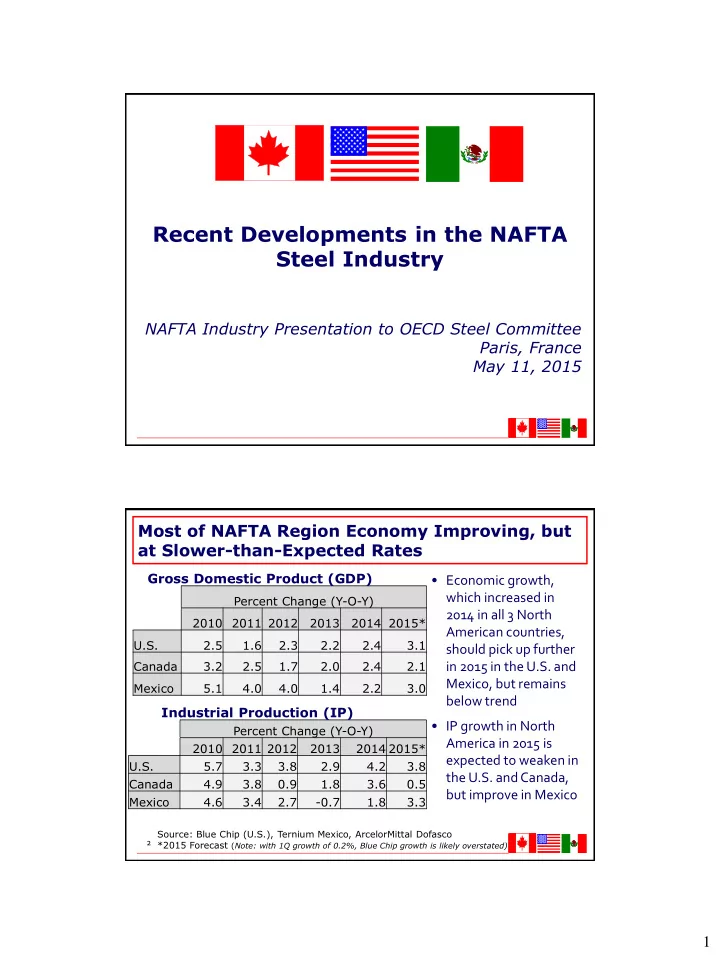
Gross Domestic Product (GDP)

Percent Change (Y-O-Y) 2010 2011 2012 2013 2014 2015* U.S. 2.5 1.6 2.3 2.2 2.4 3.1 Canada 3.2 2.5 1.7 2.0 2.4 2.1 Mexico 5.1 4.0 4.0 1.4 2.2 3.0

Industrial Production (IP)

Percent Change (Y-O-Y) 2010 2011 2012 2013 2014 2015* U.S. 5.7 3.3 3.8 2.9 4.2 3.8 Canada 4.9 3.8 0.9 1.8 3.6 0.5 Mexico 4.6 3.4 2.7

  • 0.7

1.8 3.3

Source: Blue Chip (U.S.), Ternium Mexico, ArcelorMittal Dofasco *2015 Forecast (Note: with 1Q growth of 0.2%, Blue Chip growth is likely overstated)

  • Economic growth,

which increased in 2014 in all 3 North American countries, should pick up further in 2015 in the U.S. and Mexico, but remains below trend

  • IP growth in North

America in 2015 is expected to weaken in the U.S. and Canada, but improve in Mexico

2

Most of NAFTA Region Economy Improving, but at Slower-than-Expected Rates

slide-2
SLIDE 2

2

$0 $20 $40 $60 $80 $100 $120 $140 $160 500 1,000 1,500 2,000 2,500 00 01 02 03 04 05 06 07 08 09 10 11 12 13 14 15 $ Barrel of Oil Total U.S. Oil and Gas Rig Count

North American Rig Count and Price of Oil

Rig Count $ Barrel of Oil

Source: Baker Hughes, West Texas Intermediate (WTI) 3

Recent and Significant Changes in Currencies and Oil Prices Will Impact Global/Regional Trade and Consumption Patterns

Source: American Iron and Steel Institute 4

NAFTA Production in 2014 Grew Only 2%, While Utilization Rates Tracked Below Global Rate

65% 67% 69% 71% 73% 75% 77% 79% Jan Feb Mar Apr May Jun Jul Aug Sep Oct Nov Dec

NAFTA vs. World Utilization Rates in 2014

NAFTA World

  • 2,000

4,000 6,000 8,000 10,000 12,000 JAN FEB MAR APR MAY JUN JUL AUG SEP OCT NOV DEC JAN FEB MAR APR MAY JUN JUL AUG SEP OCT NOV DEC JAN FEB MAR APR MAY JUN JUL AUG Sept Oct Nov Dec Jan Feb Mar Apr May Jun Jul Aug Sep Oct Nov Dec 2011 2012 2013 2014 Metric Tons (Thousands)

NAFTA Crude Steel Production (2011-14)

Mexico Canada U.S.

slide-3
SLIDE 3

3 NAFTA Apparent Steel Demand Significantly Outpacing Crude Steel Production

NAFTA Crude Steel Production

5

  • The 2.2%

NAFTA increase in production in 2014 (vs. a slower-than- expected 2013), should be put into perspective

  • Apparent steel

demand in 2014 was up more than 11% over 2013, mostly due to surging imports, which led to higher inventories

NAFTA Apparent Steel Demand

Source: AISI, Statistics Canada/CSPA, Canacero

Thousands MT 2013 2014 % Change Canada 12,471 12,952 +3.9% U.S. 86,877 88,174 +1.5% Mexico 18,208 18,995 +4.3% NAFTA 117,556 120,121 +2.2% Thousands MT 2013 2014 % Change Canada 14,095 15,223 +8.0% U.S. 95,686 106,921 +11.7% Mexico 20,131 22,487 +11.7% NAFTA 129,912 144,631 +11.3%

NAFTA Apparent Demand is Increasing, but Raw Steel Production Remains Flat

Source: U.S. Census Bureau (Commerce), Statistics Canada, AISI, Canacero

6

20,000 22,000 24,000 26,000 28,000 30,000 32,000 34,000 36,000 38,000 40,000 1Q 2Q 3Q 4Q 1Q 2Q 3Q 4Q 2013 2014 Million Metric Tons (MT)

NAFTA Apparent Demand

20,000 22,000 24,000 26,000 28,000 30,000 32,000 34,000 36,000 38,000 40,000 1Q 2Q 3Q 4Q 1Q 2Q 3Q 4Q 2013 2014

NAFTA Raw Steel Production

slide-4
SLIDE 4

4 Finished Imports are Capturing Growth in Apparent Demand in NAFTA Region

7

0% 5% 10% 15% 20% 25% 30% 35%

  • 1,000,000

2,000,000 3,000,000 4,000,000 5,000,000 6,000,000 7,000,000 8,000,000 9,000,000 10,000,000 1Q 2Q 3Q 4Q 1Q 2Q 3Q 4Q 2013 2014

Market Share (%) Finished Imports (MT)

NAFTA Finished Imports

Finished Imports Market Share

  • Offshore imports of

finished steel into North America increased 45% in 2014 vs. 2013

  • Finished import

market shares in NAFTA are at record levels, as imports took 21 percent of the North American steel market in 2014, up from 16 percent in 2013

Source: U.S. Census Bureau (Commerce), Statistics Canada, AISI, Canacero

Source: AISI, Statistics Canada, Canacero

NAFTA Direct Steel Trade Deficit Surged in 2014; Finished Steel Deficit at 28 MMT vs. 18 MMT in 2013

8

  • 10.5
  • 10.0
  • 9.5
  • 9.0
  • 8.5
  • 8.0
  • 7.5
  • 7.0
  • 6.5
  • 6.0
  • 5.5
  • 5.0
  • 4.5
  • 4.0
  • 3.5
  • 3.0
  • 2.5
  • 2.0
  • 1.5
  • 1.0
  • 0.5

0.0 0.5 1st 2nd 3rd 4th 1st 2nd 3rd 4th 1st 2nd 3rd 4th 1st 2nd 3rd 4th 1st 2nd 3rd 4th 1st 2nd 3rd 4th 1st 2nd 3rd 4th 2008 2009 2010 2011 2012 2013 2014 Metric Tons (million)

NAFTA Trade Balance

NAFTA Semi-finished Trade Deficit NAFTA Finished Steel Trade Deficit

slide-5
SLIDE 5

5

NAFTA Indirect Steel Trade Deficit in Manufactured Goods Over 21 Million MT in 2014 (total deficit = 49 MMT)

Source: AISI, Global Trade Atlas 9

Implications of NAFTA Steel Market Conditions

  • While apparent demand increased 11% in 2014, crude steel

production grew only 2%. The slowdown in global steel demand growth elsewhere, combined with growing global overcapacity, has led to a steel import surge crisis in NAFTA markets

  • These developments have damaged and disrupted North American

steel markets, and NAFTA steel producers have not been able to participate in the NAFTA steel demand growth story

  • Facing an historic surge in import market share and uncertainties

regarding energy and other key markets, NAFTA steel producers saw both capacity utilization and employment fall in 2014

  • In 2015, as record steel import levels continue, the NAFTA steel

industry crisis is deepening, and injury due to growing imports is reflected in a deteriorating NAFTA market; today, there are plant closures and layoffs throughout NAFTA steel producing countries

  • Efforts to remedy and address chronic unfair trade are paramount to

economic recovery in the NAFTA region to ensure “market-based” and WTO-compliant results are attained

10