Recap MDM4U: Mathematics of Data Management Example In how many - - PDF document

recap
SMART_READER_LITE
LIVE PREVIEW

Recap MDM4U: Mathematics of Data Management Example In how many - - PDF document

c o u n t i n g p r i n c i p l e s a n d p e r m u t a t i o n s c o u n t i n g p r i n c i p l e s a n d p e r m u t a t i o n s Recap MDM4U: Mathematics of Data Management Example In how many ways can six marbles be arranged in a straight


slide-1
SLIDE 1

c o u n t i n g p r i n c i p l e s a n d p e r m u t a t i o n s

MDM4U: Mathematics of Data Management

Arranging Distinct Items

Permutations

  • J. Garvin

Slide 1/18

c o u n t i n g p r i n c i p l e s a n d p e r m u t a t i o n s

Recap

Example

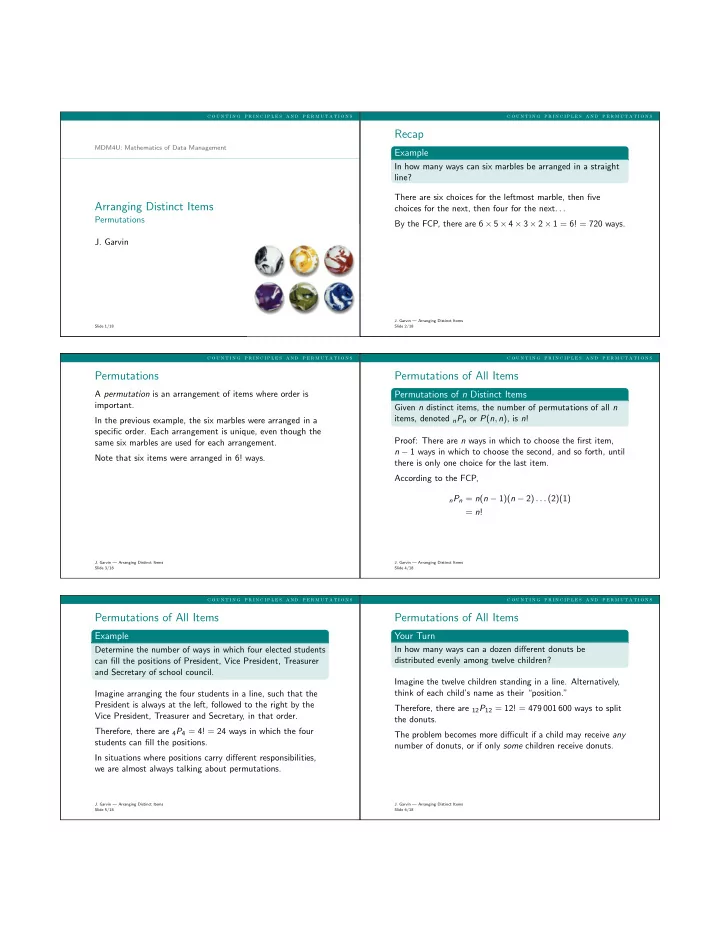
In how many ways can six marbles be arranged in a straight line? There are six choices for the leftmost marble, then five choices for the next, then four for the next. . . By the FCP, there are 6 × 5 × 4 × 3 × 2 × 1 = 6! = 720 ways.

  • J. Garvin — Arranging Distinct Items

Slide 2/18

c o u n t i n g p r i n c i p l e s a n d p e r m u t a t i o n s

Permutations

A permutation is an arrangement of items where order is important. In the previous example, the six marbles were arranged in a specific order. Each arrangement is unique, even though the same six marbles are used for each arrangement. Note that six items were arranged in 6! ways.

  • J. Garvin — Arranging Distinct Items

Slide 3/18

c o u n t i n g p r i n c i p l e s a n d p e r m u t a t i o n s

Permutations of All Items

Permutations of n Distinct Items

Given n distinct items, the number of permutations of all n items, denoted nPn or P(n, n), is n! Proof: There are n ways in which to choose the first item, n − 1 ways in which to choose the second, and so forth, until there is only one choice for the last item. According to the FCP,

nPn = n(n − 1)(n − 2) . . . (2)(1)

= n!

  • J. Garvin — Arranging Distinct Items

Slide 4/18

c o u n t i n g p r i n c i p l e s a n d p e r m u t a t i o n s

Permutations of All Items

Example

Determine the number of ways in which four elected students can fill the positions of President, Vice President, Treasurer and Secretary of school council. Imagine arranging the four students in a line, such that the President is always at the left, followed to the right by the Vice President, Treasurer and Secretary, in that order. Therefore, there are 4P4 = 4! = 24 ways in which the four students can fill the positions. In situations where positions carry different responsibilities, we are almost always talking about permutations.

  • J. Garvin — Arranging Distinct Items

Slide 5/18

c o u n t i n g p r i n c i p l e s a n d p e r m u t a t i o n s

Permutations of All Items

Your Turn

In how many ways can a dozen different donuts be distributed evenly among twelve children? Imagine the twelve children standing in a line. Alternatively, think of each child’s name as their “position.” Therefore, there are 12P12 = 12! = 479 001 600 ways to split the donuts. The problem becomes more difficult if a child may receive any number of donuts, or if only some children receive donuts.

  • J. Garvin — Arranging Distinct Items

Slide 6/18

slide-2
SLIDE 2

c o u n t i n g p r i n c i p l e s a n d p e r m u t a t i o n s

Permutations of Some Items

Sometimes we only want to arrange some items, taken from a collection. For example, suppose an artist brings five paintings to an

  • exhibition. She can hang only two paintings, next to each
  • ther, in the main gallery. In how many ways can she do this?

One approach might be to label the paintings A-E, and enumerate all 20 possible arrangements. AB, AC, AD, AE, BA, BC, BD, BE, CA, CB, CD, CE, DA, DB, DC, DE, EA, EB, EC, ED

  • J. Garvin — Arranging Distinct Items

Slide 7/18

c o u n t i n g p r i n c i p l e s a n d p e r m u t a t i o n s

Permutations of Some Items

A better approach is to use the FCP, using 5 choices for the first painting and 4 for the second, giving 5 × 4 = 20 ways. Note that 5 × 4 = 5 × 4 × 3 × 2 × 1 3 × 2 × 1 = 5 × 4 × 3 × 2 × 1 3 × 2 × 1 = 5! 3! = 5! (5 − 2)!

  • J. Garvin — Arranging Distinct Items

Slide 8/18

c o u n t i n g p r i n c i p l e s a n d p e r m u t a t i o n s

Permutations of Some Items

Permutations of r Items, Taken From n Distinct Items

Given n distinct items, the number of permutations of r items, denoted nPr or P(n, r), is n! (n − r)! Proof: There are n ways to choose the first item, n − 1 ways to choose the second item, and so forth, until there are n − r + 1 choices for the rth item. For example, for 5P3 we have 5 choices for the first item, 4 choices for the second, and 3 choices for the third. n − r + 1 = 5 − 3 + 1 = 3.

  • continued. . .
  • J. Garvin — Arranging Distinct Items

Slide 9/18

c o u n t i n g p r i n c i p l e s a n d p e r m u t a t i o n s

Permutations of Some Items

By the FCP,

nPr = n(n − 1)(n − 2) . . . (n − r + 1)

= n(n − 1)(n − 2) . . . (n − r + 1) × (n − r)! (n − r)! = n(n − 1)(n − 2) . . . (n − r + 1)(n − r)(n − r − 1) . . . (2)(1) (n − r)! = n! (n − r)!

  • J. Garvin — Arranging Distinct Items

Slide 10/18

c o u n t i n g p r i n c i p l e s a n d p e r m u t a t i o n s

Permutations of Some Items

Example

Determine the number of ways in which three students can stand in a line, taken from a group of eight students.

8P3 =

8! (8 − 3)! = 8! 5! = 8 × 7 × 6 = 336 Three of eight students can line up in 336 ways.

  • J. Garvin — Arranging Distinct Items

Slide 11/18

c o u n t i n g p r i n c i p l e s a n d p e r m u t a t i o n s

Permutations of Some Items

Your Turn

Six cards are dealt from a standard deck, one after the other, and arranged in a line. Determine the number of ways in which this can occur.

52P6 =

52! (52 − 6)! = 52! 46! = 52 × 51 × 50 × 49 × 48 × 47 = 14 658 134 400 There are over 14 billion ways to arrange the six cards!

  • J. Garvin — Arranging Distinct Items

Slide 12/18

slide-3
SLIDE 3

c o u n t i n g p r i n c i p l e s a n d p e r m u t a t i o n s

Permutations with Conditions

In some cases, we need to arrange items according to certain

  • conditions. For example, an item may need to be in a certain

position, or two items may need to be adjacent.

Example

  • Mr. Garvin and nine of his Data Management students are

seated in a row in the auditorium. If Mr. Garvin always

  • ccupies the aisle seat, determine the number of ways in

which the students can be seated.

  • Mr. Garvin’s position is fixed, so only nine items (the

students) are arranged. This can be done in 9! = 362 880 ways.

  • J. Garvin — Arranging Distinct Items

Slide 13/18

c o u n t i n g p r i n c i p l e s a n d p e r m u t a t i o n s

Permutations with Conditions

Example

In how many ways can Mr. Garvin’s nine students be seated, if Sophie and Claire insist on sitting next to each other? Since Sophie and Claire sit next to each other, treat them as a single item. There are now eight items to arrange, which can be done in 8! = 40 320 ways. However, Sophie and Claire can arrange themselves in two ways (SC or CS), so we must account for this by multiplying the previous answer by two. Thus, the nine students can be seated in 2 × 8! = 80 640 ways.

  • J. Garvin — Arranging Distinct Items

Slide 14/18

c o u n t i n g p r i n c i p l e s a n d p e r m u t a t i o n s

Permutations with Conditions

Your Turn

In how many ways can Mr. Garvin’s nine students be seated, if Devin always sits between Holly and Michael? Group the three students as one item. Now there are seven items to arrange, which can be done in 7! = 5 040 ways. The three students can sit as HDM or MDH, so multiply the answer by two to get 2 × 5 040 = 10 080 possible arrangements.

  • J. Garvin — Arranging Distinct Items

Slide 15/18

c o u n t i n g p r i n c i p l e s a n d p e r m u t a t i o n s

Indirect Method of Counting

Example

In how many ways can Mr. Garvin’s nine students be seated if Vincent and Ivan refuse to sit next to each other? Recall that some cases are easier to analyse using an indirect method: subtract the number of unacceptable possibilities from the total number of possibilities. With no restrictions, there are 9! = 362 880 ways of seating nine students. If Vincent and Ivan do sit together, there are 2 × 8! = 80 640 ways of seating the students. Thus, there must be 9! − 2 × 8! = 282 240 seating arrangements in which Vincent and Ivan are not together.

  • J. Garvin — Arranging Distinct Items

Slide 16/18

c o u n t i n g p r i n c i p l e s a n d p e r m u t a t i o n s

Indirect Method of Counting

Your Turn

In how many ways can the letters of the word THINK be arranged, such that the T and the H are not adjacent? There are 5! = 120 ways of arranging the five letters. There are 2 × 4! = 48 ways of arranging the five letters, such that the T and the H are adjacent. Therefore, there are 5! − 2 × 4! = 72 ways to arrange the five letters, such that the T and the H are not adjacent.

  • J. Garvin — Arranging Distinct Items

Slide 17/18

c o u n t i n g p r i n c i p l e s a n d p e r m u t a t i o n s

Questions?

  • J. Garvin — Arranging Distinct Items

Slide 18/18