Recall: Machine Learning Classification & Clustering a branch - - PDF document

recall machine learning classification clustering
SMART_READER_LITE
LIVE PREVIEW

Recall: Machine Learning Classification & Clustering a branch - - PDF document

Recall: Machine Learning Classification & Clustering a branch of artificial intelligence, is about the construction and study of systems that can learn from data. MSE 2400 EaLiCaRA The ability of a computer to improve its Dr. Tom


slide-1
SLIDE 1

1

Classification & Clustering

MSE 2400 EaLiCaRA

  • Dr. Tom Way

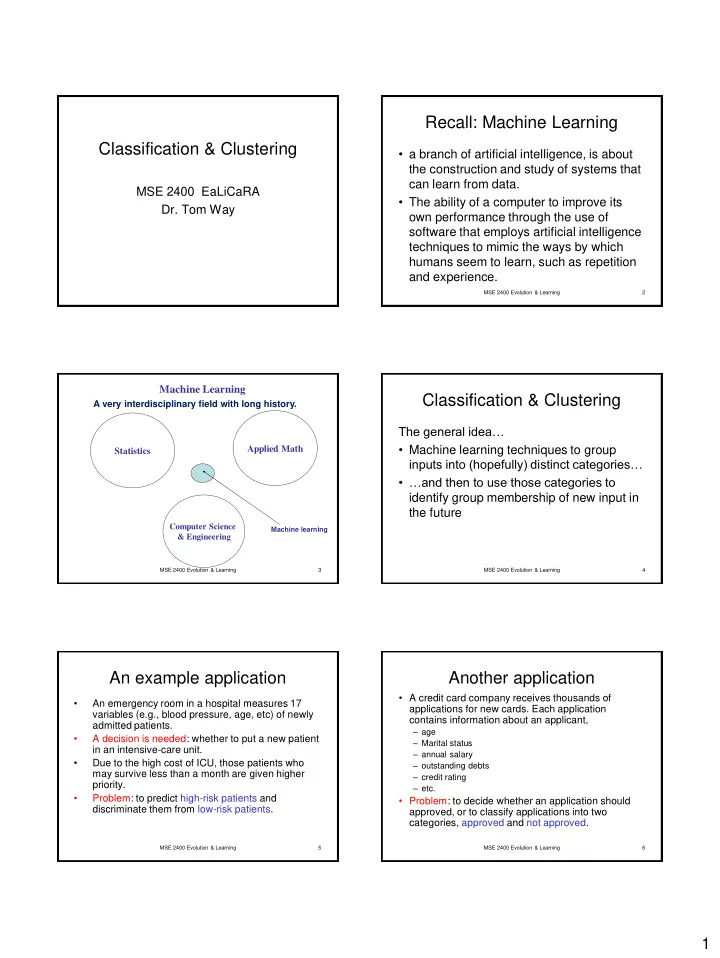
Recall: Machine Learning

  • a branch of artificial intelligence, is about

the construction and study of systems that can learn from data.

  • The ability of a computer to improve its
  • wn performance through the use of

software that employs artificial intelligence techniques to mimic the ways by which humans seem to learn, such as repetition and experience.

2 MSE 2400 Evolution & Learning

Statistics Applied Math

Computer Science & Engineering

Machine learning

Machine Learning

A very interdisciplinary field with long history.

MSE 2400 Evolution & Learning 3

Classification & Clustering

The general idea…

  • Machine learning techniques to group

inputs into (hopefully) distinct categories…

  • …and then to use those categories to

identify group membership of new input in the future

4 MSE 2400 Evolution & Learning

An example application

  • An emergency room in a hospital measures 17

variables (e.g., blood pressure, age, etc) of newly admitted patients.

  • A decision is needed: whether to put a new patient

in an intensive-care unit.

  • Due to the high cost of ICU, those patients who

may survive less than a month are given higher priority.

  • Problem: to predict high-risk patients and

discriminate them from low-risk patients.

MSE 2400 Evolution & Learning 5

Another application

  • A credit card company receives thousands of

applications for new cards. Each application contains information about an applicant,

– age – Marital status – annual salary – outstanding debts – credit rating – etc.

  • Problem: to decide whether an application should

approved, or to classify applications into two categories, approved and not approved.

MSE 2400 Evolution & Learning 6

slide-2
SLIDE 2

2

Definition of ML Classifier

 Definition of Machine Learning from dictionary.com

“The ability of a machine to improve its performance based on previous results.”  So, machine learning document classification is “the ability of a machine to improve its document classification performance based

  • n previous results of document classification”.

MSE 2400 Evolution & Learning 7

You as an ML Classifier

  • Topic 1 words:

baseball, owners, sports, selig, ball, bill, indians, isringhausen, mets, minors, players, specter, stadium, power, send, new, bud, comes, compassion, game, headaches, lite, nfl, powerful, strawberry, urges, home, ambassadors, building, calendar, commish, costs, day, dolan, drive, hits, league, little, match, payments, pitch, play, player, red, stadiums, umpire, wife, youth, field, leads

  • Topic 2 words:

merger, business, bank, buy, announces, new, acquisition, finance, companies, com, company, disclosure, emm, news, us, acquire, chemical, inc, results, shares, takeover, corporation, european, financial, investment, market, quarter, two, acquires, bancorp, bids, communications, first, mln, purchase, record, stake, west, sale, bid, bn, brief, briefs, capital, control, europe, inculab

8

Use the previous slide’s topics & related words to classify the following titles

1. CYBEX-Trotter merger creates fitness equipment powerhouse 2. WSU RECRUIT CHOOSES BASEBALL INSTEAD OF FOOTBALL 3. FCC chief says merger may help pre-empt Internet regulation 4. Vision of baseball stadium growing 5. Regency Realty Corporation Completes Acquisition Of Branch properties 6. Red Sox to punish All-Star scalpers 7. Canadian high-tech firm poised to make $415-million acquisition 8. Futures-selling hits the Footsie for six 9. A'S NOTEBOOK; Another Young Arm Called Up 10. All-American SportPark Reaches Agreement for Release of Corporate Guarantees

9

Titles & Their Classifications

1. (2) CYBEX-Trotter merger creates fitness equipment powerhouse 2. (1) WSU RECRUIT CHOOSES BASEBALL INSTEAD OF FOOTBALL 3. (2) FCC chief says merger may help pre-empt Internet regulation 4. (1) Vision of baseball stadium growing 5. (2) Regency Realty Corporation Completes Acquisition Of Branch properties 6. (1) Red Sox to punish All-Star scalpers 7. (2) Canadian high-tech firm poised to make $415- million acquisition 8. (2) Futures-selling hits the Footsie for six 9. (1) A'S NOTEBOOK; Another Young Arm Called Up

  • 10. (1) All-American SportPark Reaches Agreement for

Release of Corporate Guarantees

MSE 2400 Evolution & Learning 10

A little math

 Canadian high-tech firm poised to make $415-million acquisition

1. Estimate the probablity of a word in a topic by dividing the number of times the word appeared in the topic’s training set by the total number of word occurrences in the topic’s training set. 2. For each topic,T, sum the probability of finding each word of the title in a title that is classified as T. 3. The title is classified as the topic with the largest sum. Title’s evidence of being in Topic 2=0.01152 Title’s evidence of being in Topic 1=0.00932 Canadian 1 0: high 0 0: tech 2 0: firm 1 0 poised 0 0: make 0 0: million 4 4: acquisition 10 0 # of words in Topic2 = 1563 # of words in Topic1 = 429

MSE 2400 Evolution & Learning 11

Machine learning and our focus

  • Like human learning from past experiences.
  • A computer does not have “experiences”.
  • A computer system learns from data, which

represent some “past experiences” of an application domain.

  • Our focus: learn a target function that can be used

to predict the values of a discrete class attribute, e.g., approve or not-approved, and high-risk or low risk.

  • The task is commonly called: Supervised learning,

classification, or inductive learning.

MSE 2400 Evolution & Learning 12

slide-3
SLIDE 3

3

  • Data: A set of data records (also called

examples, instances or cases) described by

– k attributes: A1, A2, … Ak. – a class: Each example is labelled with a pre- defined class.

  • Goal: To learn a classification model from

the data that can be used to predict the classes of new (future, or test) cases/instances.

The data and the goal

MSE 2400 Evolution & Learning 13

An example: data (loan application)

Approved or not

MSE 2400 Evolution & Learning 14

An example: the learning task

  • Learn a classification model from the data
  • Use the model to classify future loan applications

into

– Yes (approved) and – No (not approved)

  • What is the class for following case/instance?

MSE 2400 Evolution & Learning 15

Supervised vs. unsupervised Learning

  • Supervised learning (classification): same

thing as learning from examples.

– Supervision: The data (observations, measurements, etc.) are labeled with pre- defined classes. It is like a “teacher” gives the classes (supervision). – Test data are classified into these classes too.

  • Unsupervised learning (clustering)

– Class labels of the data are unknown – Given a set of data, the task is to establish the existence of classes or clusters in the data

MSE 2400 Evolution & Learning 16

Supervised learning process: two steps

,

cases test

  • f

number Total tions classifica correct

  • f

Number

 Accuracy

Learning (training): Learn a model using the training data Testing: Test the model using unseen test data to assess the model accuracy

MSE 2400 Evolution & Learning 17

What do we mean by learning?

  • Given

– a data set D, – a task T, and – a performance measure M,

a computer system is said to learn from D to perform the task T if after learning the system’s performance on T improves as measured by M.

  • In other words, the learned model helps the

system to perform T better as compared to no learning.

MSE 2400 Evolution & Learning 18

slide-4
SLIDE 4

4

An example

  • Data: Loan application data
  • Task: Predict whether a loan should be

approved or not.

  • Performance measure: accuracy.

No learning: classify all future applications (test data) to the majority class (i.e., Yes): Accuracy = 9/15 = 60%.

  • We can do better than 60% with learning.

MSE 2400 Evolution & Learning 19

Fundamental assumption of learning

Assumption: The distribution of training examples is identical to the distribution of test examples (including future unseen examples).

  • In practice, this assumption is often violated to

certain degree.

  • Strong violations will clearly result in poor

classification accuracy.

  • To achieve good accuracy on the test data,

training examples must be sufficiently representative of the test data.

MSE 2400 Evolution & Learning 20

Two categories of machine learning

  • 1. Classification (supervised machine learning):
  • With the class label known, learn the features of

the classes to predict a future observation.

  • The learning performance can be evaluated by the

prediction error rate.

  • 2. Clustering (unsupervised machine learning)
  • Without knowing the class label, cluster the data

according to their similarity and learn the features.

  • Normally the performance is difficult to evaluate

and depends on the content of the problem.

MSE 2400 Evolution & Learning 21

Machine learning classification

MSE 2400 Evolution & Learning 22

Machine learning clustering

MSE 2400 Evolution & Learning 23

Examples of ML Classifiers

  • Decision Trees
  • Bayesian Networks
  • Neural Networks
  • Support Vector Machines
  • K-nearest Neighbor
  • Instance-based Classifiers

MSE 2400 Evolution & Learning 24

slide-5
SLIDE 5

5

Examples of ML algorithms

 Decision Trees – Sort instances according to feature values, build into a hierarchy of tests based on entropy or other reasonable

  • metric. Root node is the one that best

divides the data. Branches represent the values that a node can assume (the “decision”). To build the tree, apply recursion to determine next best division...

MSE 2400 Evolution & Learning 25

Decision Trees, an example

INPUT: data (symptom) low RBC count

yes no

size of cells

large small

bleeding? STOP B12 deficient?

yes yes

stop bleeding

no

STOP gastrin assay

positive negative

STOP anemia OUTPUT: category (condition) MSE 2400 Evolution & Learning 26

Decision Trees: Assessment

  • Advantages:
  • Classification of data based on limiting

features is intuitive

  • Handles discrete/categorical features best
  • Limitations:
  • Danger of “overfitting” the data
  • Not the best choice for accuracy

MSE 2400 Evolution & Learning 27

Examples of ML algorithms

 Naïve Bayes – This method computes the probability that a document is about a particular topic, T, using a) the words of the document to be classified and b) the estimated probability of each of these words as they appeared in the set of training documents for the topic, T – like the example previously given.

MSE 2400 Evolution & Learning 28

Bayesian Networks

  • Graphical algorithm that encodes the joint probability

distribution of a data set

  • Captures probabilistic relationships between variables
  • Based on probability that instances (data) belong in

each category

MSE 2400 Evolution & Learning 29

Bayesian Networks, an example

MSE 2400 Evolution & Learning 30

slide-6
SLIDE 6

6

Bayesian Networks: Assessment

  • Advantages:
  • Takes into account prior information regarding relationships

among features

  • Probabilities can be updated based on outcomes
  • Fast!…with respect to learning classification
  • Can handle incomplete sets of data
  • Avoids “overfitting” of data
  • Limitations:
  • Not suitable for data sets with many features
  • Not the best choice for accuracy

MSE 2400 Evolution & Learning 31

Examples of ML algorithms

 Neural networks – During training, a neural network looks at the patterns of features (e.g. words, phrases, or N-grams) that appear in a document of the training set and attempts to produce classifications for the document. If its attempt doesn’t match the set of desired classifications, it adjusts the weights of the connections between neurons. It repeats this process until the attempted classifications match the desired classifications.

MSE 2400 Evolution & Learning 32

Neural Networks

  • Used for:

– Classification – Noise reduction – Prediction

  • Great because:

– Able to learn – Able to generalize

  • Kiran

– Plaut’s (1996) semantic neural network that could be lesioned and retrained – useful for predicting treatment outcomes

  • Mikkulainen

– Evolving neural network that could adapt to the gaming environment – useful learning application

MSE 2400 Evolution & Learning 33

Neural Networks: Biological Basis

MSE 2400 Evolution & Learning 34

Feed-forward Neural Network

Perceptron: Hidden layer

MSE 2400 Evolution & Learning 35

Neural Networks: Training

  • Presenting the network with sample data and modifying the

weights to better approximate the desired function.

  • Supervised Learning

– Supply network with inputs and desired outputs – Initially, the weights are randomly set – Weights modified to reduce difference between actual and desired outputs – Backpropagation

MSE 2400 Evolution & Learning 36

slide-7
SLIDE 7

7

Backpropagation

MSE 2400 Evolution & Learning 37

Examples of ML algorithms

 Support Vector Machines (SVM) – do supervised learning by analyzing data and recognizing patterns, used for classification

  • tasks. The basic SVM takes a set of input

data and predicts, for each given input, which of two possible classes forms the

  • utput.

MSE 2400 Evolution & Learning 38

Support Vector Machines

  • Support vector machines were invented by V.

Vapnik and his co-workers in 1970s in Russia and became known to the West in 1992.

  • SVMs are linear classifiers that find a hyperplane to

separate two class of data, positive and negative.

  • Kernel functions are used for nonlinear separation.
  • SVM not only has a rigorous theoretical foundation,

but also performs classification more accurately than most other methods in applications, especially for high dimensional data.

  • It is perhaps the best classifier for text classification.

MSE 2400 Evolution & Learning 39

Basic SVM concepts

  • Let the set of training examples D be

{(x1, y1), (x2, y2), …, (xr, yr)}, where xi = (x1, x2, …, xn) is an input vector in a real-valued space X  Rn and yi is its class label (output value), yi  {1, -1}. 1: positive class and -1: negative class.

  • SVM finds a linear function of the form (w: weight

vector) f(x) = w  x + b

               1 1 b if b if y

i i i

x w x w

MSE 2400 Evolution & Learning 40

The SVM hyperplane

  • The hyperplane that separates positive and negative

training data is w  x + b = 0

  • It is also called the decision boundary (surface).
  • So many possible hyperplanes, which one to choose?

MSE 2400 Evolution & Learning 41

Examples of ML algorithms

 K-nearest neighbor – Creates clusters of data in an interactive fashion… does not use training data… it works on the actual data.

MSE 2400 Evolution & Learning 42

slide-8
SLIDE 8

8

k-Nearest Neighbor Classification (kNN)

  • Unlike all the previous learning methods, kNN

does not build model from the training data.

  • To classify a test instance d, define k-

neighborhood P as k nearest neighbors of d

  • Count number n of training instances in P that

belong to class cj

  • Estimate Pr(cj|d) as n/k
  • No training is needed. Classification time is linear

in training set size for each test case.

MSE 2400 Evolution & Learning 43

kNNAlgorithm

k is usually chosen empirically via a validation set or cross-validation by trying a range of k values. Distance function is crucial, but depends on applications.

MSE 2400 Evolution & Learning 44

Example: k=6 (6NN)

Government Science Arts

A new point Pr(science| )?

MSE 2400 Evolution & Learning 45

Discussions

  • kNN can deal with complex and arbitrary

decision boundaries.

  • Despite its simplicity, researchers have

shown that the classification accuracy of kNN can be quite strong and in many cases as accurate as those elaborated methods.

  • kNN is slow at the classification time
  • kNN does not produce an understandable

model

MSE 2400 Evolution & Learning 46

Examples of ML algorithms

 Instance based – Saves documents of the training set and compares new documents to be classified with the saved documents. The document to be classified gets tagged with the highest scoring classifications. One way to do this is to implement a search engine using the documents of the training set as the document collection. A document to be classified becomes a query/search. A classification, C, is picked if a large number of its training set documents are at the top of the returned answer set.

MSE 2400 Evolution & Learning 47

Building our own classifiers

  • In an upcoming lab, we will build our own

classifiers using the Python programming language

48 MSE 2400 Evolution & Learning

slide-9
SLIDE 9

9

How well do ML classifiers work?

A good system will have an accuracy

  • f above 80%.

Strong evidence of how good these systems are is the number of companies in the market place with machine learning document classification systems.

MSE 2400 Evolution & Learning 49

Advantages

 Advantage over classification by humans: Once the system is trained, classification is done automatically with no or little human intervention – saving human resources.  Advantage over classification by humans: Consistent classification.  Advantage over rule based classification: Human resources are not needed to make rules.

MSE 2400 Evolution & Learning 50

Disadvantages

 Disadvantage: Not always obvious why it classified a document in a certain way and not obvious how to keep it from doing the same type of classification in the future (i.e. don’t know how to modify it.)  Disadvantage: Human resources must be used to manually classify documents for the training set. Furthermore, the number and type of document that should be in the training set isn’t straightforward.

MSE 2400 Evolution & Learning 51

Uses of ML classifiers

 Automatically classify things.  Suggest classifications that a human can pick from.  Classify paragraphs or even sentences in a document.  Find important information in a

  • document. For example, rules of law

in a case law document, or the facts

  • f the case.

MSE 2400 Evolution & Learning 52

Challenges

Labeling the documents of the training set. What is the best way to pick documents for the training set so the machine-learning algorithm produces a classifier with high accuracy? Which machine-learning algorithm works best on your classification problem?

MSE 2400 Evolution & Learning 53

The Future of Supervised Learning (1)

  • Generation of synthetic data

– A major problem with supervised learning is the necessity of having large amounts of training data to

  • btain a good result.

– Why not create synthetic training data from real, labeled data? – Example: use a 3D model to generate multiple 2D images of some object (such as a face) under different conditions (such as lighting). – Labeling only needs to be done for the 3D model, not for every 2D model.

MSE 2400 Evolution & Learning 54

slide-10
SLIDE 10

10

The Future of Supervised Learning (2)

  • Future applications

– Personal software assistants learning from past usage the evolving interests of their users in order to highlight relevant news (e.g., filtering scientific journals for articles of interest) – Houses learning from experience to optimize energy costs based on the particular usage patterns of their occupants – Analysis of medical records to assess which treatments are more effective for new diseases – Enable robots to better interact with humans

MSE 2400 Evolution & Learning 55