SLIDE 1
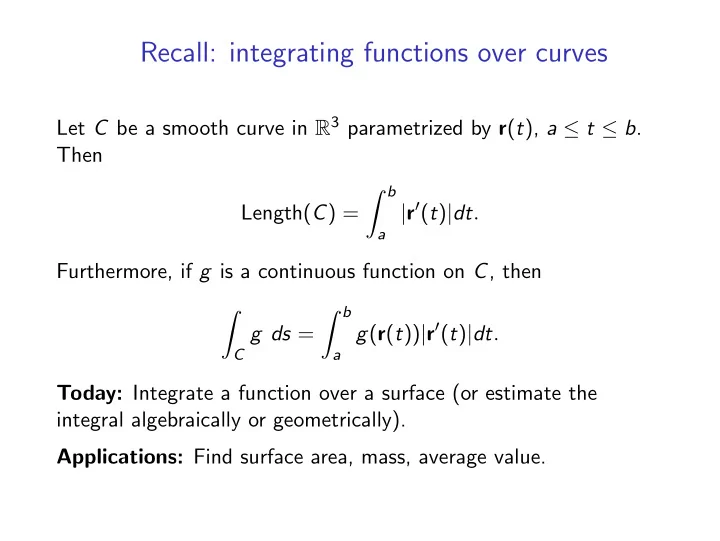
Recall: integrating functions over curves
Let C be a smooth curve in R3 parametrized by r(t), a ≤ t ≤ b. Then Length(C) = ∫︂ b
a
|r′(t)|dt. Furthermore, if g is a continuous function on C, then ∫︂
C
g ds = ∫︂ b
a
g(r(t))|r′(t)|dt. Today: Integrate a function over a surface (or estimate the integral algebraically or geometrically). Applications: Find surface area, mass, average value.
SLIDE 2
Practice with surface area
Find the surface area of S = {x2 + y2 + z2 = 1}. Step 1: Parametrize S r(φ, θ) = ⟨sin φ cos θ, sin φ sin θ, cos φ⟩, 0 ≤ φ ≤ π; 0 ≤ θ ≤ 2π. Step 2: Calculate |rφ × rθ|. rφ(φ, θ) = ⟨cos φ cos θ, cos φ sin θ, − sin φ⟩; rθ(φ, θ) = ⟨− sin φ sin θ, sin φ cos θ, 0⟩.
SLIDE 3
So rφ × rθ = ⃒ ⃒ ⃒ ⃒ ⃒ ⃒ i j k cos φ cos θ cos φ sin θ − sin φ − sin φ sin θ sin φ cos θ ⃒ ⃒ ⃒ ⃒ ⃒ ⃒ = i(sin2 φ cos θ) − j(− sin2 φ sin θ) + k(sin φ cos φ cos2 θ + sin φ cos φ sin2 θ) = ⟨sin2 φ cos θ, sin2 φ sin θ, sin φ cos φ⟩. Therefore |rφ × rθ| = √︂ sin4 φ(cos2 θ + sin2 θ) + sin2 φ cos2 φ = √︂ sin2 φ(sin2 φ + cos2 φ) = √︂ sin2 φ = sin φ (since sin φ ≥ 0 on D).
SLIDE 4
So the surface area of the sphere is ∫︂∫︂
D
|rφ × rθ|dA = ∫︂ 2π ∫︂ π sin φdφdθ = 2π [− cos φ]π = 4π.
SLIDE 5
Practice with surface area
Consider a can with sides given by the cylinder {x2 + y2 = 1, −1 ≤ z ≤ 1}, parametrized by r(θ, z) = ⟨cos θ, sin θ, z⟩, 0 ≤ θ ≤ 2π, −1 ≤ z ≤ 1. Find the surface area of the can. (Don’t forget the top and bottom!) (a) 2π (b) 4π (c) 6π (d) 8π (e) I don’t know how.
SLIDE 6
Solution
First let’s calculate the area of the cylinder, and then we’ll add the top and bottom.We use the parametrization given above, r(θ, z) = ⟨cos θ, sin θ, z⟩, 0 ≤ θ ≤ 2π, −1 ≤ z ≤ 1. Step 2: Find |rθ × rz|. rθ(θ, z) = ⟨− sin θ, cos θ, 0⟩; rz(θ, z) = ⟨0, 0, 1⟩. So rθ × rz = ⃒ ⃒ ⃒ ⃒ ⃒ ⃒ i j k − sin θ cos θ 1 ⃒ ⃒ ⃒ ⃒ ⃒ ⃒ = i cos θ + j sin θ, and |rθ × rz| = 1.
SLIDE 7
So the surface area of the cylinder is ∫︂ 2π ∫︂ 1
−1
dzdθ = 4π. The top and the bottom of the can are each circles of radius one and hence have (surface) area π, so the total area is 4π + π + π = 6π.