Recall from CIS240 CIS 371 (Martin): Instruction Set Architectures - - PowerPoint PPT Presentation

recall from cis240
SMART_READER_LITE
LIVE PREVIEW

Recall from CIS240 CIS 371 (Martin): Instruction Set Architectures - - PowerPoint PPT Presentation

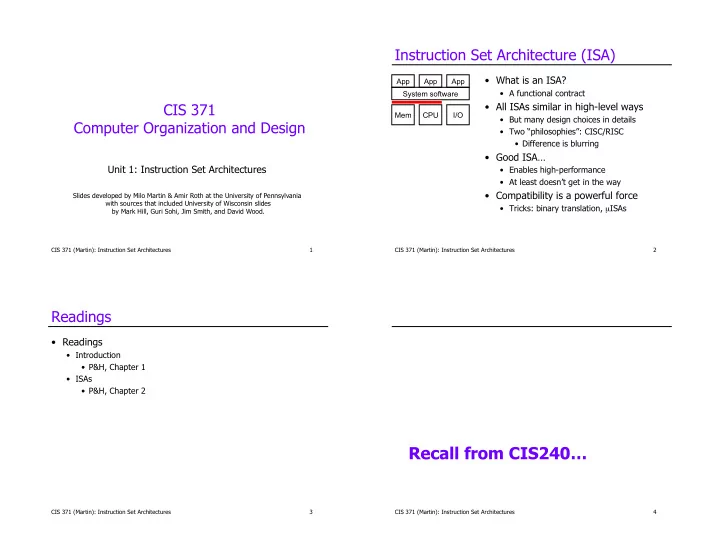
Instruction Set Architecture (ISA) What is an ISA? App App App A functional contract System software CIS 371 All ISAs similar in high-level ways Mem CPU I/O But many design choices in details Computer Organization and Design


slide-1
SLIDE 1

CIS 371 (Martin): Instruction Set Architectures 1

CIS 371 Computer Organization and Design

Unit 1: Instruction Set Architectures

Slides developed by Milo Martin & Amir Roth at the University of Pennsylvania with sources that included University of Wisconsin slides by Mark Hill, Guri Sohi, Jim Smith, and David Wood.

CIS 371 (Martin): Instruction Set Architectures 2

Instruction Set Architecture (ISA)

  • What is an ISA?
  • A functional contract
  • All ISAs similar in high-level ways
  • But many design choices in details
  • Two “philosophies”: CISC/RISC
  • Difference is blurring
  • Good ISA…
  • Enables high-performance
  • At least doesn’t get in the way
  • Compatibility is a powerful force
  • Tricks: binary translation, µISAs

CPU Mem I/O System software App App App

CIS 371 (Martin): Instruction Set Architectures 3

Readings

  • Readings
  • Introduction
  • P&H, Chapter 1
  • ISAs
  • P&H, Chapter 2

Recall from CIS240…

CIS 371 (Martin): Instruction Set Architectures 4

slide-2
SLIDE 2

240 Review: Applications

  • Applications (Firefox, iTunes, Skype, Word, Google)
  • Run on hardware … but how?

CIS 371 (Martin): Instruction Set Architectures 5

240 Review: I/O

  • Apps interact with us & each other via I/O (input/output)
  • With us: display, sound, keyboard, mouse, touch-screen, camera
  • With each other: disk, network (wired or wireless)
  • Most I/O proper is analog-digital and domain of EE
  • I/O devices present rest of computer a digital interface (1s and 0s)

CIS 371 (Martin): Instruction Set Architectures 6

240 Review: OS

  • I/O (& other services) provided by OS (operating system)
  • A super-app with privileged access to all hardware
  • Abstracts away a lot of the nastiness of hardware
  • Virtualizes hardware to isolate programs from one another
  • Each application is oblivious to presence of others
  • Simplifies programming, makes system more robust and secure
  • Privilege is key to this
  • Commons OSes are Windows, Linux, MACOS

CIS 371 (Martin): Instruction Set Architectures 7

240 Review: ISA

  • App/OS are software … execute on hardware
  • HW/SW interface is ISA (instruction set architecture)
  • A “contract” between SW and HW
  • Encourages compatibility, allows SW/HW to evolve independently
  • Functional definition of HW storage locations & operations
  • Storage locations: registers, memory
  • Operations: add, multiply, branch, load, store, etc.
  • Precise description of how to invoke & access them
  • Instructions (bit-patterns hardware interprets as commands)

CIS 371 (Martin): Instruction Set Architectures 8

slide-3
SLIDE 3

240 Review: LC4 ISA

  • LC4: a toy ISA you know
  • 16-bit ISA (what does this mean?)
  • 16-bit insns
  • 8 registers (integer)
  • ~30 different insns
  • Simple OS support
  • Assembly language
  • Human-readable ISA representation

CIS 371 (Martin): Instruction Set Architectures 9

371 Preview: A Real ISA

  • MIPS: example of real ISA
  • 32/64-bit operations
  • 32-bit insns
  • 64 registers
  • 32 integer, 32 floating point
  • ~100 different insns
  • Full OS support

CIS 371 (Martin): Instruction Set Architectures 10

Example code is MIPS, but all ISAs are similar at some level

240 Review: Program Compilation

  • Program written in a “high-level” programming language
  • C, C++, Java, C#
  • Hierarchical, structured control: loops, functions, conditionals
  • Hierarchical, structured data: scalars, arrays, pointers, structures
  • Compiler: translates program to assembly
  • Parsing and straight-forward translation
  • Compiler also optimizes
  • Compiler itself another application … who compiled compiler?

CIS 371 (Martin): Instruction Set Architectures 11

int array[100], sum;! void array_sum() {! for (int i=0; i<100;i++) {! sum += array[i];! }! }!

240 Review: Assembly Language

  • Assembly language
  • Human-readable representation
  • Machine language
  • Machine-readable representation
  • 1s and 0s (often displayed in “hex”)
  • Assembler
  • Translates assembly to machine

CIS 371 (Martin): Instruction Set Architectures 12

slide-4
SLIDE 4

240 Review: Insn Execution Model

  • The computer is just finite state machine
  • Registers (few of them, but fast)
  • Memory (lots of memory, but slower)
  • Program counter (next insn to execute)
  • Sometimes called “instruction pointer”
  • A computer executes instructions
  • Fetches next instruction from memory
  • Decodes it (figure out what it does)
  • Reads its inputs (registers & memory)
  • Executes it (adds, multiply, etc.)
  • Write its outputs (registers & memory)
  • Next insn (adjust the program counter)
  • Program is just “data in memory”
  • Makes computers programmable (“universal”)

CIS 371 (Martin): Instruction Set Architectures 13 CIS 371 (Martin): Instruction Set Architectures 14

The Sequential Model

  • Basic structure of all modern ISAs
  • Often called VonNeuman, but in ENIAC before
  • Program order: total order on dynamic insns
  • Order and named storage define computation
  • Convenient feature: program counter (PC)
  • Insn itself stored in memory at location pointed to by PC
  • Next PC is next insn unless insn says otherwise
  • Processor logically executes loop at left
  • Atomic: insn finishes before next insn starts
  • Implementations can break this constraint physically
  • But must maintain illusion to preserve correctness

What is an ISA?

CIS 371 (Martin): Instruction Set Architectures 15 CIS 371 (Martin): Instruction Set Architectures 16

What Is An ISA?

  • ISA (instruction set architecture)
  • A well-defined hardware/software interface
  • The “contract” between software and hardware
  • Functional definition of storage locations & operations
  • Storage locations: registers, memory
  • Operations: add, multiply, branch, load, store, etc
  • Precise description of how to invoke & access them
  • Not in the “contract”: non-functional aspects
  • How operations are implemented
  • Which operations are fast and which are slow and when
  • Which operations take more power and which take less
  • Instructions
  • Bit-patterns hardware interprets as commands
  • Instruction → Insn (instruction is too long to write in slides)
slide-5
SLIDE 5

CIS 371 (Martin): Instruction Set Architectures 17

A Language Analogy for ISAs

  • Communication
  • Person-to-person → software-to-hardware
  • Similar structure
  • Narrative → program
  • Sentence → insn
  • Verb → operation (add, multiply, load, branch)
  • Noun → data item (immediate, register value, memory value)
  • Adjective → addressing mode
  • Many different languages, many different ISAs
  • Similar basic structure, details differ (sometimes greatly)
  • Key differences between languages and ISAs
  • Languages evolve organically, many ambiguities, inconsistencies
  • ISAs are explicitly engineered and extended, unambiguous

CIS 371 (Martin): Instruction Set Architectures 18

LC4 vs Real ISAs

  • LC4 has the basic features of a real-world ISAs

± LC4 lacks a good bit of realism

  • Address size is only 16 bits
  • Only one data type (16-bit signed integer)
  • Little support for system software, none for multiprocessing (later)
  • Many real-world ISAs to choose from:
  • Intel x86
  • MIPS (used throughout in book)
  • ARM
  • PowerPC
  • SPARC
  • Intel’s Itanium
  • Historical: IBM 370, VAX, Alpha, PA-RISC, 68k, …

ISA Design Goals

CIS 371 (Martin): Instruction Set Architectures 19 CIS 371 (Martin): Instruction Set Architectures 20

What Makes a Good ISA?

  • Programmability
  • Easy to express programs efficiently?
  • Performance/Implementability
  • Easy to design high-performance implementations?
  • More recently
  • Easy to design low-power implementations?
  • Easy to design low-cost implementations?
  • Compatibility
  • Easy to maintain as languages, programs, and technology evolve?
  • x86 (IA32) generations: 8086, 286, 386, 486, Pentium, PentiumII,

PentiumIII, Pentium4, Core2, Core i7, …

slide-6
SLIDE 6

CIS 371 (Martin): Instruction Set Architectures 21

Programmability

  • Easy to express programs efficiently?
  • For whom?
  • Before 1985: human
  • Compilers were terrible, most code was hand-assembled
  • Want high-level coarse-grain instructions
  • As similar to high-level language as possible
  • After 1985: compiler
  • Optimizing compilers generate much better code that you or I
  • Want low-level fine-grain instructions
  • Compiler can’t tell if two high-level idioms match exactly or not
  • More on this later in this set of slides…

Performance, Performance, Performance

  • How long does it take for a program to execute?
  • Three factors
  • 1. How many insn must execute to complete program?
  • Instructions per program during execution
  • “Dynamic insn count” (not number of “static” insns in program)
  • 2. How quickly does the processor “cycle”?
  • Clock frequency (cycles per second) 1 gigahertz (Ghz)
  • or expressed as reciprocal, Clock period nanosecond (ns)
  • Worst-case delay through circuit for a particular design
  • 3. How many cycles does each instruction take to execute?
  • Cycles per Instruction (CPI) or reciprocal, Insn per Cycle (IPC)

CIS 371 (Martin): Instruction Set Architectures 22

Maximizing Performance

  • Instructions per program:
  • Determined by program, compiler, instruction set architecture (ISA)
  • Cycles per instruction: “CPI”
  • Typical range today: 2 to 0.5
  • Determined by program, compiler, ISA, micro-architecture
  • Seconds per cycle: “clock period”
  • Typical range today: 2ns to 0.25ns
  • Reciprocal is frequency: 0.5 Ghz to 4 Ghz (1 Htz = 1 cycle per sec)
  • Determined by micro-architecture, technology parameters
  • For minimum execution time, minimize each term
  • Difficult: often pull against one another

CIS 371 (Martin): Instruction Set Architectures 23 CIS 371 (Martin): Instruction Set Architectures 24

Example: Instruction Granularity

  • CISC (Complex Instruction Set Computing) ISAs
  • Big heavyweight instructions (lots of work per instruction)

+ Low “insns/program” – Higher “cycles/insn” and “seconds/cycle”

  • We have the technology to get around this problem
  • RISC (Reduced Instruction Set Computer) ISAs
  • Minimalist approach to an ISA: simple insns only

+ Low “cycles/insn” and “seconds/cycle” – Higher “insn/program”, but hopefully not as much

  • Rely on compiler optimizations
slide-7
SLIDE 7

CIS 371 (Martin): Instruction Set Architectures 25

Compiler Optimizations

  • Primarily goal: reduce instruction count
  • Eliminate redundant computation, keep more things in registers

+ Registers are faster, fewer loads/stores – An ISA can make this difficult by having too few registers

  • But also…
  • Reduce branches and jumps (later)
  • Reduce cache misses (later)
  • Reduce dependences between nearby insns (later)

– An ISA can make this difficult by having implicit dependences

  • How effective are these?

+ Can give 4X performance over unoptimized code – Collective wisdom of 40 years (“Proebsting’s Law”): 4% per year

  • Funny but … shouldn’t leave 4X performance on the table

Compiler Optimization Example (LC4)

  • Left: common sub-expression elimination
  • Remove calculations whose results are already in some register
  • Right: register allocation
  • Keep temporary in register across statements, avoid stack spill/fill

CIS 371 (Martin): Instruction Set Architectures 26

ISA Code Example

CIS 371 (Martin): Instruction Set Architectures 27

Array Sum Loop: LC4

CIS 371 (Martin): Instruction Set Architectures 28

.DATA! array .BLKW #100! sum .FILL #0! .CODE! .FALIGN! array_sum! CONST R5, #0! LEA R1, array! LEA R2, sum! L1! LDR R3, R1, #0! LDR R4, R2, #0! ADD R4, R3, R4! STR R4, R2, #0! ADD R1, R1, #1! ADD R5, R5, #1! CMPI R5, #100! BRn L1! int array[100];! int sum;! void array_sum() {! for (int i=0; i<100;i++) {! sum += array[i];! }! }!

slide-8
SLIDE 8

Array Sum Loop: LC4  MIPS

CIS 371 (Martin): Instruction Set Architectures 29

.DATA! array .BLKW #100! sum .FILL #0! .CODE! .FALIGN! array_sum! CONST R5, #0! LEA R1, array! LEA R2, sum! L1! LDR R3, R1, #0! LDR R4, R2, #0! ADD R4, R3, R4! STR R4, R2, #0! ADD R1, R1, #1! ADD R5, R5, #1! CMPI R5, #100! BRn L1! .data! array: .space 100! sum: .word 0! .text! array_sum:! li $5, 0! la $1, array! la $2, sum! L1:! lw $3, 0($1)! lw $4, 0($2)! add $4, $3, $4! sw $4, 0($2)! addi $1, $1, 1! addi $5, $5, 1! li $6, 100! blt $5, $6, L1!

Array Sum Loop: LC4  x86

CIS 371 (Martin): Instruction Set Architectures 30

.DATA! array .BLKW #100! sum .FILL #0! .CODE! .FALIGN! array_sum! CONST R5, #0! LEA R1, array! LEA R2, sum! L1! LDR R3, R1, #0! LDR R4, R2, #0! ADD R4, R3, R4! STR R4, R2, #0! ADD R1, R1, #1! ADD R5, R5, #1! CMPI R5, #100! BRn L1! .LFE2! .comm array,400,32! .comm sum,4,4! .globl array_sum! array_sum:! movl $0, -4(%rbp)! .L1:! movl -4(%rbp), %eax! movl array(,%eax,4), %edx! movl sum(%rip), %eax ! addl %edx, %eax! movl %eax, sum(%rip)! addl $1, -4(%rbp)! cmpl $99,-4(%rbp)! jle .L1!

x86 Operand Model

  • x86 uses explicit accumulators
  • Both register and memory
  • Distinguished by addressing mode

CIS 371 (Martin): Instruction Set Architectures 31

Array Sum Loop: x86  Optimized x86

32

.LFE2! .comm array,400,32! .comm sum,4,4! .globl array_sum! array_sum:! movl $0, -4(%rbp)! .L1:! movl -4(%rbp), %eax! movl array(,%eax,4), %edx! movl sum(%rip), %eax ! addl %edx, %eax! movl %eax, sum(%rip)! addl $1, -4(%rbp)! cmpl $99,-4(%rbp)! jle .L1!

CIS 371 (Martin): Instruction Set Architectures

slide-9
SLIDE 9

Aspects of ISAs

CIS 371 (Martin): Instruction Set Architectures 33 CIS 371 (Martin): Instruction Set Architectures 34

Length and Format

  • Length
  • Fixed length
  • Most common is 32 bits

+ Simple implementation (next PC often just PC+4) – Code density: 32 bits to increment a register by 1

  • Variable length

+ Code density

  • x86 can do increment in one 8-bit instruction

– Complex fetch (where does next instruction begin?)

  • Compromise: two lengths
  • E.g., MIPS16 or ARM’s Thumb
  • Encoding
  • A few simple encodings simplify decoder
  • x86 decoder one nasty piece of logic

Fetch[PC] Decode Read Inputs Execute Write Output Next PC

CIS 371 (Martin): Instruction Set Architectures 35

LC4/MIPS/x86 Length and Encoding

  • LC4: 2-byte insns, 3 formats
  • MIPS: 4-byte insns, 3 formats
  • x86: 1–16 byte insns, many formats

CIS 371 (Martin): Instruction Set Architectures 36

Operations and Datatypes

  • Datatypes
  • Software: attribute of data
  • Hardware: attribute of operation, data is just 0/1’s
  • All processors support
  • Integer arithmetic/logic (8/16/32/64-bit)
  • IEEE754 floating-point arithmetic (32/64-bit)
  • More recently, most processors support
  • “Packed-integer” insns, e.g., MMX
  • “Packed-floating point” insns, e.g., SSE/SSE2
  • For multimedia, more about these later
  • Other, infrequently supported, data types
  • Decimal, other fixed-point arithmetic

Fetch Decode Read Inputs Execute Write Output Next Insn

slide-10
SLIDE 10

CIS 371 (Martin): Instruction Set Architectures 37

LC4/MIPS/x86 Operations and Datatypes

  • LC4
  • 16-bit integer: add, and, not, sub, mul, div, or, xor, shifts
  • No floating-point
  • MIPS
  • 32(64) bit integer: add, sub, mul, div, shift, rotate, and, or, not, xor
  • 32(64) bit floating-point: add, sub, mul, div
  • x86
  • 32(64) bit integer: add, sub, mul, div, shift, rotate, and, or, not, xor
  • 80-bit floating-point: add, sub, mul, div, sqrt
  • 64-bit packed integer (MMX): padd, pmul…
  • 64(128)-bit packed floating-point (SSE/2): padd, pmul…

CIS 371 (Martin): Instruction Set Architectures 38

Where Does Data Live?

  • Registers
  • Named directly in instructions
  • “short term memory”
  • Faster than memory, quite handy
  • Memory
  • Fundamental storage space
  • “longer term memory”
  • Immediates
  • Values spelled out as bits in instructions
  • Input only

Fetch Decode Read Inputs Execute Write Output Next Insn

CIS 371 (Martin): Instruction Set Architectures 39

How Many Registers?

  • Registers faster than memory, have as many as possible?
  • No
  • One reason registers are faster: there are fewer of them
  • Small is fast (hardware truism)
  • Another: they are directly addressed (no address calc)

– More registers, means more bits per register in instruction – Thus, fewer registers per instruction or larger instructions

  • Not everything can be put in registers
  • Structures, arrays, anything pointed-to
  • Although compilers are getting better at putting more things in

– More registers means more saving/restoring

  • Across function calls, traps, and context switches
  • Trend: more registers: 8 (x86) → 32 (MIPS) → 128 (IA64)
  • 64-bit x86 has 16 64-bit integer and 16 128-bit FP registers

CIS 371 (Martin): Instruction Set Architectures 40

LC4/MIPS/x86 Registers

  • LC4
  • 8 16-bit integer registers
  • No floating-point registers
  • MIPS
  • 32 32-bit integer registers ($0 hardwired to 0)
  • 32 32-bit floating-point registers (or 16 64-bit registers)
  • x86
  • 8 8/16/32-bit integer registers (not general purpose)
  • No floating-point registers!
  • 64-bit x86
  • 16 64-bit integer registers
  • 16 128-bit floating-point registers
slide-11
SLIDE 11

CIS 371 (Martin): Instruction Set Architectures 41

How Much Memory? Address Size

  • What does “64-bit” in a 64-bit ISA mean?
  • Each program can address (i.e., use) 264 bytes
  • 64 is the virtual address (VA) size
  • Alternative (wrong) definition: width of arithmetic operations
  • Most critical, inescapable ISA design decision
  • Too small? Will limit the lifetime of ISA
  • May require nasty hacks to overcome (E.g., x86 segments)
  • x86 evolution:
  • 4-bit (4004), 8-bit (8008), 16-bit (8086), 24-bit (80286),
  • 32-bit + protected memory (80386)
  • 64-bit (AMD’s Opteron & Intel’s Pentium4)
  • All ISAs moving to 64 bits (if not already there)

CIS 371 (Martin): Instruction Set Architectures 42

LC4/MIPS/x86 Memory Size

  • LC4
  • 16-bit (216 16-bit words) x 2 (split data and instruction memory)
  • MIPS
  • 32-bit
  • 64-bit
  • x86
  • 8086: 16-bit
  • 80286: 24-bit
  • 80386: 32-bit
  • AMD Opteron/Athlon64, Intel’s newer Pentium4, Core 2: 64-bit

CIS 371 (Martin): Instruction Set Architectures 43

How Are Memory Locations Specified?

  • Registers are specified directly
  • Register names are short, can be encoded in instructions
  • Some instructions implicitly read/write certain registers
  • How are addresses specified?
  • Addresses are as big or bigger than insns
  • Addressing mode: how are insn bits converted to addresses?
  • Think about: what high-level idiom addressing mode captures

CIS 371 (Martin): Instruction Set Architectures 44

Memory Addressing

  • Addressing mode: way of specifying address
  • Used in memory-memory or load/store instructions in register ISA
  • Examples
  • Displacement: R1=mem[R2+immed]
  • Index-base: R1=mem[R2+R3]
  • Memory-indirect: R1=mem[mem[R2]]
  • Auto-increment: R1=mem[R2], R2= R2+1
  • Auto-indexing: R1=mem[R2+immed], R2=R2+immed
  • Scaled: R1=mem[R2+R3*immed1+immed2]
  • PC-relative: R1=mem[PC+imm]
  • What high-level program idioms are these used for?
  • What implementation impact? What impact on insn count?
slide-12
SLIDE 12

CIS 371 (Martin): Instruction Set Architectures 45

LC4/MIPS/x86 Addressing Modes

  • LC4
  • Displacement: R1+offset (6-bit)
  • MIPS
  • Displacement: R1+offset (16-bit)
  • Experiments showed this covered 80% of accesses on VAX
  • x86 (MOV instructions)
  • Absolute: zero + offset (8/16/32-bit)
  • Displacement: R1+offset (8/16/32-bit)
  • Indexed: R1+R2
  • Scaled: R1 + (R2*Scale) + offset (8/16/32-bit) Scale = 1, 2, 4, 8
  • PC-relative: PC + offset (32-bit)

x86 Addressing Modes

CIS 371 (Martin): Instruction Set Architectures 46 CIS 371 (Martin): Instruction Set Architectures 47

Two More Addressing Issues

  • Access alignment: address % size == 0?
  • Aligned: load-word @XXXX00, load-half @XXXXX0
  • Unaligned: load-word @XXXX10, load-half @XXXXX1
  • Question: what to do with unaligned accesses (uncommon case)?
  • Support in hardware? Makes all accesses slow
  • Trap to software routine? Possibility
  • Use regular instructions
  • Load, shift, load, shift, and
  • MIPS? ISA support: unaligned access using two instructions

lwl @XXXX10; lwr @XXXX10

  • Endian-ness: arrangement of bytes in a word
  • Big-endian: sensible order (e.g., MIPS, PowerPC)
  • A 4-byte integer: “00000000 00000000 00000010 00000011” is 515
  • Little-endian: reverse order (e.g., x86)
  • A 4-byte integer: “00000011 00000010 00000000 00000000 ” is 515
  • Why little endian? To be different? To be annoying? Nobody knows

CIS 371 (Martin): Instruction Set Architectures 48

How Many Explicit Register Operands

  • Operand model: how many explicit operands
  • 3: general-purpose

add R1,R2,R3 means: R1 = R2 + R3 (MIPS uses this)

  • 2: multiple explicit accumulators (output doubles as input)

add R1,R2 means: R1 = R1 + R2 (x86 uses this)

  • 1: one implicit accumulator

add R1 means: ACC = ACC + [R1]

  • 4+: useful only in special situations
  • Fused multiply & accumulate instruction
  • Why have fewer?
  • Primarily code density (size of each instruction in program binary)
slide-13
SLIDE 13

CIS 371 (Martin): Instruction Set Architectures 49

Operand Model: Register or Memory?

  • “Load/store” architectures
  • Memory access instructions (loads and stores) are distinct
  • Separate addition, subtraction, divide, etc. operations
  • Examples: MIPS, ARM, SPARC, PowerPC
  • Alternative: mixed operand model (x86, VAX)
  • Operand can be from register or memory
  • x86 example: addl 100, 4(%eax)
  • 1. Loads from memory location [4 + %eax]
  • 2. Adds “100” to that value
  • 3. Stores to memory location [4 + %eax]
  • Would requires three instructions in MIPS, for example.

CIS 371 (Martin): Instruction Set Architectures 50

LC4/MIPS/x86 Operand Models

  • LC4
  • Integer: 8 general-purpose registers, load-store
  • Floating-point: none
  • MIPS
  • Integer/floating-point: 32 general-purpose registers, load-store
  • x86
  • Integer (8 registers) reg-reg, reg-mem, mem-reg, but no mem-mem
  • Floating point: stack (why x86 floating-point lagged for years)
  • SSE introduced 16 general purpose floating-point registers
  • Note: integer push, pop for managing software stack
  • Note: also reg-mem and mem-mem string functions in hardware
  • x86-64
  • Integer/floating-point: 16 registers

x86 Operand Model: Accumulators

  • x86 uses explicit accumulators
  • Both register and memory
  • Distinguished by addressing mode

CIS 371 (Martin): Instruction Set Architectures 51 CIS 371 (Martin): Instruction Set Architectures 52

Operand Model & Compiler Optimizations

  • How do operand model & addressing mode affect compiler?
  • Again, what does a compiler try to do?
  • Reduce insn count, reduce load/store count (important), schedule
  • What features enable or limit these?

+ (Many) general-purpose registers let you reduce stack accesses − Implicit operands clobber values

  • addl %edx, %eax destroys initial value in %eax!
  • Requires additional insns to preserve if needed

− Implicit operands also restrict scheduling

  • Classic example, condition codes (flags)
  • Result: you want a general-purpose register load-store ISA (MIPS)
slide-14
SLIDE 14

CIS 371 (Martin): Instruction Set Architectures 53

Control Transfers

  • Default next-PC is PC + sizeof(current insn)
  • Branches and jumps can change that
  • Otherwise dynamic program == static program
  • Computing targets: where to jump to
  • For all branches and jumps
  • PC-relative: for branches and jumps with function
  • Absolute: for function calls
  • Register indirect: for returns, switches & dynamic calls
  • Testing conditions: whether to jump at all
  • For (conditional) branches only

Fetch Decode Read Inputs Execute Write Output Next Insn

CIS 371 (Martin): Instruction Set Architectures 54

Control Transfers I: Computing Targets

  • The issues
  • How far (statically) do you need to jump?
  • Not far within procedure, further from one procedure to another
  • Do you need to jump to a different place each time?
  • PC-relative
  • Position-independent within procedure
  • Used for branches and jumps within a procedure
  • Absolute
  • Position independent outside procedure
  • Used for procedure calls
  • Indirect (target found in register)
  • Needed for jumping to dynamic targets
  • Used for returns, dynamic procedure calls, switch statements

CIS 371 (Martin): Instruction Set Architectures 55

Control Transfers II: Testing Conditions

  • Compare and branch insns

branch-less-than R1,10,target + Fewer instructions – Two ALUs: one for condition, one for target address – Less room for target in insn – Extra latency

  • Implicit condition codes or “flags” (x86, LC4)

cmp R1,10 // sets “negative” flag branch-neg target + More room for target in insn, condition codes often set “for free” + Branch insn simple and fast – Implicit dependence is tricky

  • Condition registers, separate branch insns (MIPS)

set-less-than R2,R1,10 branch-not-equal-zero R2,target ± A compromise

CIS 371 (Martin): Instruction Set Architectures 56

LC4, MIPS, x86 Control Transfers

  • LC4
  • 9-bit offset PC-relative branches (condition codes)
  • 11-bit offset PC-relative jumps
  • 11-bit absolute 16-byte aligned calls
  • MIPS
  • 16-bit offset PC-relative conditional branches
  • Uses register for condition
  • Compare 2 regs: beq, bne or reg to 0: bgtz, bgez, bltz, blez

+ Don’t need adder for these, cover 80% of cases

  • Explicit condition registers: slt, sltu, slti, sltiu, etc.
  • 26-bit target absolute jumps and calls
  • x86
  • 8-bit offset PC-relative branches
  • Uses condition codes
  • Explicit compare instructions (and others) to set condition codes
slide-15
SLIDE 15

ISAs Also Include Support For…

  • Function calling conventions
  • Which registers are saved across calls, how parameters are passed
  • Operating systems & memory protection
  • Privileged mode
  • System call (TRAP)
  • Exceptions & interrupts
  • Interacting with I/O devices
  • Multiprocessor support
  • “Atomic” operations for synchronization
  • Data-level parallelism
  • Pack many values into a wide register
  • Intel’s SSE2: four 32-bit float-point values into 128-bit register
  • Define parallel operations (four “adds” in one cycle)

CIS 371 (Martin): Instruction Set Architectures 57

The RISC vs. CISC Debate

CIS 371 (Martin): Instruction Set Architectures 58 CIS 371 (Martin): Instruction Set Architectures 59

RISC and CISC

  • RISC: reduced-instruction set computer
  • Coined by Patterson in early 80’s
  • RISC-I (Patterson), MIPS (Hennessy), IBM 801 (Cocke)
  • Examples: PowerPC, ARM, SPARC, Alpha, PA-RISC
  • CISC: complex-instruction set computer
  • Term didn’t exist before “RISC”
  • Examples: x86, VAX, Motorola 68000, etc.
  • Philosophical war (one of several) started in mid 1980’s
  • RISC “won” the technology battles
  • CISC won the high-end commercial war (1990s to today)
  • Compatibility a stronger force than anyone (but Intel) thought
  • RISC won the embedded computing war

CIS 371 (Martin): Instruction Set Architectures 60

The Context

  • Pre 1980
  • Bad compilers (so assembly written by hand)
  • Complex, high-level ISAs (easier to write assembly)
  • Slow multi-chip micro-programmed implementations
  • Vicious feedback loop
  • Around 1982
  • Moore’s Law makes single-chip microprocessor possible…
  • …but only for small, simple ISAs
  • Performance advantage of this “integration” was compelling
  • Compilers had to get involved in a big way
  • RISC manifesto: create ISAs that…
  • Simplify single-chip implementation
  • Facilitate optimizing compilation
slide-16
SLIDE 16

CIS 371 (Martin): Instruction Set Architectures 61

Role of Compilers

  • Who is generating assembly code?
  • Humans like high-level “CISC” ISAs (close to prog. langs)

+ Can “concretize” (“drill down”): move down a layer + Can “abstract” (“see patterns”): move up a layer – Can deal with few things at a time → like things at a high level

  • Computers (compilers) like low-level “RISC” ISAs

+ Can deal with many things at a time → can do things at any level + Can “concretize”: 1-to-many lookup functions (databases) – Difficulties with abstraction: many-to-1 lookup functions (AI)

  • Translation should move strictly “down” levels
  • Stranger than fiction
  • People once thought computers would execute prog. lang. directly

CIS 371 (Martin): Instruction Set Architectures 62

Early 1980s: The Tipping Point

  • Moore’s Law makes single-chip microprocessor possible…
  • …but only for small, simple ISAs
  • Performance advantage of “integration” was compelling
  • RISC manifesto: create ISAs that…
  • Simplify implementation
  • Facilitate optimizing compilation
  • Some guiding principles (“tenets”)
  • Single cycle execution/hard-wired control
  • Fixed instruction length, format
  • Lots of registers, load-store architecture
  • No equivalent “CISC manifesto”

CIS 371 (Martin): Instruction Set Architectures 63

The RISC Design Tenets

  • Single-cycle execution
  • CISC: many multicycle operations
  • Hardwired (simple) control
  • CISC: “microcode” for multi-cycle operations
  • Load/store architecture
  • CISC: register-memory and memory-memory
  • Few memory addressing modes
  • CISC: many modes
  • Fixed-length instruction format
  • CISC: many formats and lengths
  • Reliance on compiler optimizations
  • CISC: hand assemble to get good performance
  • Many registers (compilers are better at using them)
  • CISC: few registers

CIS 371 (Martin): Instruction Set Architectures 64

CISCs and RISCs

  • The CISCs: x86, VAX (Virtual Address eXtension to PDP-11)
  • Variable length instructions: 1-321 bytes!!!
  • 14 registers + PC + stack-pointer + condition codes
  • Data sizes: 8, 16, 32, 64, 128 bit, decimal, string
  • Memory-memory instructions for all data sizes
  • Special insns: crc, insque, polyf, and a cast of hundreds
  • x86: “Difficult to explain and impossible to love”
  • The RISCs: MIPS, PA-RISC, SPARC, PowerPC, Alpha, ARM
  • 32-bit instructions
  • 32 integer registers, 32 floating point registers, load-store
  • 64-bit virtual address space
  • Few addressing modes
  • Why so many basically similar ISAs? Everyone wanted their own
slide-17
SLIDE 17

CIS 371 (Martin): Instruction Set Architectures 65

The Debate

  • RISC argument
  • CISC is fundamentally handicapped
  • For a given technology, RISC implementation will be better (faster)
  • Current technology enables single-chip RISC
  • When it enables single-chip CISC, RISC will be pipelined
  • When it enables pipelined CISC, RISC will have caches
  • When it enables CISC with caches, RISC will have next thing...
  • CISC rebuttal
  • CISC flaws not fundamental, can be fixed with more transistors
  • Moore’s Law will narrow the RISC/CISC gap (true)
  • Good pipeline: RISC = 100K transistors, CISC = 300K
  • By 1995: 2M+ transistors had evened playing field
  • Software costs dominate, compatibility is paramount

CIS 371 (Martin): Instruction Set Architectures 66

Compatibility

  • In many domains, ISA must remain compatible
  • IBM’s 360/370 (the first “ISA family”)
  • Another example: Intel’s x86 and Microsoft Windows
  • x86 one of the worst designed ISAs EVER, but survives
  • Backward compatibility
  • New processors supporting old programs
  • Can’t drop features (caution in adding new ISA features)
  • Or, update software/OS to emulate dropped features (slow)
  • Forward (upward) compatibility
  • Old processors supporting new programs
  • Include a “CPU ID” so the software can test of features
  • Add ISA hints by overloading no-ops (example: x86’s PAUSE)
  • New firmware/software on old processors to emulate new insn

CIS 371 (Martin): Instruction Set Architectures 67

Intel’s Compatibility Trick: RISC Inside

  • 1993: Intel wanted “out-of-order execution” in Pentium Pro
  • Hard to do with a coarse grain ISA like x86
  • Solution? Translate x86 to RISC micro-ops (µops) in hardware

push $eax becomes (we think, uops are proprietary) store $eax, -4($esp) addi $esp,$esp,-4 + Processor maintains x86 ISA externally for compatibility + But executes RISC µISA internally for implementability

  • Given translator, x86 almost as easy to implement as RISC
  • Intel implemented “out-of-order” before any RISC company
  • “out-of-order” also helps x86 more (because ISA limits compiler)
  • Also used by other x86 implementations (AMD)
  • Different µops for different designs
  • Not part of the ISA specification, not publically disclosed

Potential Micro-op Scheme

  • Most instructions are a single micro-op
  • Add, xor, compare, branch, etc.
  • Loads example: mov -4(%rax), %ebx
  • Stores example: mov %ebx, -4(%rax)
  • Each memory access adds a micro-op
  • “addl -4(%rax), %ebx” is two micro-ops (load, add)
  • “addl %ebx, -4(%rax)” is three micro-ops (load, add, store)
  • Function call (CALL) – 4 uops
  • Get program counter, store program counter to stack,

adjust stack pointer, unconditional jump to function start

  • Return from function (RET) – 3 uops
  • Adjust stack pointer, load return address from stack, jump register
  • Again, just a basic idea, micro-ops are specific to each chip

CIS 371 (Martin): Instruction Set Architectures 68

slide-18
SLIDE 18

CIS 371 (Martin): Instruction Set Architectures 69

Translation and Virtual ISAs

  • New compatibility interface: ISA + translation software
  • Binary-translation: transform static image, run native
  • Emulation: unmodified image, interpret each dynamic insn
  • Typically optimized with just-in-time (JIT) compilation
  • Examples: FX!32 (x86 on Alpha), Rosetta (PowerPC on x86)
  • Performance overheads reasonable (many recent advances)
  • Virtual ISAs: designed for translation, not direct execution
  • Target for high-level compiler (one per language)
  • Source for low-level translator (one per ISA)
  • Goals: Portability (abstract hardware nastiness), flexibility over time
  • Examples: Java Bytecodes, C# CLR (Common Language Runtime)

NVIDIA’s “PTX”

CIS 371 (Martin): Instruction Set Architectures 70

Ultimate Compatibility Trick

  • Support old ISA by…
  • …having a simple processor for that ISA somewhere in the system
  • How first Itanium supported x86 code
  • x86 processor (comparable to Pentium) on chip
  • How PlayStation2 supported PlayStation games
  • Used PlayStation processor for I/O chip & emulation

CIS 371 (Martin): Instruction Set Architectures 71

Current Winner (Revenue): CISC

  • x86 was first 16-bit microprocessor by ~2 years
  • IBM put it into its PCs because there was no competing choice
  • Rest is historical inertia and “financial feedback”
  • x86 is most difficult ISA to implement and do it fast but…
  • Because Intel sells the most non-embedded processors…
  • It has the most money…
  • Which it uses to hire more and better engineers…
  • Which it uses to maintain competitive performance …
  • And given competitive performance, compatibility wins…
  • So Intel sells the most non-embedded processors…
  • AMD as a competitor keeps pressure on x86 performance
  • Moore’s law has helped Intel in a big way
  • Most engineering problems can be solved with more transistors

CIS 371 (Martin): Instruction Set Architectures 72

Current Winner (Volume): RISC

  • ARM (Acorn RISC Machine → Advanced RISC Machine)
  • First ARM chip in mid-1980s (from Acorn Computer Ltd).
  • 3 billion units sold in 2009 (>60% of all 32/64-bit CPUs)
  • Low-power and embedded devices (phones, for example)
  • Significance of embedded? ISA Compatibility less powerful force
  • 32-bit RISC ISA
  • 16 registers, PC is one of them
  • Many addressing modes, e.g., auto increment
  • Condition codes, each instruction can be conditional
  • Multiple implementations
  • X-scale (design was DEC’s, bought by Intel, sold to Marvel)
  • Others: Freescale (was Motorola), Texas Instruments,

STMicroelectronics, Samsung, Sharp, Philips, etc.

slide-19
SLIDE 19

CIS 371 (Martin): Instruction Set Architectures 73

Redux: Are ISAs Important?

  • Does “quality” of ISA actually matter?
  • Not for performance (mostly)
  • Mostly comes as a design complexity issue
  • Insn/program: everything is compiled, compilers are good
  • Cycles/insn and seconds/cycle: µISA, many other tricks
  • What about power efficiency? Maybe
  • ARMs are most power efficient today…
  • …but Intel is moving x86 that way (e.g, Intel’s Atom)
  • Open question: can x86 be as power efficient as ARM?
  • Does “nastiness” of ISA matter?
  • Mostly no, only compiler writers and hardware designers see it
  • Even compatibility is not what it used to be
  • Software emulation
  • Open question: will “ARM compatibility” be the next x86?

CIS 371 (Martin): Instruction Set Architectures 74

Summary

  • What is an ISA?
  • A functional contract
  • All ISAs similar in high-level ways
  • But many design choices in details
  • Two “philosophies”: CISC/RISC
  • Difference is blurring
  • Good ISA…
  • Enables high-performance
  • At least doesn’t get in the way
  • Compatibility is a powerful force
  • Tricks: binary translation, µISAs

CPU Mem I/O System software App App App