MASTER CLASS ON TRACEABILITY, RECALL & WITHDRAWAL Ms Vinod - - PowerPoint PPT Presentation

master class on traceability
SMART_READER_LITE
LIVE PREVIEW

MASTER CLASS ON TRACEABILITY, RECALL & WITHDRAWAL Ms Vinod - - PowerPoint PPT Presentation

MASTER CLASS ON TRACEABILITY, RECALL & WITHDRAWAL Ms Vinod Kotwal Director (Codex), FSSAI 3 rd December 2014 INTRODUCTION Food Recall :- According to FAO, food recall is the action to remove food from the market at any stage of the food


slide-1
SLIDE 1

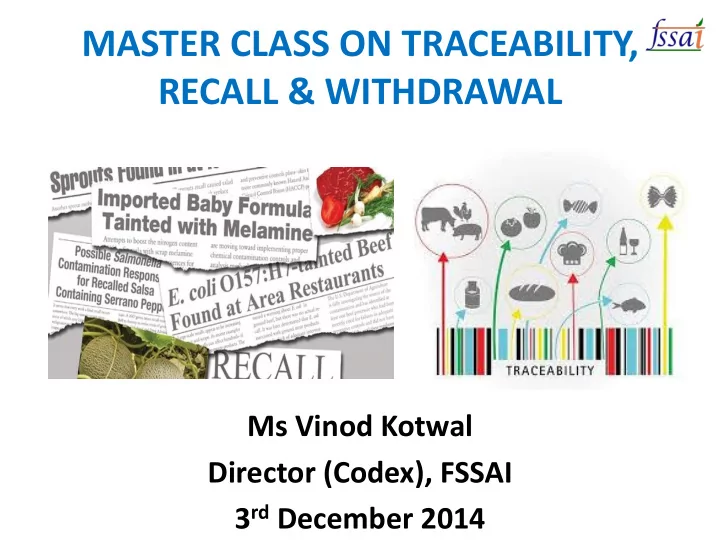
MASTER CLASS ON TRACEABILITY, RECALL & WITHDRAWAL

Ms Vinod Kotwal Director (Codex), FSSAI 3rd December 2014

slide-2
SLIDE 2

INTRODUCTION

  • Food Recall :- According to FAO, food recall is the action to

remove food from the market at any stage of the food chain, including that possesed by consumers.

  • Traceability :- The Codex Alimentarius Commission has

defined traceability as the ability to follow the movement of a food through specific stages of production, processing and distribution.

  • Withdrawal :-The term ‘withdrawal’ can be defined in three

ways: a) The retrieval of a food item that did not reach consumers. b) The retrieval of a food item because of reasons unrelated to safety (e.g. quality). c) The retrieval of a food item by food business operators, in contrast to an action taken by the national authority.

slide-3
SLIDE 3

Why Food Recall?

  • The major objective of a food recall is to protect public health

by ensuring that:  There is rapid removal of unsafe food from all possible stages

  • f the supply chain,

 The concerned consumers and customers are informed, and  The food under recall has been retrieved, destroyed or reprocessed.

slide-4
SLIDE 4

Codex Alimentarius/FAO/WHO guidance on the Subject

  • Codex Principles for traceability/product tracing as a tool

within inspection systemsCXG_060e.pdf

  • Codex Guidelines for exchange of information in food control

emergency situationsCXG_019e.pdf

  • FAO/WHO Guide for application of risk analysis principles and

procedures during food safety emergenciesApplication principles procedures of risk analysis during fo.pdf

  • FAO/WHO Framework for developing national food safety

emergency response plansFAO WHO framework for developing national food safety emerge.pdf

  • FAO/WHO Guide for developing and improving national food

recall systems FAO- FOOD RECALL.pdf

slide-5
SLIDE 5

Questions that we need to ask for putting in place a National Food Recall System

  • 1. Agency responsible
  • Which are the agencies responsible for this?

2.Legislative Framework

  • What is the legislative framework?
  • Does the legislation have a provision for food recall and

traceability?

  • What is the purpose of food recall (safety, confidence in

product, product identity)?-Trigger for initiating the action.

  • What is the role and responsibility of the competent

Authority?

  • Are the roles and responsibilities of the FBO’s laid down and

what are they?

  • Are there existing provisions that may be a barrier to effective

recall system?

slide-6
SLIDE 6

Questions that we need to ask for putting in place a National Food Recall System

  • 3. Do we have a national food recall plan/system in place?
  • 4. What is the system of communication and notification with:
  • Other authorities
  • FBO’s
  • International organizations
  • Consumers

5.What is the coordination mechanism:

  • Between agencies?
  • With FBO’s?

6.What is the enforcement mechanism for overseeing:

  • Effective recalls?
  • Management and disposal of recalled good?
  • 7. Has any recall incident occurred recently?
slide-7
SLIDE 7

National Food Recall System

National food recall systems provide a framework, put in place by national governments, to support competent authorities and food business operators in protecting public health through the effective removal of unsafe food from the market. Essential Elements of a National Food Recall System:

  • Organizations with clearly defined roles and responsibilities

for food control management, and mechanisms for communication and coordination between them-Agency responsible

  • An enabling policy, legal and regulatory framework for food

safety-Legislation

  • Functioning food inspection and certification systems;
  • Capable diagnostic and analytical laboratories; and
  • IEC
slide-8
SLIDE 8

Principles taken into account when developing an effective national food recall system include:

  • 1. the legal framework
  • 2. the powers of the competent authority
  • 3. clearly defined roles and responsibilities
  • 4. effective communication and notification
  • 5. accurate record-keeping
  • 6. guidance materials and training
  • 7. review of the national food recall system.
slide-9
SLIDE 9

FOOD RECALL SYSTEM IN INDIA

  • Section 28 of the FSS Act, 2006 lays down the legislative

framework for Food Recall by a Food Business Operator

  • Under FSS Act, Food Business operator (FBO) means a person

by whom the business is carried on or owned and is responsible for ensuring the compliance of this Act, rules and regulations made thereunder; i.e. he is allowed to market safe food.

slide-10
SLIDE 10

CONTD…

  • As per Section 28 of the FSS Act, the FBO must follow the

FOOD RECALL procedures when a FBO considers or has reasons to believe that a food which he has processed, manufactured or distributed is not in compliance with this Act, or the rules or regulations, made thereunder, he shall immediately initiate procedures to withdraw the food in question from the market and consumers indicating reasons for its withdrawal and inform the competent authorities thereof.

  • A food business operator shall immediately inform the

competent authorities and co-operate with them, if he considers or has reasons to believe that a food which he has placed on the market may be unsafe for the consumers.

slide-11
SLIDE 11

CONTD…

  • The food business operator shall inform the competent

authorities of the action taken to prevent risks to the consumer and shall not prevent or discourage any person from cooperating, in accordance with this Act, with the competent authorities, where this may prevent, reduce or eliminate a risk arising from a food.

  • Every food business operator shall follow such conditions and

guidelines relating to food recall procedures as the Food Authority may specify by regulations.

  • Draft Food safety and Standards (Food Recall) Regulation,

2014

slide-12
SLIDE 12

INFOSAN

  • FSSAI is a focal point for INFOSAN (International Food Safety

Authorities Network) the global network managed by FAO/WHO . The INFOSAN network provides a mechanism for the exchange of information on both routine and emerging food safety issues. INFOSAN helps both government and industry to recall contaminated food that has been distributed

  • internationally. It provides an important platform for the rapid

exchange of information in the case of international food safety events and for emerging food safety issues.

slide-13
SLIDE 13

CONTD…

  • If a food subjected to a recall has entered international trade,

the competent authority establish contact with INFOSAN in

  • rder to facilitate the sharing of information with

international counterparts.

  • India became the member of INFOSAN in 2011. Since 2011, all

the Food Alerts sent by INFOSAN Secretariat to FSSAI has been examined carefully and action taken on alerts which are of concern to India has been dealt very swiftly. Other emergency alerts from INFOSAN has been disseminated by uploading on the http://www.fssai.gov.in/

slide-14
SLIDE 14

TRACEABILITY

  • A traceability system is an effective tool with which food

business operators can trace food throughout the food chain. The most common legal requirement is for food business

  • perators to have, as a minimum, a documented one-step-

back/one-step forward traceability approach. Small food business operators with limited distribution may not be required to have a fully documented traceability system in place and may rely solely on their purchasing and sale records to act as their traceability records.

slide-15
SLIDE 15

CONTD…

In the context of a food recall, the objectives of traceability are to:

  • 1. identify uniquely a lot/batch/consignment of food in a way

that allows tracing of the physical flow of the food forwards through the food chain to the immediate customer and tracing

  • f the physical flow of raw materials backwards to the

immediate supplier;

  • 2. create and maintain accurate traceability records that can be

provided within a short time period when needed for recall or at the request of the competent authorities.

slide-16
SLIDE 16

CONTD…

Key steps involved in establishing a traceability system Step 1. Decide on the scope of the traceability system. Step 2. Decide on the size of the optimal production unit for tracing purposes (e.g. lot, batch, consignment). Tip: selecting larger production units can simplify tracing activities; however, it could mean that more food would have to be recalled should a food-related event occur. Step 3. Identify the traceability information needed, including information on food ingredients, internal processes, packaging material and food products. Step 4. Establish a system of record-keeping and retrieval. Step 5. Establish procedures for review and testing of the traceability system. Step 6. Document the traceability system.

slide-17
SLIDE 17

THANK YOU