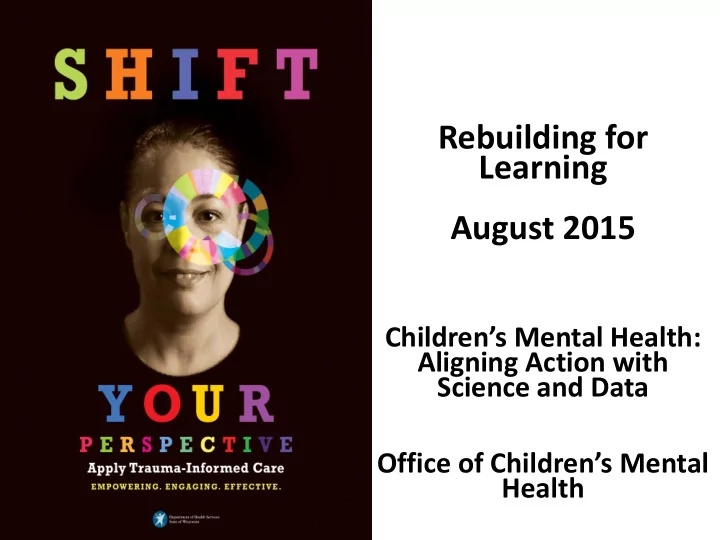
Rebuilding for Learning August 2015 Childrens Mental Health: - - PowerPoint PPT Presentation
Rebuilding for Learning August 2015 Childrens Mental Health: Aligning Action with Science and Data Office of Childrens Mental Health Wisconsin Office of Children s Mental Health Wide Range of Stakeholders SHIFT Our Perspective
Wisconsin Office of Children’s Mental Health
Wide Range of Stakeholders
SHIFT Our Perspective
- From illness to adaptation
- From primarily a clinical approach to
a public health approach
- From families as receivers to families
as leaders
- From a programs approach to a
systems approach
SHIFT
from Mental Illness to Adaptation “Early experiences are biologically embedded in the development of the brain and other organ systems leaving a lifelong impact on learning, behavior and both physical and mental health.” Harvard Center on the Developing Child
Washington State Family Council
Safe, Stable, Nurturing, Informed Families Knowledgeable Lawmakers Consistent Media Messaging Trauma-Informed Care
- Understand basic
trauma & ACEs information
- Recognize triggers
- Recognize signs of
emotional dysregulation
- Learn basic self-
regulation and de- escalation skills
- Approach others from a
frame of cultural competence
- Shift your perspective
from “what’s wrong with that person?” to “what might have happened to that person?” Mental Health Providers Mental Health Coaches and Consultants Youth and Parent Peer Specialists
Create common understanding related to:
- Disproportionality across
state agencies
- High youth psychiatric
hospitalization rates
- High youth suicide rates
- Child/youth psychotropic
medication prescribing patterns
SHIFT
from a primarily Clinical Approach to a Public Health Approach
Student Support Services Skilled Child Serving Workforce
Harvard Center on the Developing Child: Building Adult Capabilities to Improve Child Outcomes: A Theory of Change
http://developingchild.harvard.edu/resources/multimedia/vide
- s/theory_of_change/
SHIFT
from Families as Receivers to Families as Leaders
Develop an infrastructure to ensure meaningful parent and youth involvement in state agency activities
Children’s Social and Emotional Development
Children’s Trust Fund Other Stakeholders Youth and Parents with Lived Experience Department
- f Public
Instruction Department
- f
Corrections Department
- f Children
and Families Department
- f Health
Office of Children’s Mental Health
SHIFT
from a Programs Approach to a Systems Approach
Wisconsin Data Themes
- What is the prevalence of children’s mental health issues?
- What are some of the risk factors that contribute to mental
health difficulties?
- What do we know about access to mental health services?
- Using the available data, where do we see serious concerns?
- Where do we have opportunities to shift our perspective?
- What kind of disparities do we see?
- What strengths can we build on?
11 11
Prevalence
Prevalence Rates Are Higher For…
- LGBT Youth
– 57% experienced depressive symptoms in the last month
- African Americans
– Nationally, black youth have about 25% higher incidence of mental health challenges than white youth
- Those in Poverty
– Twice the rate of severe emotional disturbance as non- poor kids
12
Almost half (46%) of WI s children have experienced any adversity
13
Risk Factor: Adversity
14
Risk Factor: Poverty
Poorer mothers report poorer mental health
- From Children
s Trust Fund, Wisconsin ACE Brief
Risk Factor: Parental Capacity
Risk Factor: Parental Incarceration
- Parental incarceration is an ACE
- At least 18,000 WI children had a parent
who was incarcerated in 2012
- Preliminary analysis: 15% of child/youth
BadgerCare respondents have ever had a parent incarcerated
17
WI has 1,033 residents per provider (vs. 750:1 nationally) Mental Health America: WI is 42nd nationally in mental health workforce capacity
18
Access: Providers
Access: School Support Services
Concerns: Psychotropic Drug Patterns among Children / Youth on Medicaid
7 out of 10 young people prescribed a psychotropic drug in 2013 had no therapy Younger kids (0-12) on psychotropic drugs were the least likely to have therapy
Concerns: Hospitalization Rates
Rate of hospitalizing in a state facility is 4.5 times the national average and the highest in the Midwest
Concerns: Suicide Rates
In Wisconsin (2013)… …one in seven students reported seriously considering suicide …the youth suicide rate is 40% higher than the national average …suicide is the second leading cause of death for youth (first is accidents)
Opportunities: Rethink School Sanctions
Person/Sexual 30%
Property 32% Public Order 24%
Other 14%
Reasons for Youth Detentions, 2013
- Most detentions (70%) are for non-violent
- ffenses
- 98% of youth in State correctional institutes
report a trauma history (ACEs)
25
Opportunities: Rethink Societal Sanctions
Disparities: Suicide Risk
26
White Hispanic Black LGBT (all races) 4% 11% 16% 28%
What % of WI HS Students Attempted Suicide in the last year? (2013)
- Wisconsin
s Black youth suicide attempt rate is 82% higher the national average.
- LGBT, Hispanic, and Black youth are at the highest risk of
attempting suicide
Disparities: School Discipline
- Approximately 1 in 5 Black students were
suspended in 2013 (21%) - more than 9 times the rate of White students
- American Indian students were suspended at
- ver 3 times the rate of White students
- Hispanic/Latino students were twice as likely as
their White peers to be suspended
Disparities: Out-of-Home Placement
American Indian children are at the highest risk of being placed in foster care (25 per 1,000 children) and are almost seven times more likely to be in out-of-home care than their White peers
WI has the worst juvenile incarceration disparities in the nation 29
Disparities: Juvenile Justice
Strengths: The Good News…
Wisconsin is better than the national average when it comes to…
…insuring kids …identifying kids with emotional distress (EBD) in schools …poverty rates (lower than national average) …having safe, strong neighborhoods with good schools (61% of youth) …positive home environments for children (33% of youth)
Strengths: State Activities
- DHS and counties expanding CST and CCS which may lead to
reduced hospitalizations
- DCF performance goals which may lead to reduction of out-of-
home care and improved outcomes
- DPI focus on TIC, PBIS and RTI which may reduce the use of
suspension, seclusion, restraint and expulsions
- DJC reducing rates of juvenile arrests and developing innovative
approaches
- DHS/DCF Care4Kids offering trauma-informed physical, behavioral
health, and dental services to foster children
Strengths: Recognition that Early Relationships Matter
- Home visiting programs
- Pyramid Model for developing social and emotional
skills
- University of Wisconsin’s Infant Mental Health
certification
- YoungStar
- Statewide 4K
- Wisconsin Healthiest Family Initiative
- Fostering Futures
How Data Is Guiding OCMH Activities
Access
- Promote the use of coaches and mental health consultants
- Promote the use of Parent Peer Specialists
- Promote school-based mental health
Concerns
- Facilitate DHS, DCF and WCHSA workgroup addressing high rates of youth
hospitalizations and Emergency Detentions
- Participate in DHS and DCF workgroup examining psychotropic prescribing
patterns
- Raise awareness related to the need for integrated data system and the lack
- f data related to service outcomes
- Work with Mental Health America to address high suicide rates
Disparities
- Facilitate DHS, DCF, DPI and DOC workgroup to align state agency activities
related to reducing disparities
Thank hank yo you
WI Office of Children’s Mental Health Elizabeth Hudson, Director Elizabeth.Hudson@wi.gov Kate McCoy, PhD, Research Analyst
katherine.mccoy@wi.gov
Sources
- Annie E. Casey Kids Count
- Children’s Defense Fund, “Mental Health Fact Sheet”
- Children’s Trust Fund, “Wisconsin ACE Brief: 2011 and 2012 Data”
- Data and Resource Center for Children and Adolescent Health
- DCF, “Wisconsin Children in Out-of-Home Care” 2012 Annual Report
- DOC, Division of Juvenile Corrections, 2013 Report
- DPI, WiseDash online data dashboard
- DPI, “Youth Risk Behavior Survey Executive Summary 2013”
- Individual Student Enrollment System (ISES)
- Juvenile Secure Detention Registry
- Mental Health America, Parity or Disparity: The State of Mental Health in
America 2015
- Office of Detention Facilities, 2013 Annual Report
- SAMHSA, 2012 URS tables
- SAMHSA, “Behavioral Health Barometer Wisconsin”
- WI Health Information Organization (WHIO) dataset