Realigning Cancer Care To Address Interactional Suffering Debra - - PowerPoint PPT Presentation

realigning cancer care to address interactional suffering
SMART_READER_LITE
LIVE PREVIEW

Realigning Cancer Care To Address Interactional Suffering Debra - - PowerPoint PPT Presentation

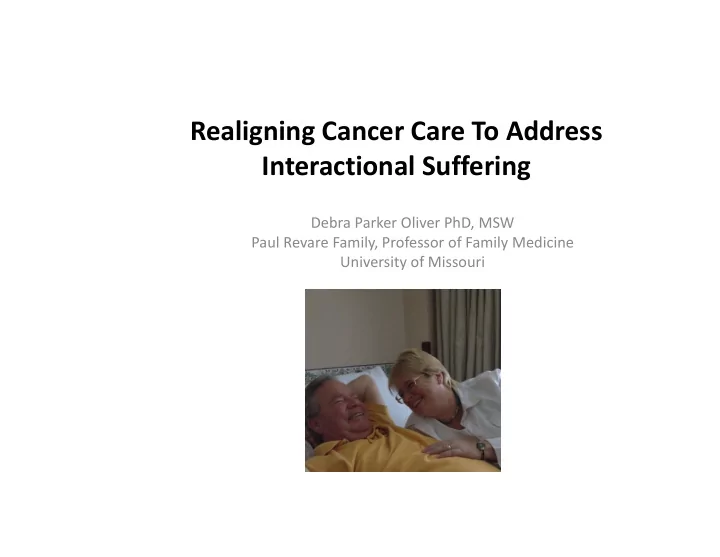
Realigning Cancer Care To Address Interactional Suffering Debra Parker Oliver PhD, MSW Paul Revare Family, Professor of Family Medicine University of Missouri Conflicts No conflicts to report Rosalynn Carter There are only four kinds


slide-1
SLIDE 1

Realigning Cancer Care To Address Interactional Suffering

Debra Parker Oliver PhD, MSW Paul Revare Family, Professor of Family Medicine University of Missouri
slide-2
SLIDE 2

Conflicts

  • No conflicts to report
slide-3
SLIDE 3

Rosalynn Carter

“There are only four kinds of people in the world: – Those who have been caregivers, – Those we are currently caregivers, – Those who will be caregivers, – And those who will need caregivers”

slide-4
SLIDE 4
slide-5
SLIDE 5

Science of Caregiving

  • Intensity and duration of

experience are predictors

  • f negative health effects
  • Higher incidence of chronic

disease

  • Depression/Anxiety
  • Social Isolation
  • Caregiving could be a

diagnosis

slide-6
SLIDE 6

Experience of Caregiving

Interactional Suffering

  • Lack of Attention (Timely, Full attention)
  • Lack of understanding (Thoughts and feelings)
  • Lack of Communication (Empathy, hope)
  • Lack of Competence (Pall Care; collaboration)
  • Issues of Limitation(Med Science, technology)
  • Invisible

Health Care Interactional Suffering in Palliative Care. Beng,TS; NgChong Guan;Lim Le Jane;American Journal of Hospice and Palliative Medicine. (2014), 3 (3) pg304.

slide-7
SLIDE 7

What is a Labyrinth?

  • A circular pathway with one way in that

leads directly to the endpoint. 7 Circuit’s

– Transitions: Changes as you move from one circuit to another – Fork in the Road: Decision points – Blind Alley: Unexpected turn, surprises

slide-8
SLIDE 8

My Labyrinth

slide-9
SLIDE 9

Entrance

Diagnosis And Treatment Consultation

Interactional Suffering

  • Lack of Attention
  • Lack of understanding
  • Lack of communication
  • Lack of competence
  • Limitations
  • Signals of Invisibility

Blind Alleys

  • No Map
  • Everyone speaks

a foreign language

slide-10
SLIDE 10

Treatment

Interactional Suffering

  • Lack of Attention
  • Lack of understanding
  • Lack of communication
  • Lack of competence
  • Limitations
  • Signals of invisibility

Forks in the Road

  • Scans and Symptoms
slide-11
SLIDE 11

Waiting

Forks in the Road

  • Signs of reoccurrence

Blind Alleys

  • False hope

Interactional Suffering

  • Lack of Attention
  • Lack of understanding
  • Lack of communication
  • Lack of competence
  • Limitations
  • Signals of Invisibility
slide-12
SLIDE 12

Transition

  • Return to caregiving

Reoccurrence

Interactional Suffering

  • Lack of Attention
  • Lack of understanding
  • Lack of communication
  • Lack of competence
  • Limitations
  • Signals of Invisibility
slide-13
SLIDE 13

Hospice

  • Transitions

– Losses: private space, privacy, home to hospital

Interactional Suffering

  • Lack of Attention
  • Lack of understanding
  • Lack of communication
  • Lack of competence
slide-14
SLIDE 14

Death

Transitions

  • Caregiver to widow

Now to get back through alone Interactional Suffering

No More

slide-15
SLIDE 15

Family Centered Care

  • 1. Beware of Interactional Suffering
  • 2. Watch for Signals of Invisibility
  • 3. Invite and Encourage caregiver involvement
  • 4. Routinely interact with caregiver
  • 5. Speak privately with both patient and caregiver
  • 6. Attend to patient and family preferences for

information

  • 7. Assign team member to focus on caregiver

Facilitating collaborative and effective family involvement in cancer setting: Guidelines for clinicians(TRIO guidelines) Laidsaar‐Powell, R.; Butow,P.; Boyle,R.; Juraskova,I. (2018) Patient Education and Counseling 101 970‐982.

slide-16
SLIDE 16

Easy Individual Fix

  • Validate Caregiver

– Respect knowledge

  • “What problems have you seen”

– Embrace as a partner

  • “What do you think about this plan”

– Recognize and hear the emotion

  • “This must be very hard for you on so many levels”
slide-17
SLIDE 17

. . . To begin depriving death of its greatest

advantage over us, let us adopt a way clean contrary to that common one; let us deprive death of its strangeness, let us frequent it, let us get used to it. . .We do not know where death awaits us: so let us wait for it everywhere.

Michel de Montaigne

slide-18
SLIDE 18

Thank you

  • oliverdr@missouri.edu
  • http://Legaciesfromthelivingroom.com
  • Amazon, Kindle, Ipad, Nook, etc