Ready, Willing & Able: a Creating an inclusive and effective - - PowerPoint PPT Presentation

ready willing able
SMART_READER_LITE
LIVE PREVIEW

Ready, Willing & Able: a Creating an inclusive and effective - - PowerPoint PPT Presentation

Ready, Willing & Able: a Creating an inclusive and effective labour market RWA January 2014 Ready, Willing & Able (RWA) l A national initiative of the Canadian Association for Community Living (CACL) in partnership with Canadian


slide-1
SLIDE 1

a

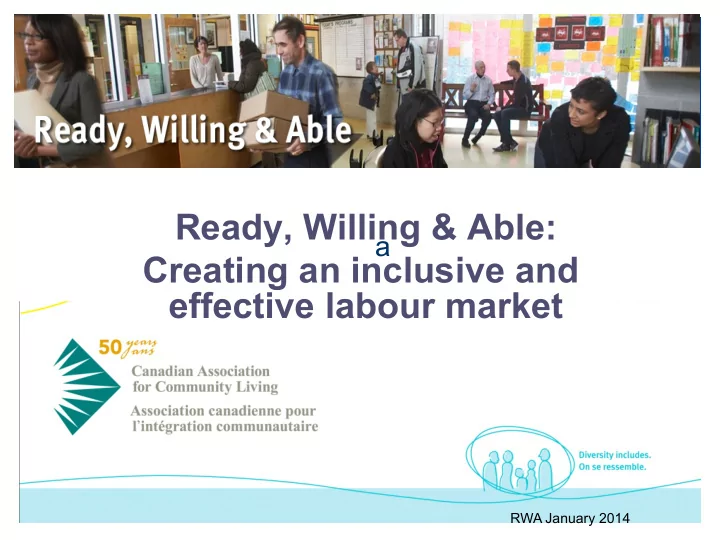
Ready, Willing & Able: Creating an inclusive and effective labour market

RWA January 2014
slide-2
SLIDE 2

Ready, Willing & Able (RWA)

l A national initiative of the Canadian

Association for Community Living (CACL) in partnership with Canadian Autism Spectrum Disorders Alliance (CASDA)

l Provincial and Territorial Associations for

Community Living and CASDA membership

l Employers and community service providers

RWA January 2014

slide-3
SLIDE 3

Ready, Willing & Able (RWA) – A National Strategy to:

  • 1. Engage and support small, medium, large, and

national-scale employers to recruit, hire and support people with developmental disabilities

  • 2. Promote awareness among employers and the

general public to promote hiring of people with developmental disabilities

  • 3. Modernize the community employment supports

delivery system to be the effective bridge-builders that small, medium and large-scale employers need

RWA January 2014

slide-4
SLIDE 4

Why an RWA

l Canada faces labour market challenges l People with developmental disabilities are

largely not in the labour market

l Employers need a community partner l Community agencies are not positioned for

effective labour market bridging

RWA January 2014

slide-5
SLIDE 5

The Opportunity

l An inclusive and effective labour market is

possible

– Individuals with developmental disabilities are

capable of working in paid labour force

– Relationship formation with employer – Individualized navigation and job coaching

support

– Strategies for skill development for the job seeker

RWA January 2014

slide-6
SLIDE 6

The Opportunity

l RWA marks a shift in strategy

– Aligns with current federal priorities – Meets employer needs – Enhances and transforms the community

employment delivery system

l RWA finds efficiencies and brings

transformation to the system

RWA January 2014

slide-7
SLIDE 7

Six key building blocks

l Employer capacity and confidence to hire:

Engaging and supporting employers to promote understanding and awareness of the value of hiring people with developmental disabilities and providing them with the needed supports to do so;

l Community-based delivery of employment

support and labour market bridging: Transforming the community employment supports delivery system to be the effective bridge-builders employers need;

RWA January 2014

slide-8
SLIDE 8

Six key building blocks

l Planning for transitions from school to

employment and careers: Working with employers and the school system to ensure supports are in place to assist students to plan and pursue effective transitions to employment and careers;

l Inclusive post-secondary education: Expanding

  • n current models that put supports in place at

colleges and universities for students with developmental disabilities to pursue post-secondary education;

RWA January 2014

slide-9
SLIDE 9

Six key building blocks

l Employer-to-employer networks: Engagement and

support of employer-to-employer networks such as Rotary, Chambers of Commerce and others to champion hiring of people with developmental disabilities;

l Entrepreneurship and small business

development: Enabling entrepreneurship as an

  • ption for people with developmental disabilities by

providing expertise, knowledge, resources and support to community agencies to assist people in business ventures.

RWA January 2014

slide-10
SLIDE 10

Ø RWA engages, supports and connects three labour market actors:

Community Agencies People with Developmental Disabilities Employers

slide-11
SLIDE 11

RW&A Program Model

Ongoing research, evaluation and policy development

Raise employer expectations and harness demand Create the pipeline to align the workforce of people with developmental disabilities with demand Activate needed building blocks for an inclusive and effective labour market Provide responsive employer and employee supports Transformed labour market system

slide-12
SLIDE 12

RW&A Design Features

l The RWA is designed to enable coherency of design and

consistency of implementation in communities throughout the country.

l Activities within RWA occur concurrently at the community, PT

and national levels.

l At each level of the initiative, activities undertaken to create

and/or contribute to conditions necessary to facilitate increased employment of people with developmental disabilities.

l Implementation of the initiative is led by key resource people,

working in collaboration with employers and community partners, situated at each level, namely

RWA January 2014

slide-13
SLIDE 13

RWA – Delivery Structure and Roles

l At Community Level:

– Partnership development (engagement of local employers,

community agencies, schools, etc.)

– Outreach and awareness – Facilitation of community employment planning – Delivery of labour market bridge-building services (employer

awareness, accommodation, workplace policy information, training and assistance; pre-employment support; recruitment, hiring, on-boarding and post-placement support; fostering community and employer leadership)

RWA January 2014

slide-14
SLIDE 14

RWA – Delivery Structure and Roles

l At Provincial/Territorial Level (via PT Labour Market

Facilitators):

– Labour market development – working with

national scale employers at PT, regional and local level

– Training and support to community agencies – to

lead modernization process

– Policy development and reform – RWA program coordination and administration

RWA January 2014

slide-15
SLIDE 15

RWA – Delivery Structure and Roles

l At National Level (via national Project Team): – Engaging national-scale employers – Research, evaluation and policy development – Inter-provincial sharing of learning and best-

practice

– Public awareness campaigns – Project coordination and administration

RWA January 2014

slide-16
SLIDE 16

Implementation Strategy

l Designed as a multi-year initiative, RWA, in its

implementation, consists of two stages designed to firstly focus on the creation of a more direct and effective bridge between supply and demand; and secondly, to boost employment opportunities and community leadership via the resourcing and implementation of known best practices so as to secure meaningful employment.

RWA January 2014

slide-17
SLIDE 17

Stage 1 - Bridging Supply and Demand

Employer Outreach and Awareness:

l Partnership development with large national employers l Employer Awareness Forums in selected communities

Community Capacity for Delivery of Employment Support:

l Assistance to employers identified with hiring and

retention—20 employment outcomes/community;

l Partnership development for community capacities to

respond effectively to employer demand;

RWA January 2014

slide-18
SLIDE 18

Stage 2 - Boosting Opportunities and Community Leadership

l Implementation in areas of: – Youth Transitions to employment and careers; – Employer-to-employer networks; – Inclusive Post-Secondary Training and Education – Entrepreneurship and Self-Employment l Projects in these areas build on and enhance

  • pportunities for people with developmental

disabilities and employer leadership.

l Community Employment Forums

RWA January 2014

slide-19
SLIDE 19

RWA Results

l Project activity in at least 20 communities, in all

provinces and territories

l Over 3 years, 1200 employment outcomes l Thousands of employers engaged l Transformed community employment delivery

system for employers and people with developmental disabilities

l Research, Evaluation and Knowledge Transfer

RWA January 2014

slide-20
SLIDE 20

Benefits

l People move from dependence to paid employment l Millions saved in P/T social assistance payments l Economic benefits from increased income tax, sales

tax revenue, etc.

l Decreased dependence on segregated non-work

daytime activities

l Groundbreaking partnerships

RWA January 2014

slide-21
SLIDE 21

Conclusion

l Canada cannot afford the cost of exclusion l Employers cannot afford to overlook this

untapped workforce

l RWA creates a labour market that includes

those who currently are most overlooked and under-represented.

RWA January 2014