Reading quiz List Recursion: Practice & Examples #1 #2 - - PDF document

reading quiz list recursion practice examples
SMART_READER_LITE
LIVE PREVIEW

Reading quiz List Recursion: Practice & Examples #1 #2 - - PDF document

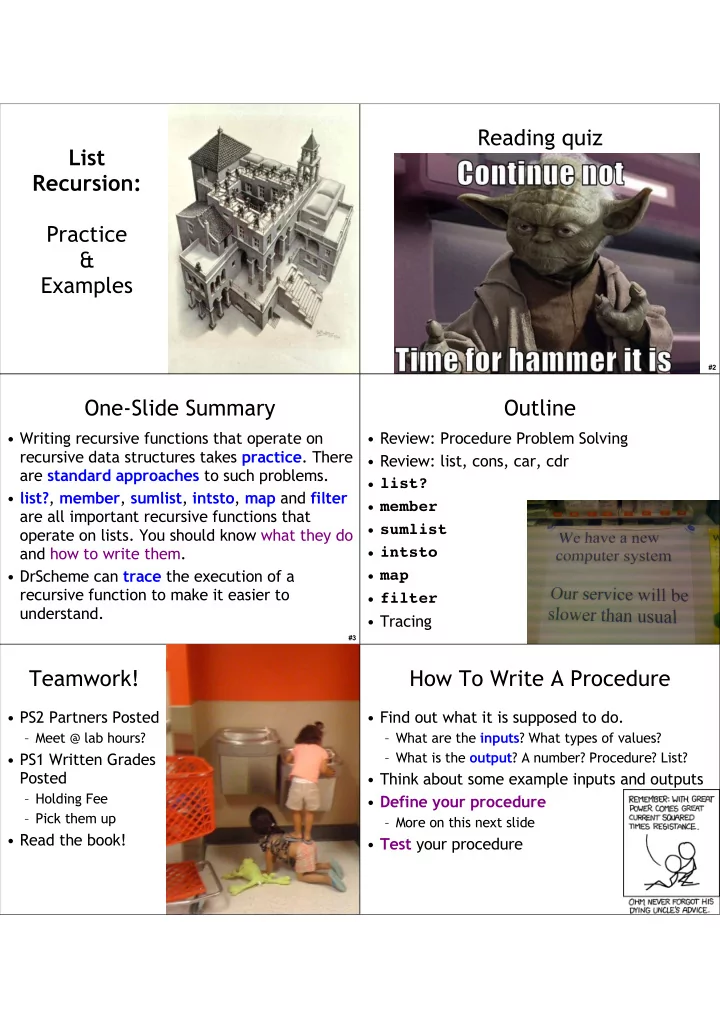
Reading quiz List Recursion: Practice & Examples #1 #2 One-Slide Summary Outline Writing recursive functions that operate on Review: Procedure Problem Solving recursive data structures takes practice . There Review: list,


slide-1
SLIDE 1

#1

List Recursion: Practice & Examples

#2

Reading quiz

#3

One-Slide Summary

  • Writing recursive functions that operate on

recursive data structures takes practice. There are standard approaches to such problems.

  • list?, member, sumlist, intsto, map and filter

are all important recursive functions that

  • perate on lists. You should know what they do

and how to write them.

  • DrScheme can trace the execution of a

recursive function to make it easier to understand.

#4

Outline

  • Review: Procedure Problem Solving
  • Review: list, cons, car, cdr
  • list?
  • member
  • sumlist
  • intsto
  • map
  • filter
  • Tracing

#5

Teamwork!

  • PS2 Partners Posted

– Meet @ lab hours?

  • PS1 Written Grades

Posted

– Holding Fee – Pick them up

  • Read the book!

#6

How To Write A Procedure

  • Find out what it is supposed to do.

– What are the inputs? What types of values? – What is the output? A number? Procedure? List?

  • Think about some example inputs and outputs
  • Define your procedure

– More on this next slide

  • Test your procedure
slide-2
SLIDE 2

#7

Defining A Procedure

  • Be optimistic!
  • Base case: Think of the simplest input to the

problem that you know the answer to.

– For number inputs, this is often zero. – For list inputs, this is often the empty list (null).

  • Recursive step: Think of how you would solve

the problem in terms of a smaller input. Do part of the work now, then make a recursive call to handle the rest.

– For numbers, this usually involves subtracting 1. – For lists, this usually involves cdr.

#8

Procedure Skeleton

  • The vast majority of recursive functions look

like this: (define (my-procedure my-input) (if (is-base-case? my-input) (handle-base-case my-input) (combine (first-part-of my-input) (my-procedure (rest-of my-input)))))

#9

Pairs and Lists

  • cons makes a pair of two things

– (cons 1 2) --> (1 . 2) – (pair? (cons 1 2)) --> #t

  • car and cdr get the first and second part

– (car (cons “a” “b”)) --> “a” – (cdr (cons “y” “z”)) --> “z”

  • A list is either null or a pair where the second

element is also a list

– (cons 1 (cons 2 (cons 3 null))) --> (1 2 3) – (list 1 2 3) --> (1 2 3) – (null? (list 1 2)) --> #f – (append (list 1 2) (list 3 4)) -> (1 2 3 4)

#10

More Power Needed!

#11

list?

  • The list? function takes a single argument and

returns #t if that argument is a list, #f

  • therwise.

– Recall: a list is either null or a pair where the second element is a list – (list? null) --> #t – (pair? (cons 1 2)) --> #t – (list? (cons 1 null)) --> #t – (list? 5) --> #f – (list? (cons 1 2)) --> #f

  • Write it now on paper. Base case? Recursion?

#12

list? Hint

  • Here's a hint:

(define (list? something) (if (null? something) #t ...))

slide-3
SLIDE 3

#13

Definition of list?

  • Here it is:

(define (list? something) (if (null? something) #t (if (pair? something) (list? (cdr something)) #f) ))

Base Base Case! Case!

Inductive Inductive Step! Step!

#14

Liberal Arts Trivia: Economics

  • This 1930 Tariff Act raised US tariffs on

imported goods to record levels. Over 1000 US Economists signed a petition against it, and after it passed many others contributed increased their tariffs in retribution. US exports and imports dropped by half and many view this Act as a major catalyst for the Great Depression.

#15

Liberal Arts Trivia: German Lit

  • This tragic closet play is considered by many to

be one of the greatest works of German

  • literature. It centers on a man who makes a

pact with the Devil in exchange for knowledge in his quest to discover the essence of life (“was die Welt im Innersten zusammenhält”) The man's name officially means “Lucky” in Latin, but now has negative connotations.

#16

member

  • Write a function member that takes two

arguments: an element and a list. It returns #f if the list does not contain the element. Otherwise it returns the sublist starting with that element.

– (member 2 (list 1 2 3)) -> (2 3) – (member 5 (list 1 2 3)) -> #f – (member 1 (list 1 2 3)) -> (1 2 3) – (member 3 (list 1 2 3)) -> (3) – (eq? 3 5) -> #f (eq? 2 2) -> #t

#17

Definition of member

(define (member elt lst) (if (null? lst) #f ;; empty list contains nothing (if (eq? elt (car lst)) lst ;; we found it! (member elt (cdr lst))))) ;; keep looking

  • Where is the base case? Where is the inductive

step?

#18

sumlist

  • Write a procedure sumlist that takes as input a

list of numbers. It returns the sum (addition)

  • f all of the elements of the list. It returns 0

for the empty list.

– (sumlist (list 1 2 3)) -> 6 – (sumlist null) -> 0

slide-4
SLIDE 4

#19

Definition of sumlist

  • And here it is ...

(define (sumlist lst) (if (null? lst) ;; base case (+ (car lst) ;; else add current element (sumlist (cdr lst))))) ;; to rest of list

#20

intsto

  • The function intsto takes a single non-negative

integer as an argument. It produces a list of all

  • f the integers between 1 and its argument.

– (intsto 3) -> (1 2 3) – (intsto 7) -> (1 2 3 4 5 6 7) – (intsto 0) -> null

#21

Definition of intsto ?

(define (intsto x) (if (< x 1) null ;; base case (cons ;; else make a list x ;; list contains x (intsto (- x 1))))) ;; and recursive result

  • What's wrong?

#22

Correct Definition of intsto

(define (intsto x) (if (< x 1) null ;; base case (append ;; else make a list (intsto (- x 1)) ;; recursive result (list x)))) ;; followed by x

  • Huzzah!

#23

Higher-Order Functions: map

  • The map function takes two arguments: a work

function and a list. It applies the work function to every element of the list in order and returns a list of the result.

– (map sqrt (list 9 16 36)) -> (3 4 6) – (map square (list 1 2 3)) -> (1 4 9) – (map abs (list 2 -3 4)) -> (2 3 4) – (map string-length (list “I” “Claudius”)) -> (1 8) – (map sqrt null) -> null

#24

Mission Impossible: Write map

  • You can do it!
  • (map square (list 1 2 3))

– (1 4 9)

  • (map abs (list 2 -3 4))

– (2 3 4)

  • (map sqrt null)

– null

slide-5
SLIDE 5

#25

Definition of map

  • Let's look in detail:

(define (map work-fun lst) (if (null? lst) null ;; base case (cons ;; else make a list (work-fun (car lst)) ;; first part of result (map work-fun (cdr lst))))) ;; rest o'result

#26

Liberal Arts Trivia: Philosophy

  • This branch of philosophy deals with the

theory, nature and scope of knowledge. Key questions include “what is knowledge?”, “how is knowledge acquired?”, “what do people know?”, “how do we know what we know?”, “what is the relationship between truth and belief?”.

#27

Liberal Arts Trivia: Norse Myth

  • In Norse Mythology, this god is associated with

light and beauty. His mother made every

  • bject on earth vow never to harm him, but

she did not ask mistletoe. The other gods made a new pastime of hurling objects at him and watching them bounce off. The trickster Loki heard of this, fashioned a spear from mistletoe and had it thrown a him, with fatal results.

#28

Liberal Arts Trivia: Music

  • This musical instrument of the brass family

produces sound when the player's vibrating lips cause the air column inside the instrument to

  • vibrate. It is usually characterized by a

telescopic slide with which the player varies the length of the tube to change the pitch. Glenn Miller, famous for his “big band” and songs like In the Mood and Chattanooga Choo Choo, played this instrument.

#29

Using map to get iteration

  • In C or Java:

for (x=1 ; x <= 5 ; x=x+1) { display(x*x); } // output: 1 4 9 16 25

  • Recall that we have intsto:

– (intsto 3) -> (1 2 3) – (intsto 7) -> (1 2 3 4 5 6 7)

  • How can map and intsto to simulate for?

#30

Using map to get iteration

  • In C or Java:

for (x=1 ; x <= 5 ; x=x+1) { display(x*x); } // output: 1 4 9 16 25

  • Recall that we have intsto:

– (intsto 3) -> (1 2 3)

  • Then we can do:

(map (lambda (x) (display (square x))) (intsto 5))

Expect me on tests

  • r extra credit later!
slide-6
SLIDE 6

#31

filter

  • The filter function takes two arguments: a

predicate and a list. A predicate is a function that returns true or false. Filter returns the sublist consisting of those elements that satisfy the predicate.

– (filter is-odd? (list 1 2 3 4)) -> (1 3) – (filter null? (list 1 null null “hi”)) -> (null null) – (filter (lambda (x) (< x 5)) (list 1 9 2 0)) -> (1 2 0) – (filter null? (list “susan” “b” “anthony”)) -> null – (filter is-odd? null) -> null

#32

Definition of filter

(define (filter pred lst) (if (null? lst) null ;; base case (if (pred (car lst)) ;; does this element ;; satisfy the predicate? (cons (car lst) (filter pred (cdr lst))) ;; if so, include it in the result (filter pred (cdr lst))))) ;; if not, do not include it

#33

Tracing

  • DrScheme will trace through a functions

execution for you.

  • This can make it easier to debug or understand

a function.

To enable tracing of myfun: (require (lib "trace.ss")) (trace myfun)

Tracing sumlist

> (trace sumlist) > (sumlist (list 1 2 3 4)) |(sumlist (1 2 3 4)) | (sumlist (2 3 4)) | |(sumlist (3 4)) | | (sumlist (4)) | | |(sumlist ()) | | |0 | | 4 | |7 | 9 |10 10 (define (sumlist p) (if (null? p) 0 (+ (car p) (sumlist (cdr p)))))

Tracing map

> (map (lambda (x) (* x 2)) (list 1 2 3))

|(map #<procedure> (1 2 3)) | (map #<procedure> (2 3)) | |(map #<procedure> (3)) | | (map #<procedure> ()) | | () | |(6) | (4 6) |(2 4 6) (2 4 6)

(define (map f lst) (if (null? lst) null (cons (f (car lst)) (map f (cdr lst)))))

#36

Homework

  • Problem Set 2 Due Monday
  • (Re-)Read Chapters 4-5 by Monday