Reading CPSC 314 Computer Graphics FCG Chap 15 Curves Jan-Apr 2013 - - PowerPoint PPT Presentation

reading
SMART_READER_LITE
LIVE PREVIEW

Reading CPSC 314 Computer Graphics FCG Chap 15 Curves Jan-Apr 2013 - - PowerPoint PPT Presentation

University of British Columbia Reading CPSC 314 Computer Graphics FCG Chap 15 Curves Jan-Apr 2013 Ch 13 2nd edition Tamara Munzner Curves http://www.ugrad.cs.ubc.ca/~cs314/Vjan2013 2 Parametric Curves parametric form for a line:


slide-1
SLIDE 1

http://www.ugrad.cs.ubc.ca/~cs314/Vjan2013

Curves

University of British Columbia CPSC 314 Computer Graphics Jan-Apr 2013 Tamara Munzner

2

Reading

  • FCG Chap 15 Curves
  • Ch 13 2nd edition

3

Curves

4

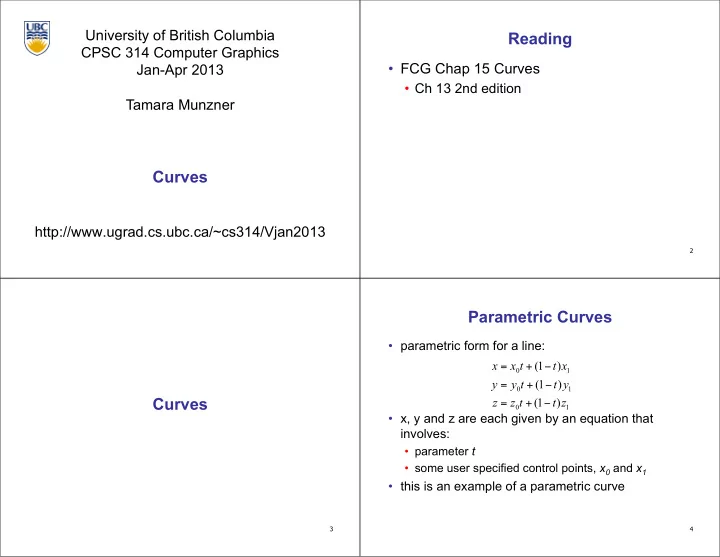
Parametric Curves

  • parametric form for a line:
  • x, y and z are each given by an equation that

involves:

  • parameter t
  • some user specified control points, x0 and x1
  • this is an example of a parametric curve

1 1 1

) 1 ( ) 1 ( ) 1 ( z t t z z y t t y y x t t x x − + = − + = − + =

slide-2
SLIDE 2

5

Splines

  • a spline is a parametric curve defined by

control points

  • term “spline” dates from engineering drawing,

where a spline was a piece of flexible wood used to draw smooth curves

  • control points are adjusted by the user to

control shape of curve

6

Splines - History

  • draftsman used ‘ducks’

and strips of wood (splines) to draw curves

  • wood splines have second-
  • rder continuity, pass

through the control points

a duck (weight) ducks trace out curve

7

Hermite Spline

  • hermite spline is curve for which user

provides:

  • endpoints of curve
  • parametric derivatives of curve at endpoints
  • parametric derivatives are dx/dt, dy/dt, dz/dt
  • more derivatives would be required for higher
  • rder curves

8

Basis Functions

  • a point on a Hermite curve is obtained by multiplying each

control point by some function and summing

  • functions are called basis functions
  • 0.4
  • 0.2
0.2 0.4 0.6 0.8 1 1.2

x1 x0 x'1 x'0

slide-3
SLIDE 3

9

Sample Hermite Curves

10

Bézier Curves

  • similar to Hermite, but more intuitive

definition of endpoint derivatives

  • four control points, two of which are knots

11

Bézier Curves

  • derivative values of Bezier curve at knots

dependent on adjacent points

12

Bézier Blending Functions

  • look at blending functions
  • family of polynomials called
  • rder-3 Bernstein polynomials
  • C(3, k) tk (1-t)3-k; 0<= k <= 3
  • all positive in interval [0,1]
  • sum is equal to 1
slide-4
SLIDE 4

13

Bézier Blending Functions

  • every point on curve is linear

combination of control points

  • weights of combination are all

positive

  • sum of weights is 1
  • therefore, curve is a convex

combination of the control points

14

Bézier Curves

  • curve will always remain within convex hull

(bounding region) defined by control points

15

Bézier Curves

  • interpolate between first, last control points
  • 1st point’s tangent along line joining 1st, 2nd pts
  • 4th point’s tangent along line joining 3rd, 4th pts

16

Comparing Hermite and Bézier

0.2 0.4 0.6 0.8 1 1.2 B0 B1 B2 B3

  • 0.4
  • 0.2
0.2 0.4 0.6 0.8 1 1.2

x1 x0 x'1 x'0

Bézier Hermite

slide-5
SLIDE 5

17

Rendering Bezier Curves: Simple

  • evaluate curve at fixed set of parameter values, join

points with straight lines

  • advantage: very simple
  • disadvantages:
  • expensive to evaluate the curve at many points
  • no easy way of knowing how fine to sample points,

and maybe sampling rate must be different along curve

  • no easy way to adapt: hard to measure deviation of

line segment from exact curve

18

Rendering Beziers: Subdivision

  • a cubic Bezier curve can be broken into two

shorter cubic Bezier curves that exactly cover

  • riginal curve
  • suggests a rendering algorithm:
  • keep breaking curve into sub-curves
  • stop when control points of each sub-curve

are nearly collinear

  • draw the control polygon: polygon formed by

control points

19

Sub-Dividing Bezier Curves

  • step 1: find the midpoints of the lines joining

the original control vertices. call them M01, M12, M23

P0 P1 P2 P3 M01 M12 M23

20

Sub-Dividing Bezier Curves

  • step 2: find the midpoints of the lines joining

M01, M12 and M12, M23. call them M012, M123

P0 P1 P2 P3 M01 M12 M23 M012 M123

slide-6
SLIDE 6

21

Sub-Dividing Bezier Curves

  • step 3: find the midpoint of the line joining

M012, M123. call it M0123

P0 P1 P2 P3 M01 M12 M23 M012 M123 M0123

22

Sub-Dividing Bezier Curves

  • curve P0, M01, M012, M0123 exactly follows original

from t=0 to t=0.5

  • curve M0123 , M123 , M23, P3 exactly follows
  • riginal from t=0.5 to t=1

P0 P1 P2 P3 M01 M12 M23 M012 M123 M0123

23

Sub-Dividing Bezier Curves

P0 P1 P2 P3

  • continue process to create smooth curve

24

de Casteljau’s Algorithm

  • can find the point on a Bezier curve for any parameter

value t with similar algorithm

  • for t=0.25, instead of taking midpoints take points 0.25 of

the way

P0 P1 P2 P3 M01 M12 M23 t=0.25

demo: www.saltire.com/applets/advanced_geometry/spline/spline.htm

slide-7
SLIDE 7

25

Longer Curves

  • a single cubic Bezier or Hermite curve can only capture a small class of curves
  • at most 2 inflection points
  • ne solution is to raise the degree
  • allows more control, at the expense of more control points and higher degree

polynomials

  • control is not local, one control point influences entire curve
  • better solution is to join pieces of cubic curve together into piecewise cubic

curves

  • total curve can be broken into pieces, each of which is cubic
  • local control: each control point only influences a limited part of the curve
  • interaction and design is much easier

26

Piecewise Bezier: Continuity Problems

demo: www.cs.princeton.edu/~min/cs426/jar/bezier.html

27

Continuity

  • when two curves joined, typically want some

degree of continuity across knot boundary

  • C0, “C-zero”, point-wise continuous, curves

share same point where they join

  • C1, “C-one”, continuous derivatives
  • C2, “C-two”, continuous second derivatives

28

Geometric Continuity

  • derivative continuity is important for animation
  • if object moves along curve with constant parametric

speed, should be no sudden jump at knots

  • for other applications, tangent continuity suffices
  • requires that the tangents point in the same direction
  • referred to as G1 geometric continuity
  • curves could be made C1 with a re-parameterization
  • geometric version of C2 is G2, based on curves

having the same radius of curvature across the knot

slide-8
SLIDE 8

29

Achieving Continuity

  • Hermite curves
  • user specifies derivatives, so C1 by sharing points and

derivatives across knot

  • Bezier curves
  • they interpolate endpoints, so C0 by sharing control pts
  • introduce additional constraints to get C1
  • parametric derivative is a constant multiple of vector joining first/

last 2 control points

  • so C1 achieved by setting P0,3=P1,0=J, and making P0,2 and J and

P1,1 collinear, with J-P0,2=P1,1-J

  • C2 comes from further constraints on P0,1 and P1,2
  • leads to...

30

B-Spline Curve

  • start with a sequence of control points
  • select four from middle of sequence

(pi-2, pi-1, pi, pi+1)

  • Bezier and Hermite goes between pi-2 and pi+1
  • B-Spline doesn’t interpolate (touch) any of them but

approximates the going through pi-1 and pi

P0 P1 P3 P2 P4 P5 P6

31

B-Spline

  • by far the most popular spline used
  • C0, C1, and C2 continuous

demo: www.siggraph.org/education/materials/HyperGraph/modeling/splines/demoprog/curve.html

32

B-Spline

  • locality of points