Reading Required Angel, 7.6-7.8. Recommended Paul S. Heckbert. - - PDF document

reading
SMART_READER_LITE
LIVE PREVIEW

Reading Required Angel, 7.6-7.8. Recommended Paul S. Heckbert. - - PDF document

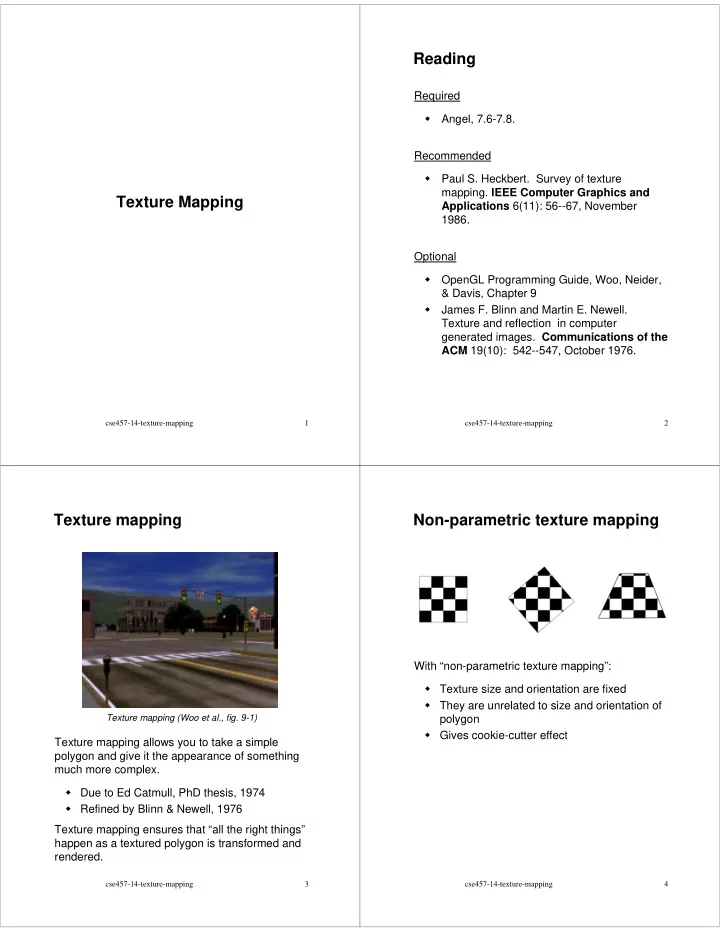
Reading Required Angel, 7.6-7.8. Recommended Paul S. Heckbert. Survey of texture mapping. IEEE Computer Graphics and Texture Mapping Applications 6(11): 56--67, November 1986. Optional OpenGL Programming Guide, Woo, Neider,


slide-1
SLIDE 1

cse457-14-texture-mapping 1

Texture Mapping

cse457-14-texture-mapping 2

Reading

Required

  • Angel, 7.6-7.8.

Recommended

  • Paul S. Heckbert. Survey of texture
  • mapping. IEEE Computer Graphics and

Applications 6(11): 56--67, November 1986. Optional

  • OpenGL Programming Guide, Woo, Neider,

& Davis, Chapter 9

  • James F. Blinn and Martin E. Newell.

Texture and reflection in computer generated images. Communications of the ACM 19(10): 542--547, October 1976.

cse457-14-texture-mapping 3

Texture mapping

Texture mapping (Woo et al., fig. 9-1)

Texture mapping allows you to take a simple polygon and give it the appearance of something much more complex. Due to Ed Catmull, PhD thesis, 1974 Refined by Blinn & Newell, 1976 Texture mapping ensures that “all the right things” happen as a textured polygon is transformed and rendered.

cse457-14-texture-mapping 4

Non-parametric texture mapping

With “non-parametric texture mapping”: Texture size and orientation are fixed They are unrelated to size and orientation of polygon Gives cookie-cutter effect

slide-2
SLIDE 2

cse457-14-texture-mapping 5

With “parametric texture mapping,” texture size and

  • rientation are tied to the polygon.

Idea: Separate “texture space” and “screen space” Texture the polygon as before, but in texture space Deform (render) the textured polygon into screen space A texture can modulate just about any parameter – diffuse color, specular color, specular exponent, …

Parametric texture mapping

A texture lives in it own abstract image coordinates parameterized by (u,v) in the range ([0..1], [0..1]): It can be wrapped around many different surfaces: Computing (u,v) texture coordinates in a ray tracer is fairly straightforward. Note: as the surface moves or deforms, the texture goes with it.

Implementing texture mapping

cse457-14-texture-mapping 7

Mapping to texture image coords

The texture is usually stored as an image. Thus, we need to convert from abstract texture coordinate: (u,v) in the range ([0..1], [0..1]) to texture image coordinates: (utex,vtex) in the range ([0.. wtex], [0.. htex]) Q: What do you do when the texture sample you need lands between texture pixels?

cse457-14-texture-mapping 8

Texture resampling

We need to resample the texture: A common choice is bilinear interpolation:

( )

= + ∆ + ∆ = + + + + + + + T( , ) T , __________T[ , ] __________T[ 1 , ] __________T[ , 1 ] __________T[ 1 , 1 ]

x y

a b i j i j i j i j i j

slide-3
SLIDE 3

cse457-14-texture-mapping 9

Antialiasing

If you point-sample the texture map, you get aliasing: Proper antialiasing requires area averaging in the texture:

From Crow, SIGGRAPH '84 cse457-14-texture-mapping 10

Computing the average color

The computationally difficult part is summing over the covered pixels. Several methods have been used: The simplest is brute force: Figure out which texels are covered and add up their colors to compute the average.

Approximating a quadrilateral texture area with (a) a square, (b) a rectangle. Too small an area causes aliasing; too large an area causes blurring. After Heckbert 86.

cse457-14-texture-mapping 11

Mip maps

A faster method is mip maps developed by Lance Williams

  • Stands for “multum in parvo” – many things in a small

place

  • Keep textures prefiltered at multiple resolutions
  • Has become the graphics hardware standard
  • figure out the closest two levels and then interpolate

magnify

128x128 64x64 1x1 . . .

cse457-14-texture-mapping 12

Mip map pyramid

The mip map hierarchy can be thought of as an image pyramid:

  • Level 0 (T0[i,j]) is the original image.
  • Level 1 (T1[i,j]) averages over 2x2 neighborhoods of
  • riginal.
  • Level 2 (T2[i,j]) averages over 4x4 neighborhoods of
  • riginal
  • Level 3 (T3[i,j]) averages over 8x8 neighborhoods of
  • riginal

T0 T1 T3 T2 T4

slide-4
SLIDE 4

cse457-14-texture-mapping 13

Mip map resampling

What would the mip-map return for an average over a 5x5 neighborhood at location (u0,v0)?

T1 T2

(u0, v0) 4x4

u v v u

5x5 8x8 Filter size

cse457-14-texture-mapping 14

Summed area tables

A more accurate method than mip maps is summed area tables invented by Frank Crow. Rectangles vs squares. Recall from calculus: In discrete form:

−∞ −∞

= −

∫ ∫ ∫

( ) ( ) ( )

b b a a

f x dx f x dx f x dx

= = =

= −

∑ ∑ ∑

[ ] [ ] [ ]

m m k i k i i

f i f i f i

cse457-14-texture-mapping 15

Summed area tables (cont’d)

We can extend this idea to 2D by creating a table, S[i,j], that contains the sum of everything below and to the left. Q: How do we compute the average over a region from (l, b) to (r, t)? Characteristics: Requires more memory Gives less blurry textures

l b t r S[i, j] cse457-14-texture-mapping 16

Comparison of techniques

Point sampled MIP-mapped Summed area table

From Crow, SIGGRAPH '84

slide-5
SLIDE 5

cse457-14-texture-mapping 17

Texture mapping and the z-buffer

Texture-mapping can also be handled in z-buffer algorithms. Method: Scan conversion is done in screen space, as usual Each pixel is colored according to the texture Texture coordinates are found by Gouraud- style interpolation

cse457-14-texture-mapping 18

Solid textures

Q: What kinds of artifacts might you see from using a marble veneer instead of real marble? One solution is to use solid textures: Use model-space coordinates to index into a 3D texture Like “carving” the object from the material One difficulty of solid texturing is coming up with the textures.

x y z

cse457-14-texture-mapping 19

Solid textures (cont'd)

Here's an example for a vase cut from a solid marble texture:

Solid marble texture by Ken Perlin, (Foley, IV-21)

cse457-14-texture-mapping 20

Displacement mapping

Textures can be used for more than just color. In displacement mapping, a texture is used to perturb the surface geometry itself: These displacements move with the surface Q: Do you have to do hidden surface calculations on Q?

~

slide-6
SLIDE 6

cse457-14-texture-mapping 21

In bump mapping, a texture is used to perturb the normal: Use the original, simpler geometry, Q(u), for hidden surfaces Use the normal from the displacement map for shading: N = normal[Q(u)] Q: What artifacts in the images would reveal that bump mapping is a fake?

Bump mapping

~ ~

cse457-14-texture-mapping 22

Displacement vs. bump mapping

Input texture Rendered as displacement map over a rectangular surface

cse457-14-texture-mapping 23

Displacement vs. bump mapping (cont'd)

Original rendering Rendering with bump map

wrapped around a cylinder Bump map and rendering by Wyvern Aldinger

cse457-14-texture-mapping 24

Environment mapping

In environment mapping (also known as reflection mapping), a texture is used to model an object's environment:

  • Rays are bounced off objects into environment
  • Color of the environment used to determine color
  • f the illumination
  • Really, a simplified form of ray tracing
  • Environment mapping works well when there is

just a single object – or in conjunction with ray tracing With a ray tracer, the concept is easily extended to handle refraction as well as reflection.

Image of gazing sphere (taken in a pub) Environment-mapped rendering

slide-7
SLIDE 7

cse457-14-texture-mapping 25

Combining texture maps

Using texture maps in combination gives even better effects, as Young Sherlock Holmes demonstrated …

Construction of the glass knight, (Foley, IV-24)

cse457-14-texture-mapping 26 Phong lighting Environment- with mapped diffuse texture mirror reflection Bump mapping + Combine textures Glossy reflection and add dirt Rivet stains + Shinier reflections Close-up

Construction of the glass knight, (Foley, IV-24)

Combining texture maps (cont'd)

cse457-14-texture-mapping 27

Summary

What to take home from this lecture:

  • The meaning of the boldfaced terms.
  • Familiarity with the various kinds of texture

mapping, including their strengths and limitations.

  • Understanding of the various approaches to

antialiased texture mapping:

  • Brute force
  • Mip maps
  • Summed area tables