Re-dating the Athenian Empire The Greek World 500 400 BC Development - - PowerPoint PPT Presentation

re dating the athenian empire
SMART_READER_LITE
LIVE PREVIEW

Re-dating the Athenian Empire The Greek World 500 400 BC Development - - PowerPoint PPT Presentation

Re-dating the Athenian Empire The Greek World 500 400 BC Development of Option H Greece: DR GIL DAVIS 2 Athens and the Athenian Empire gil.davis@mq.edu.au Option G Pericles Evaluation 4 What I will discuss The nature of the


slide-1
SLIDE 1

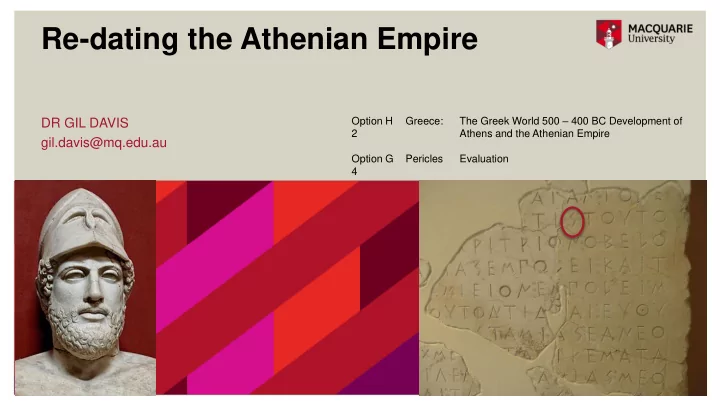
Re-dating the Athenian Empire

DR GIL DAVIS gil.davis@mq.edu.au

Option H Greece: The Greek World 500 – 400 BC Development of 2 Athens and the Athenian Empire Option G Pericles Evaluation 4
slide-2
SLIDE 2

2 Department of Ancient History

What I will discuss

  • The nature of the problem & why it is important
  • The history of the 3-bar sigma debate – the “sigma-enigma”*
  • New dating criteria
  • Old & new dates
  • 2 case studies
  • Dating imperialism
  • Cavalcade. Block II from the west frieze
  • f the Parthenon, ca. 447–433 B.C.

* A. Henry, ZPE 120 (1998) 45-8

slide-3
SLIDE 3

3

The nature of the problem & why it is important

Department of Ancient History

* Our understanding of the Athenian Empire is based upon three types of evidence:

  • 1. Texts, including Thucydides, Plutarch, Xenophon, Diodorus Siculus, plays etc
  • 2. Archaeology, including artefacts such as coins
  • 3. Inscriptions

* There has been a tendency to privilege the first type of evidence, especially Thucydides, with absence of evidence often being seen as significant * Epigraphical evidence from inscriptions can pose interpretive difficulties due to missing

  • r damaged sections, especially dates which rely mainly on the name of the eponymous

Archon being preserved. In the absence of this, epigraphists have relied upon other criteria

slide-4
SLIDE 4

4

The history of the 3-bar sigma debate

Department of Ancient History

Athenian tribute lists in the Athens Epigraphical Museum. It is worth remembering how much is restored, and missing! Cf. Stroud 2006

  • ATL published in 1939
  • Used the 3-bar sigma lettering criterion which held

that no Athenian public document containing this form (as opposed to the Ionic 4-bar sigma) could predate the year 446 B.C. (= date of last aparchē inscription – IG I3 265)

  • Cf use of ‘tailed rho’
  • From 1961, Harold Mattingly alone opposed
  • In 1990, Chambers, Gallaci & Spanos used photo-

enhancement & laser scanning to argue that the archon on the Egesta decree was [Ant]iphon (418/7 B.C.), not [Ha]bron (dated 458/7 B.C.).

  • It took until 2010 for this to be widely accepted
slide-5
SLIDE 5

5

New dating criteria

Department of Ancient History

  • Historical contextualisation should always take precedence over other considerations.
  • Grammatical observations can be good guidelines: similarity in diction, syntax, idioms and

similia offer good comparison anchors.

  • Archon names appear in the prescripts of Attic decrees from 421/0 onwards. Clearly

something caused the Athenians to reorganise their bureaucratic protocol (perhaps the Peace

  • f Nicias).

(Papazarkadas 2009, 68)

But, not every 5th-century inscription must be down-dated; it only means that the later date cannot be ruled out on account of its letter forms.

(Rhodes 2008, 503)

slide-6
SLIDE 6

6

Key decrees – old orthodox dating

M&L IG I3 M&L date Subject Context 31 10 469-50 Phaselis Compelling court cases to be held at Athens 37

  • 11. a

458/7 ? (S)Egesta Involvement in Sicily 40 14

  • c. 453/2

Erythrae Allied submission - requirement for members

  • f the League to bring offerings to Great

Panathenaia 44 35

  • c. 448

Athena Nike Acropolis building program 45 1453 + ors 450-46 Coinage etc Enforcing the use of Athenian coins, weights and measures 46 34 447 ? Tribute (Clinias) Tightening up tribute collection – allies as cash cows 47 37 447/6 ? Colophon Treaty imposing democracy 52 40 446/5 Chalcis Oath of loyalty to Athens

Department of Ancient History

slide-7
SLIDE 7

7

Key decrees – new dating

M&L IG I3 M&L date New date Subject/Context 40 14

  • c. 453/2

435/4 Erythrae: Allied submission - requirement for members of the League to bring offerings to Great Panathenaia 47 37 447/6 ? 428/7 Colophon: Treaty imposing democracy 31 10 469-50 420s Phaselis: Compelling court cases to be held at Athens 46 34 447 ? 425/4 Clinias: Tightening up tribute payment 45 1453 + ors 450-46 425 Coinage: Enforcing the use of Athenian coins, weights and measures 52 40 446/5 424/3 Chalcis: Oath of loyalty to Athens 44 35

  • c. 448

424/3 Athena Nike: Acropolis building program 37

  • 11. a

458/7 ? 418/7 (S)Egesta: Involvement in Sicily

Department of Ancient History

slide-8
SLIDE 8

8

Case studies

Department of Ancient History

IG I3 35 – Athena Nike decree

[ἔδοχσεν τeι βολeι καὶ τo]ι [δέ]μ̣ο̣[ι·…] 1 [……ἐπεστάτει..8].ι̣κος εἶπε· [τeι] [Ἀθεναίαι τeι Νί]κ̣ει hιέρεαν hὲ ἄγ̣[..] […..11…..]ι ἐχς Ἀθεναίον hαπα[σο] [ν…7….].σ̣θ̣αι καὶ το hιερὸν θυρoσα- 5 ι καθ’ ὅ τι ἂν Καλλικράτες χσυγγράφσ- ει· ἀπομισθoσαι δὲ τὸς πολετὰς ἐπὶ τ- eς Λεοντίδος πρυτανείας· φέρεν δὲ τ- ὲν hιέρεαν πεντέκοντα δραχμὰς καὶ τὰ σκέλε καὶ τὰ δέρματα φέρεν τoν δε- 10 μοσίον· νεὸν δὲ οἰκοδομeσαι καθότι ἂν Καλλικράτες χσυγγράφσει καὶ βο- μὸν λίθινον. vac. hεστιαῖος εἶπε· τρeς ἄνδρας hελέσθ- αι ἐγ βολeς· τούτος δὲ μετ[ὰ] Καλλικρά- 15 [το]ς χσυγγράφσαντας ἐπ[….10……] [..4..]ει καθ’ ὅ τι ἀπομ̣[ισθοθέσεται..] […6…] ε̣ι [.] ος […..18……..]

  • c. 448 or 424/3 B.C. ?
slide-9
SLIDE 9

9

Case studies

Department of Ancient History

IG I3 35 – Athena Nike decree […].ikos proposed: to select (or: establish) as a priestess for Athena Nike whoever will be [allotted] from all Athenian women and to provide the sanctuary with doors in whatever way Kallikrates will specify; and the poletai are to place the contract within the prytany

  • f Leontis; the priestess is to receive fifty drachmai and

to receive the backlegs and hides of the dêmosios sacrifices; and that a temple be built in whatever way Kallikrates may specify and a stone (marble) altar. vac. Hestiaios proposed: that three men be selected from the boulê; and that they will make the specifications with Kallikrates and […..] in accordance with [the contracts…]

  • The polis decided to honour Athena

with new sacrifices

  • Paid by the dēmos to garner her

support or thank her for victory

  • Radical step of creating a new

priestess selected from all Athenians (not a genē)

  • Glorious new temple and altar
  • Priestess

appointed for life and renumerated by perquisites + 50

  • drachmae. p.a.
slide-10
SLIDE 10

10

Case studies

Department of Ancient History

IG I3 35 – Athena Nike decree

  • Post quem is 448 when the Acropolis building program was conceived. The embellishment of

the cult of Athena Nike and the construction of her temple are part of this.

  • Ante quem is IG I3 36 which refers explicitly to the earlier decision conventionally dated to

424/3.

  • The temple was built in the 420s and Mattingly suggested the decrees should be associated

with this.

  • BUT:
  • The decree could have been associated with the commissioning of the building works in

448.

  • The plan of the temple required integration with the SW wing of the Propylaea begun in

437; there was a large treasury of Nike in her sanctuary before 433/2 which could have required doors. So there are several plausible historical contexts

slide-11
SLIDE 11

11

Case studies

Department of Ancient History

IG I3 1453 & ors – The Coinage Decree

  • Many examples all found outside Athens: Smyrna; Olbia

(?); Aphytis (in Macedonia); Kos, Siphnos and Syme (islands); Hamaxitos (in the Troad)

  • No fragment has a date or datable reference
  • Numismatic evidence is no help
  • Kos fragment inscribed in Attic with the 3-bar sigma

Possible dates:

  • 449 – ‘missing year’ on the ATL
  • 414 - Aristophanes Birds 1040 ff parodies the decree
  • Mid 420s = consensus
slide-12
SLIDE 12

12

Case studies

Department of Ancient History

IG I3 1453 & ors – The Coinage Decree

  • Aphytis fragment is in two parts. The 1st fragment was published in 1935
  • The 2nd fragment was discovered in 1969 but “languished unrecognized” until publication in

2003 by Miltiades Hatzopoulos

  • The second fragment (non-joining) preserves the end of the stele

So what?

The Smyrna fragment contains the same final words as the Aphytis fragment, but its text continues for another 9 lines, with big discrepancies in content. Major implications for epigraphical method. Cannot assume a ‘composite’ text. Different copies were set up tailored to local circumstances. Was there more than one date and/or more than

  • ne decree? (Per R. Stroud [2006], 18-26)
slide-13
SLIDE 13

13

Dating imperialism

  • The word ‘empire’ has pejorative connotations - changed over (modern) time
  • Inscriptions attest to democratic practice
  • Thucydides (1.95-9) – summarises substantive change from 478 – 467 from hēgemonia

(popular leadership) to archē (exacting rule/control)

  • He portrays Athenian empire as moderate under Pericles, but harsh under Cleon and his fellow
  • demagogues. Scholars tend to read the ‘tone’ of inscriptions through this prism
  • A down-dating (or redating back) of many of the inscriptions to 430s/420s fits this literary

evidence better

  • Harris (2016) argues that paired opposites of demokratia/oligarchia enter discourse in the

context of tensions with Sparta. Word demokratia 1st appears in the 420s – cf. Pericles’ funeral

  • ration (Thuc. 2.37.1). Previously Athens based her right to lead on fighting the Persians and
  • pposing tyranny.
  • Was there ever any intention to have an empire?

Department of Ancient History

slide-14
SLIDE 14

14

Select Bibliography

Department of Ancient History

  • J. Blok, ‘The priestess of Athena Nike: A new reading of IG I3 35 and 36’, Kernos [Online] 27 (2014).
  • M. H Chambers, R. Galluci, P. Spanos, ‘Athens’ Alliance with Egesta in the year of Antiphon’, ZPE 83

(1990), 38-57.

  • E. Harris, ‘The Flawed Origins of Greek Democracy’, in A. Havliček, C. Horn and J. Jinek (Eds.), Nous,

Polis, Nomos (Academia Verlag 2016), 43-55. * A. P. Matthaiou, R. Pitt (Eds.), Athinaion Episkopos: Studies in honour of Harold B. Mattingly (Athens 2014).

  • H. Mattingly, ‘The Athenian Coinage Decree’, Historia 10 (1961), 148-88.
  • H. Mattingly, The Athenian Empire Restored (Ann Arbor 1999).

* J. Ma, N. Papazarkadas, R. Parker (Eds.), Interpreting the Athenian Empire (Duckworth 2009).

  • P. Rhodes, ‘After the Three-Bar Sigma Controversy: The History of Athenian Imperialism Reassessed’,

Classical Quarterly 58 (2008), 501-6.

  • R. Stroud, The Athenian Empire on Stone. David M. Lewis Memorial Lecture Oxford 2006. (Athens 2006).

* Collection of articles, many of which are useful in this debate.

slide-15
SLIDE 15

Thank you

ANY QUESTIONS?