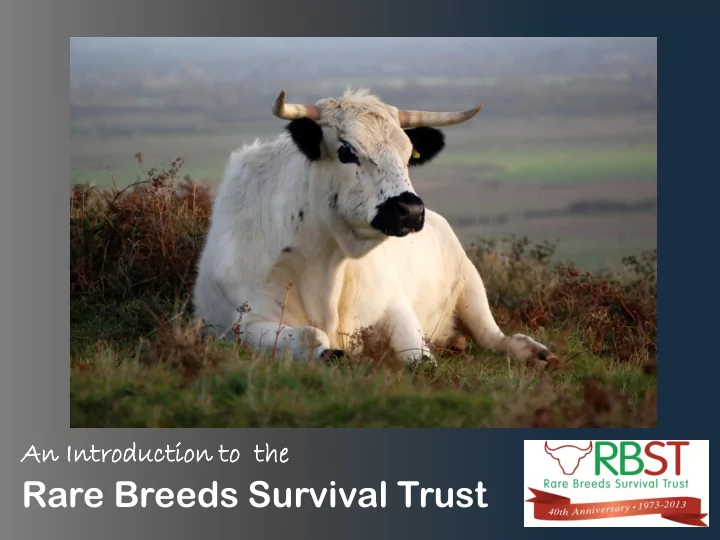
SLIDE 1 An Introdu ductio tion to t the
Rare Breeds Survival Trust
Presen ented ted by
John Halmshaw
SLIDE 2
- Registered Charity in its 40th Year
- Patron is HRH Prince of Wales (1987)
- Dedicated to the protection and
conservation of Britain’s farm livestock heritage
- Since formation it has halted the
extinction of ANY native UK breeds
- National - HQ is at Stoneleigh Park
- Funding - Membership, Legacies,
Donations
Who and what is the RBST
SLIDE 3 Origins of RBST In 1973 RBST was founded to conserve UK native farm animal genetic resources. Between 1923 and 1973 26 26 British farmed breeds became EXTINCT including: Cattle: Alderney, Suffolk Dun, Sheeted Somerset, Castlemartin,
Caithness, Irish Dun
Sheep: Limestone, St Rona’s Hill, Roscommon, Rhiw Pigs: Ulster White, Small White, Yorkshire Blue & White, Dorset
Gold Tip, Lincolnshire Curly Coat, Cumberland.
Horses: Manx, Cushendale, Tiree, Long Mynd, Galloway,
Goonyhill
SLIDE 4 Status of Cattle Breeds in 1973
Belted Galloway British White Blue Albion Dexter Gloucester Irish Dun Irish Moiled Kerry Longhorn Northern Dairy Shorthorn Red Poll Shetland White Park Welsh Black (Belted)
SLIDE 5 Park Cattle Registration Programme
The park cattle registration programme in Britain was started in 1918 but registrations lapsed during
- 1946. By then only the Dynevor,
Woburn, Whipsnade and Cadzow herds survived as domesticated
- herds. The ancient herds at Vaynol
in Wales and Chillingham herd having become semi-feral. 1973 the Rare Breeds Survival Trust was formed in Britain and the following year the registration programme was revived for the remaining British herds in the “white Park” herd book. Numbers have increased and now exceed 1,000 breeding cows in the UK.
SLIDE 6
Breed Monitoring Annual Assessment RBST Classification of Rare Breeds
SLIDE 7 Protecting a National Treasure
In 1940 one or two pairs of White Park cattle from the Cadzow herd were exported to Canada to preserve a British “national treasure” from the threat of Nazi invasion. They where kept at the Toronto Zoo. The Canadian offspring of those cattle were transferred to the Bronx Zoo but facilities there were inadequate for their long term housing and they where moved to the King Ranch in Texas where they remained for the next 40 years before being purchased by Mr. &
- Mrs. John Moeckly of Polk City,
Iowa.
SLIDE 8
Highland Cattle
NATIVE > 1500 Contrary to common thought this breed has never appeared on any of the RBST Priority / Watchlists
SLIDE 9
Survivor - Belted Galloway
NATIVE > 1500 Over 20% depletion in breed numbers due to FMD 1974 1992 VULNERABLE MINORITY 2012
SLIDE 10 Breed Conservation - Special Herds
Chillingham Wild Cattle
Northumberland
CRITICAL
SLIDE 11 CRITICAL
Vaynol Cattle
Temple Newsham
Breed Conservation - Special Herds
SLIDE 12
Using Native Breeds - Meat
Slower maturing animals - high taste meat Produced & finished within ‘natural’ environment Increasingly used by Top Chefs Difficulties in production and marketing
SLIDE 13 Using Native Breeds - Meat
“White park beef was really excellent: softly chewy, with that strong, distinctive, almost corrupt flavour
- f proper beef… it was the best steak I’ve had this
year” AA Gill the food critic said in the Sunday Times 2012
SLIDE 14
Using Native Breeds - Meat
“White parks beef reputation was first established in August 1617, when after a days hunt at the medieval castle Hoghton Tower Near Preston, King James 1 sat down to his dinner and declared “finer beef nae man ever put his teeth into…Henceforth, it shall be Sir-Loin”
SLIDE 15
Conservation Grazing
SLIDE 16
Thank nk yo you for listening ening to the RB RBST ST an and Wh Whit ite Park k talk this evening, ning, on th n the back k of the Wa Watch list are members bership hip application lication forms. s.