Ranking climate change adaptation options through multi-criteria - - PDF document

ranking climate change adaptation options through multi
SMART_READER_LITE
LIVE PREVIEW

Ranking climate change adaptation options through multi-criteria - - PDF document

20/01/2014 Ranking climate change adaptation options through multi-criteria analysis Karianne de Bruin Senior Research Fellow CICERO NZCCRI Seminar Series Wednesday 4 th December 2013 Multi criteria analysis Cost benefit analysis


slide-1
SLIDE 1

20/01/2014 1

Ranking climate change adaptation

  • ptions through multi-criteria analysis

Karianne de Bruin Senior Research Fellow – CICERO

NZCCRI Seminar Series Wednesday 4th December 2013

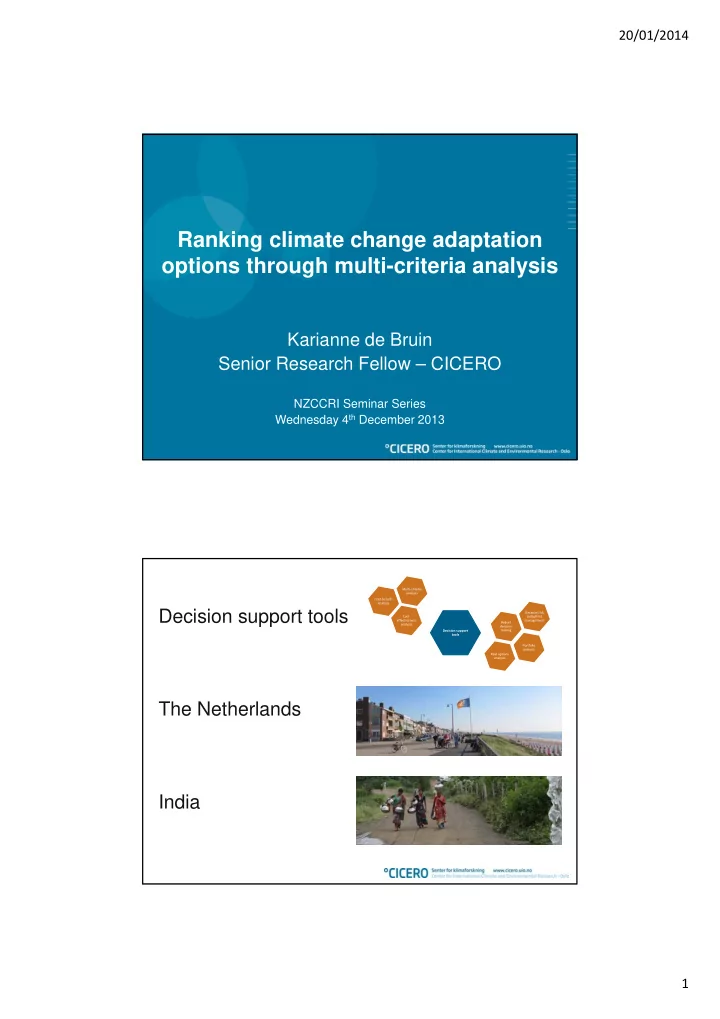
Decision support tools The Netherlands India

Robust decision making Decision support tools Multi‐criteria analysis Cost‐ effectiveness analysis Portfolio analysis Real options analysis Iterative risk (adaptive) management Cost‐benefit analysis

slide-2
SLIDE 2

20/01/2014 2

Decision support tools

Robust decision making

Decision support tools

Multi‐criteria analysis Cost‐ effectiveness analysis Portfolio analysis Real options analysis Iterative risk (adaptive) management Cost‐benefit analysis

slide-3
SLIDE 3

20/01/2014 3

Robust decision making

Decision support tools

Multi‐ criteria analysis

Cost‐ effectiveness analysis Portfolio analysis Real options analysis Iterative risk (adaptive) management Cost‐benefit analysis

Multi-Criteria Analysis

Approach that allows consideration of both quantitative and qualitative data in the ranking of alternative options Systematic method for assessing and scoring options against a range of decision criteria

slide-4
SLIDE 4

20/01/2014 4

Approach (1)

  • Identify alternative options
  • Select criteria
  • Scores options against criteria
  • Assign weights to each criterion
  • Calculate weighted sum
  • Rank options

Approach (2)

Urgency Feasibility Costs …

3 2 1 5 4 3 5 5 5

slide-5
SLIDE 5

20/01/2014 5

Strengths

  • Combine quantitative

and qualitative data

  • Transparent and

simple method

  • Involvement

stakeholders

  • Subjective scoring

and weighting

  • Analysis of

uncertainty

Weaknesses Application to adaptation

  • Consideration of relevant criteria
  • Analysis with qualitative information
slide-6
SLIDE 6

20/01/2014 6

Multi Criteria Adaptation Assessment in the Netherlands

Photo: Karianne de Bruin

Background (1)

Routeplanner project

  • Formulation of adaptation
  • ptions
  • A qualitative assessment
  • f adaptation options
  • A quantitative

assessment of adaptation

  • ptions
slide-7
SLIDE 7

20/01/2014 7

Background (2)

Project team

Environmental Economics and Natural Resources group – Wageningen University In co-operation with: RIZA, RIKZ, ESA-WUR, Alterra, LEI, PRI, Erasmus University

Funding

BSIK program’s Climate change Spatial Planning, Living with Water, Habiforum

Governmental departments in cooperation with the Associations of Provincial Authorities, Netherlands Municipalities and Water Boards

Starting point

Climate change scenario relevant for the Netherlands for the period up to 2050

Source: KNMI, 2006

slide-8
SLIDE 8

20/01/2014 8

Methodology

  • Identification of adaptation options
  • Characteristics of the options
  • Definition of criteria
  • Determining the scores
  • Determining the weights

MCA for ranking the adaptation options

Identification options

96 adaptation options identified Sectors:

  • Agriculture
  • Nature
  • Water
  • Energy & Transport
  • Housing & Infrastructure
  • Health
  • Recreation & Tourism
slide-9
SLIDE 9

20/01/2014 9

Criteria for scoring (1)

Evaluation criteria Importance Urgency No-regret characteristics Co-benefits Effect on mitigation

Criteria for scoring (2)

Feasibility criteria Technical complexity Social complexity Institutional complexity

slide-10
SLIDE 10

20/01/2014 10

Scoring

Options scored on evaluation and feasibility criteria by experts

Ranking

Ranking based on

  • rdered criteria (e.g. 1

urgency, 2 importance, etc.) Ranking based on criteria weighting (e.g. 40% importance, 20% urgency)

Criteria Ordering Weights Importance 1 40% Urgency 2 20% No regret 3 15% Ancillary benefits 4 15% Mitigation effect 5 10% Criteria Ordering Weights Importance 1 40% Urgency 2 20% No regret 3 15% Ancillary benefits 4 15% Mitigation effect 5 10%

slide-11
SLIDE 11

20/01/2014 11

Database Results (1)

Highest priority (weighted summation)

  • Integrated nature and water management
  • Integrated coastal zone management
  • More space for water
  • Risk based allocation policy
  • Risk management as basic strategy
  • New institutional alliances
  • Design and implementation of ecological networks
  • Construct buildings differently
  • Change modes of transport
  • Make existing and new cities robust
slide-12
SLIDE 12

20/01/2014 12

Results (2)

Lowest priority (weighted summation)

  • Subsoil drainage of peat lands
  • Reclamation of (part of) southern North Sea
  • Abandoning of the whole of low-lying Netherlands
  • Self sufficiency in production of roughage

Follow-up

National Strategy on Adapting Spatial Planning to Climate Change (ARK), with the aim of ‘climate proofing’ the Netherlands From the National Adaptation Strategy to the Deltaprogramme, where the Dutch government formulated new priorities in the field of adaptation to climate change

http://www.climateresearchnetherlands.nl/ARKprogramme http://www.deltacommissie.com/en/advies

slide-13
SLIDE 13

20/01/2014 13

Participatory assessment

  • f adaptation options, India

Photo: Karianne de Bruin

Background (1)

Pilot project ‘Extreme risks, vulnerabilities and Community- Based Adaptation (EVA)’ in India Impacts of extreme weather events on agriculture and water resources in the drought-prone Jalna district, Maharashtra

slide-14
SLIDE 14

20/01/2014 14

Background (2)

Five partners in consortium: AFPRO, TERI and CIENS (NIBR, CICERO, NIVA) Funded by the Norwegian Embassy, New Delhi

Participatory assessment

  • Long-list of 26 adaptation options

identified, focused on agriculture, water and social development

  • Definition of criteria
  • Block-level officers and at village cluster

level rank criteria and score adaptation

  • ptions
slide-15
SLIDE 15

20/01/2014 15

Field work

Photos: Ulka Kelkar & Karianne de Bruin

Preliminary results (1)

  • Construction of water conservation structures
  • Educating youth
  • Integrated farming system
  • Ground water regulation
  • Water budgeting
slide-16
SLIDE 16

20/01/2014 16

Preliminary results (2)

  • Water

conservation

  • Drip irrigation
  • Women’s capacity

building

  • Strengthening of

self-help groups for credit

Photo: Karianne de Bruin

Multi-criteria analysis

Decision support tools Multi‐ criteria analysis

Cost‐ effectiveness analysis Cost‐benefit analysis

slide-17
SLIDE 17

20/01/2014 17

Summary

  • Decision-support tool to assess and rank

adaptation options

  • Broad applicability
  • Combine with economic assessment of

costs and benefits

Strengths

  • Combine quantitative

and qualitative data

  • Transparent and

simple method

  • Involvement of

experts and stakeholders

  • Subjective scoring

and weighting

  • Analysis of

uncertainty

Weaknesses

slide-18
SLIDE 18

20/01/2014 18

References

  • De Bruin, K., R.B. Dellink, A. Ruijs, L. Bolwidt, A. van Buuren, J.

Graveland, R.S. de Groot, P.J. Kuikman, S. Reinhard, R.P. Roetter, V.C. Tassone, A. Verhagen and E.C. van Ierland (2009). Adapting to climate change in The Netherlands: an inventory of climate adaptation options and ranking of alternatives. Climatic Change 95(1-2): 23-45 (doi: 10.1007/s10584-009-9576-4)

  • Van Ierland, E.C., de Bruin, K., and Watkiss, P. (2013). Multi-Criteria

Analysis: Decision Support Methods for Adaptation, MEDIATION Project, Briefing Note 6. Funded by the EC’s 7FWP – including references for further reading

  • Van Ierland, E.C., de Bruin, K. and R.B. Dellink, forthcoming.

Prioritisation of adaptation options for the Netherlands: A Multi- Criteria Analysis. Climate Change Adaptation Manual, Lessons learned from European and Other Industrialised Countries. Edited by: A. Prutsch, T. Grothmann, S. McCallum, I. Schauser and R.

  • Swart. Routledge
slide-19
SLIDE 19

20/01/2014 19

Thank you for your attention

Contact details: karianne.debruin@cicero.oslo.no

Photo: Karianne de Bruin