SLIDE 1
1
Range Definitions
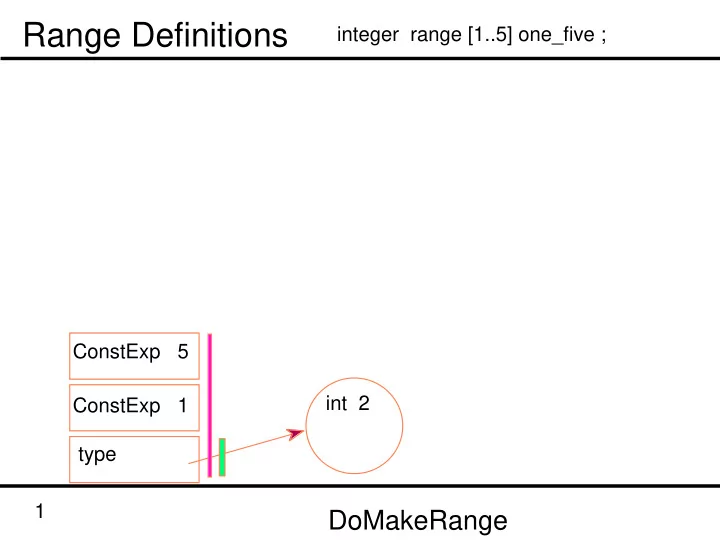
type ConstExp 5 integer range [1..5] one_five ;
DoMakeRange
int 2 ConstExp 1
SLIDE 2
2
Range Definitions
type ConstExp 5 integer range [1..5] one_five ;
DoMakeRange
int 2 ConstExp 1 range 2 lo=1 hi = 5 bo =4 base = newType C1 ... ... int 1 int 5
SLIDE 3
3
Range Definitions
type integer range [1..5] one_five ;
DoMakeRange
int 2 range 2 lo=1 hi = 5 bo = 4 base = newType
SLIDE 4
4
Array Definitions
type mark integer array [one_five] [one_three] *a, b ;
DoMakeArray
int 2 Assumes we have previously defined integer range [1..5] one_five; integer range [1..3] one_three; type type range 1 3... range 1 5...
SLIDE 5
5
Array Definitions
in DoMakeArray
int 2
finalType
integer array [one_five] [one_three] *a, b ; type mark type type range 1 3... range 1 5...
SLIDE 6
6
Array Definitions
in DoMakeArray
int 2
finalType currentType
array 6 subs= comp= integer array [one_five] [one_three] *a, b ; range 1 3... type mark type type
SLIDE 7 7
Array Definitions
in DoMakeArray
integer array [one_five] [one_three] *a, b ; At end of loop
int 2
finalType currentType
array 6 subs= comp= range 1 3... type mark type type
SLIDE 8
8
Array Definitions
in DoMakeArray
array 30 subs= comp= integer array [one_five] [one_three] *a, b ;
finalType
int 2
finalType currentType
array 6 subs= comp= range 1 3... range 1 5... type mark type type
SLIDE 9
9
Array Definitions
in DoMakeArray
integer array [one_five] [one_three] *a, b ; End of 2nd pass array 30 subs= comp=
finalType
int 2
finalType currentType
array 6 subs= comp= range 1 3... range 1 5... type mark type type
SLIDE 10
10
Array Definitions
in DoMakeArray
integer array [one_five] [one_three] *a, b ; array 30 subs= comp=
finalType
int 2
finalType currentType
array 6 subs= comp= range 1 3... range 1 5... type mark type type
SLIDE 11
11
Array Definitions
DoDeclVars exactly as before
integer array [one_five] [one_three] *a, b ; array 30 subs= comp= int 2 array 6 subs= comp= type range 1 3... range 1 5...
SLIDE 12
12
Array Definitions Notes: Type pointers represent linked lists (if we have records then trees actually) We may need to “walk” the list to process an array type. The “head” pointer represents the type as a whole.
SLIDE 13
13
Subscript reduction
x := a[ 3 ] • [ m] ; expr “x” expr int 3
Subscript
expr “a” (1,4,false) array 30 subs= comp= array 6 subs= comp= range 1 3... range 1 5... int 2
SLIDE 14
14
Subscript reduction
expr “x” expr “a” (1,4,false) expr int 3
in Subscript
LD R0, #3 TRNG R0, +..(R14) IS R0, #1 IM R0, #6 LDA R1, +4(R15) IA R1, R0 x := a[ 3 ] • [ m] ; array 30 subs= comp= array 6 subs= comp= range 1 3... range 1 5... int 2
SLIDE 15
15
Subscript reduction
expr “x” expr var (0,1,true) this represents a[3] x := a[ 3 ] • [ m] ;
in Subscript
LD R0, #3 TRNG R0, +..(R14) IC R0, #1 IM R0, #6 LDA R1, +4(R15) IA R1, R0 array 30 subs= comp= array 6 subs= comp= range 1 3... range 1 5... int 2
SLIDE 16
16
Subscript reduction
x := a[ 3 ] [ m ] • ; expr “x” expr var (0,1,true)
Subscript(second call)
expr “m” (1,6,false) LD R0, #3 TRNG R0, +..(R14) IS R0, #1 IM R0, #6 LDA R1, +4(R15) IA R1, R0 array 30 subs= comp= array 6 subs= comp= range 1 3... range 1 5... int 2
SLIDE 17
17
Subscript reduction
expr “x” expr var (0,1,true)
in Subscript(second call)
LD R0, #3 TRNG R0, +..(R14) IS R0, #1 IM R0, #6 LDA R1, +4(R15) IA R1, R0 LD R0, +6(R15) TRNG R0, +..R14) IS R0 #1 IM R0, #2 IA R1, R0 expr “m” (1,6,false) x := a[ 3 ] [ m ] • ; array 30 subs= comp= array 6 subs= comp= range 1 3... range 1 5... int 2
SLIDE 18
18
Subscript reduction
expr “x” expr var (0,1,true)
Assign: exactly as before
LD R0, #3 TRNG R0, +..(R14) IS R0, #1 IM R0, #6 LD R1, +4(R15) IA R1, R0 LD R0, +6(R15) TRNG R0, +..R14) IS R0, #1 IM R0, #2 IA R1, R0 This represents a[ 3] [ m ] x := a[ 3 ] [ m ] ;• array 30 subs= comp= array 6 subs= comp= range 1 3... range 1 5... int 2
SLIDE 19 19
Subscript reduction Notes: ReduceSubscript handles only one
- subscript. It is called multiple times if
there are many. It needs to check its two entries for legality--top = integer type, next has array type.
SLIDE 20
20
Range Checking
HALT C1 INT 1 INT 3 Bounds offset for this array would be +0(R14)
back in DoMakeRange
integer range [1..3] one_three ; type ConstExp 3 int 2 ConstExp 1 range 2 lo=1 hi = 3 bo =0 base = newType Assuming no constants had yet been allocated in C1 block
SLIDE 21
21
Range Checking
HALT C1 INT 1 INT 3 INT 1 INT 5 Bounds offset for this array would be +4(R14) In actuality, you enter two constants into the constant table, lobound and highbound integer range [1..5] one_five ; type ConstExp 5 int 2 ConstExp 1 range 2 lo=1 hi = 5 bo =4 base = newType