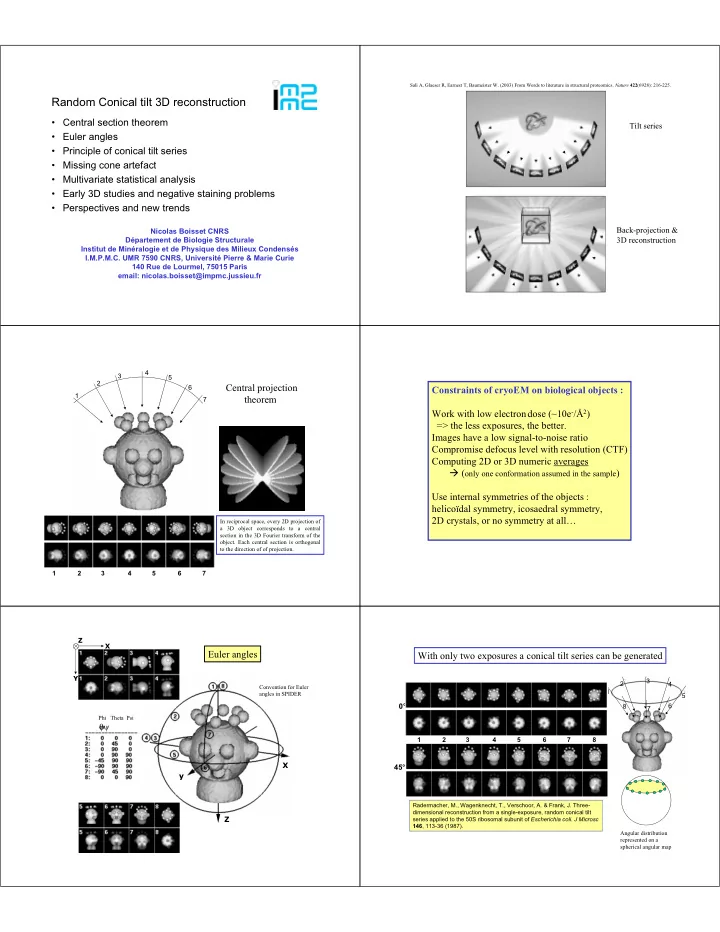
SLIDE 4 Original side views Aligned side views Alignment Determination
MSA and clustering 5 views
A simplified and therefore mathematically incorrect description of Correspondence analysis (CORAN) To get the “flavour” of this method.
You have normalized, aligned a set of noisy images and you want to sort them automatically. (For correspondence analysis no negative density is tolerated, while for principal component analysis (PCA) you don’t care). 1- Create a mask following the shape of the total average 2- For each image, extract all densities from the pixels falling within the mask and re-dispose then into a line.
Image No1 Image No76 Pixel 1 Pixel 2754 Sum per colum Sum per line Total sum
K
ij
fI .
K
ij
3- Place theses lines of densities into a table 4- An other way to consider the data is to say that these densities are coordinates in a multidimensional space. 5- Hence in this example, each image having 2754 pixels under le mask, our data set corresponds to 76 images, that we can consider as 76 dots in a space of 2754 dimensions. “Intelligenti pauca” = intelligent people understand each other with a few words ! …
1. Absolute values frequencies Kij Kij / kij = fij
- 2. Euclidian distance 2 distance
fij fij / fi. f.j
Origine changed to the center of gravity
- f the table = -f.j
- 4. Diagonalization of the covariance matrix
Xij = (fij – fi. f.j) / fi. f.j equivalent to a least square fit to define new factorial axes (eigen vectors) and the coordinates of each image on these axes.
Intuitively one can guess that two identical images will have similar coordinates in the multi-dimensional space. Therefore in the multidimensional space they correspond to two dots located near each other. Conversely, two dissimilar images will correspond to two dots located far away from each other. Multi-dimensional statistical analysis (MSA), reinforces this idea of “similarity = proximity” but it changes the coordinate system of our data set in order to reduce the number of dimensions to a number a few meaningful axes. These axes or “eigen vectors” correspond to main “trends” or “variations” within our population of images.
The ALMOND approach
Space with 2754 dimensions
2 3 1
Eigen vector 1 Eigen vector 2 Eigen vector 3
One method of diagonalization of the co-variance matrix (T = X’ X), called “la méthode de la dragée” or the “Almond method” illustrates what happens at this stage. The original multi-dimensional space has been distorted by the chi square matrix to express the variations among the
- images. Schematically one can say that the cloud of 76 dots (representing our 76 images) which was originally
contained in a multi-dimensional “sphere” is now contained within a multi-dimensional “almond”. 1. The longest dimension of the almond corresponds to the major “trend” or variation among the image set and is defined as the first eigen vector. Its amplitude (length) corresponds to the first eigen value 1. Coordinates of our 76 dots along this new axis are calculated. 2. Then, the second longest dimension of the almond, orthogonal to the first eigen vector is determined (width of the almond). This second direction corresponds to eigen vector number two and corresponds to the second variation among the images. The amplitude of this second vector is the second eigen value 2. Coordinates of
- ur 76 dots along this new axis are calculated.
3. Then the third longest dimension of the alond, orthogonal to the first and second eigen vectors is determined (thickness of the almond). This third direction corresponds to eigen vector number three and corresponds to the third variation among the images. The amplitude of this third vector is the third eigen value 3. Coordinates of
- ur 76 dots along this new axis are calculated.
etc…. Eigen vector 1 Eigen vector 2 The 76 dots can be projected on planes defines by two selected eigen vectors. Here again the “proximity = similarity” rule applies, and we can identify four types of images in the example set of images. In fact, the information contained in our data is so much compressed that a set of coordinates on the eigen vectors can characterize a given image. Jean-Pierre Brétaudière and Joachim Frank designed “reconstitution and importance images” to express this relationship and to explore the variation related to each eigen vectors. For example, according to you, how looks an image having for coordinates zero on all eigen vectors ? 0, 0, 0, etc..
+0.2, 0, 0, etc..