= r x y z ( , , ) ( , , ) x y z dxdydz Dipole moment - - PowerPoint PPT Presentation

r x y z x y z dxdydz dipole moment vector for polymatomic
SMART_READER_LITE
LIVE PREVIEW

= r x y z ( , , ) ( , , ) x y z dxdydz Dipole moment - - PowerPoint PPT Presentation

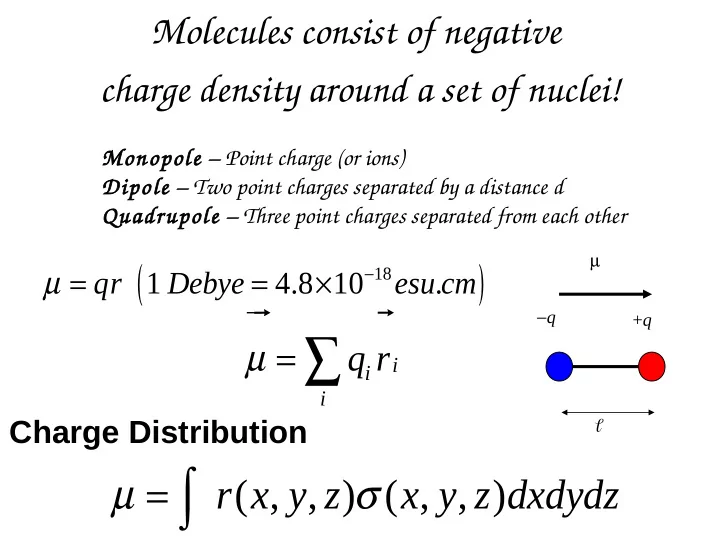
Molecules consist of negative charge density around a set of nuclei! Monopole Point charge (or ions) Dipole Two point charges separated by a distance d Quadrupole Three point charges separated from each other u r r ( )


slide-1
SLIDE 1

Molecules consist of negative charge density around a set of nuclei!

i i i

q r

µ = ∑

u r r

( , , ) ( , , ) r x y z x y z dxdydz

µ σ = ∫

u r r

Monopole – Point charge (or ions) Dipole – Two point charges separated by a distance d Quadrupole – Three point charges separated from each other

Charge Distribution

( )

18

1 4.8 10 . qr Debye esu cm µ

= = × u r r

+q −q  µ

slide-2
SLIDE 2

O H H µb2 µb1 µ Cl Cl C O O Cl Cl µb µb θ µ

( )

2 bcos

2

θ

µ = µ

Dipole moment – Vector! For polymatomic molecules?

+

  • + q
  • q

µ = ql

l Note: the direction of The arrows should be reversed: In chemistry, dipole moment Direction Is from positive to negative!

slide-3
SLIDE 3

1 2

( ) E E E E α α β γ = + + u r u r u r

Induced Dipole in presence of an electric field: Polarizability

Induced dipole moment Induced dipole moment in a atom or molecule due to the polarization of charge distribution

; ( ) E Polarizability molecular property µ α α = → u r u r

β  Hyperpolarizability; γ 2nd order hyperpolarizability

2 3 0 E

E E α β γ

µ =

+ + u u r u r u r u r

α Measure of the extent to which a charge distribution around an atom or a molecule can be distorted in presence on an uniform electric field (due to ion, another dipole) Loosely relate polarizability to volume  units of volume!

slide-4
SLIDE 4

Lennard-Jones Potential

12 6

2

e e LJ

r r V r r ε       = −    ÷  ÷        

ε

e

r

Sum of the pairwise potential energy of interaction Sum of the pairwise potential energy of interaction

Nature of intermolecular potential

What are the inter- molecular interactions that contribute to the total potential energy between two species?

slide-5
SLIDE 5

Ions in Electrolyte – Charges involve strong force! Liquid Helium- Weakest interactions Energy spectrum of intermolecular interactions Energy spectrum of intermolecular interactions

Magnitudes of force vary depending on the type

  • f interaction
slide-6
SLIDE 6

Various categories of intermolecular interactions (forces)

slide-7
SLIDE 7

Ion-Ion Interaction for Charged molecules: Coulomb Potential

Interaction via Coulomb potential

1 2

( )( ) ( ) 4 q e q e V r r πε =

r

q1e Z2e

slide-8
SLIDE 8

Monopole (Ion)-dipole interaction

( )

2

, .

j i j ion dipole

q Cos V r E r µ θ θ µ

= = u r u r u r

r

slide-9
SLIDE 9

( ) ( )

2

, . : ( ) 0 , 0 !!!

j i j ion dipole ion dipole

q Cos V r E r Simple average over all Cos Sin d Cos d Cos V r

π π

µ θ θ µ θ θ θ θ θ θ θ

− −

= = = = =

∫ ∫

u r u r u r

Monopole-dipole interaction

( ) ( )

Dictated by Boltzmann Distribution , P ~ exp

B

V r Orientation k T θ   −  ÷  

Are all orientations equally probable? No! Orientations with lower energy are slightly favored! Need to calculate the average over all oreintations weighted by Boltzmann factor  Boltzman Avgerage!

slide-10
SLIDE 10

( ) ( ) ( )

2 2

, , , .exp . exp Analytically difficult, numerically easy!

j j i i ion dip BA B B

q Cos q V r V r V r Cos r k T r k T µ θ µ θ θ θ θ

    = − = −  ÷  ÷     u r u r ( )

: , interaction energy between monopole and dipole is small compared to the thermal energy ( ) 2 expand exponential function exp(- ) 1- .. 1 2!

B B

Assume V r k T k T x x x x θ << → = + − ≈ −

Boltzmann Average over all orientations

( ) ( ) ( ) ( )

, , exp 1 , ,

B B B B

V r V r Cos Cos k T k T V r V r Cos Cos Cos k T k T θ θ θ θ θ θ θ θ θ     − ≈ −  ÷  ÷     = − = −

slide-11
SLIDE 11

[ ]

3 2 2 2

2 ( ) 3 3 Cos Cos Cos Sin d Cos d Cos

π π π

θ θ θ θ θ θ θ = = − = − = ≠

∫ ∫

( ) ( )

2 2 2

, ,

j i ion dipole B j j i i B

Boltzman

q Cos V r V r r k T q q Cos Cos r r k T µ θ θ θ µ µ θ θ

    = × − ×       = − × × u r u r u r

Orientation-Averaged potential for ion-dipole interactions

( )

2 2

2 1 ,

j i ion dipole B

Boltzman

q V r Cos r k T µ θ θ

  = − × ×  ÷  ÷   u r

( )

( )

2 4

4

1 . 3

j i ion dipole B

Boltzman

q const V r k T r

r

µ

− − uu r : :

slide-12
SLIDE 12

Interactions between two dipoles!

Depending on the relative Orientation – magnitude and Sign of force will vary

slide-13
SLIDE 13

Orientation–averaged potential energy of two dipoles

Dipole-dipole interaction potential

V(r) = µ1µ2 f (θ) 4πε 0r3

f (θ) = 1− 3cos2θ

V(r) = µ1µ2 f (θ) 4πε 0r 3

Take a Boltzmann average !!

( )

2 2 1 2 2 6 6

2 1 ( ) ~ 3 4

d d B

V r r k T r µ µ πε

= −

attractive

+ q2

  • q2

+ q1

  • q1

r

θ

Consider parallel dipoles (simplified)

Temperature Dependent!

slide-14
SLIDE 14

Interaction of Ion and Induced-Dipole

Presence of a nearby Ion (charge) will affect the Electronic distribution of An atom or a neutral (non-polar) molecule Induced Dipole moment is generated, magnitude of Which depends on the Polarizability (α)!

( )

4 4

2 _

~ 2

i

ion ind dipole

q V r r r α α

= −

slide-15
SLIDE 15

Dipole Induced-Dipole Interaction

( )

2 1 2 2 6 6

_

~ 4

dipole ind dipole

V r r r µ α α π ε

= −

Not a thermal Or Boltzman Average: No temperature dependence

slide-16
SLIDE 16

Instantaneous electronic fluctuations – transient dipoles!

slide-17
SLIDE 17

µ = 0

Transient induced-dipole moments – electronic polarizabilies has to be involved - Due to correlated motion of electrons

( )

6

~

i j id id

V r r α α

Independent of Orientation and Temperature: No (KT) terms!

Induced Dipole-Induced Dipole Interaction (Dispersion force)

Termed London Forces, or dispersion! Termed London Forces, or dispersion! core of a quantum-mechanical effect! core of a quantum-mechanical effect! Can be extremely strong force if a large Can be extremely strong force if a large number of molecules are involved – number of molecules are involved – higher alkanes are solid at 300K higher alkanes are solid at 300K

slide-18
SLIDE 18

Comparison of Various Interactions