R ECOMMENDATION ON E SSENTIAL N UTRIENT (IOM) Heaney R AJH 2013 - - PowerPoint PPT Presentation

r ecommendation on e ssential n utrient iom
SMART_READER_LITE
LIVE PREVIEW

R ECOMMENDATION ON E SSENTIAL N UTRIENT (IOM) Heaney R AJH 2013 - - PowerPoint PPT Presentation

R ECOMMENDATION ON E SSENTIAL N UTRIENT (IOM) Heaney R AJH 2013 Criterion Definition Recommended Dietary The average daily dietary nutrient intake level sufficient to meet the nutrient requirement of nearly all (97 Allowance to 98 percent)


slide-1
SLIDE 1

RECOMMENDATION ON ESSENTIAL NUTRIENT (IOM)

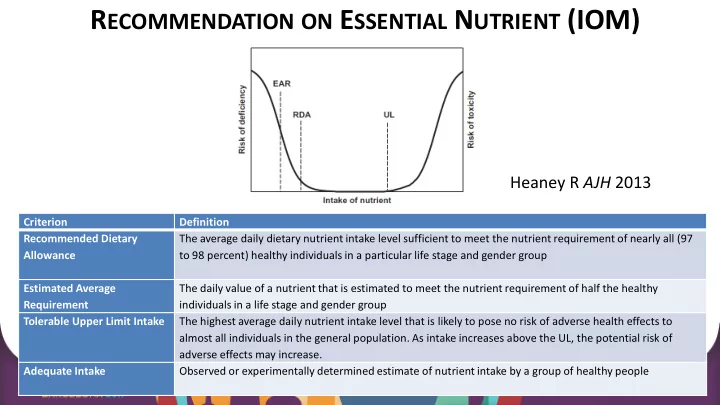
Criterion Definition Recommended Dietary Allowance The average daily dietary nutrient intake level sufficient to meet the nutrient requirement of nearly all (97 to 98 percent) healthy individuals in a particular life stage and gender group Estimated Average Requirement The daily value of a nutrient that is estimated to meet the nutrient requirement of half the healthy individuals in a life stage and gender group Tolerable Upper Limit Intake The highest average daily nutrient intake level that is likely to pose no risk of adverse health effects to almost all individuals in the general population. As intake increases above the UL, the potential risk of adverse effects may increase. Adequate Intake Observed or experimentally determined estimate of nutrient intake by a group of healthy people

Heaney R AJH 2013

slide-2
SLIDE 2

PURE: 135,335 from 667 communities in 18 (Phase 1) countries from 5 continents

Target: 200,000 people

slide-3
SLIDE 3

Mean fruit, vegetable and legume intake by region

slide-4
SLIDE 4

Risk of mortality and major CVD by total fruit, vegetable and legume intake (servings/day)

Mortality Major CVD

P-trend=0.0001

Intake HR (95% CI) 1 1.2 0.8 0.6

P-trend=0.13

Intake HR (95% CI) 1 1.2 0.8 0.6 1.4

slide-5
SLIDE 5

Risk of mortality and major CVD by raw vegetable intake (servings)

Mortality Major CVD

Excluding China

P-trend=0.0004 P-trend=0.27

Intake HR (95% CI) 1 1.2 0.8 0.6 Intake HR (95% CI) 1 1.2 0.8 0.6

<1/month 1/month to <1/week 1/week to <3/week >3/week 1.00 (1.00, 1.00) 0.86 (0.76, 0.98) 0.78 (0.68, 0.89) 0.77 (0.66, 0.89) 1.00 (1.00, 1.00) 0.86 (0.76, 0.98) 0.78 (0.68, 0.89) 0.77 (0.66, 0.89) <1/month 1/month to <1/week 1/week to <3/week >3/week 1.00 (1.00, 1.00) 0.96 (0.82, 1.13) 0.86 (0.73, 1.01) 0.91 (0.77, 1.09) 1.00 (1.00, 1.00) 0.96 (0.82, 1.13) 0.86 (0.73, 1.01) 0.91 (0.77, 1.09)

slide-6
SLIDE 6

Risk of mortality and major CVD by cooked vegetable intake (servings)

Mortality Major CVD

Excluding China

P-trend=0.011 P-trend=0.085

Intake HR (95% CI) 1 1.2 0.8 0.6 Intake HR (95% CI) 1 1.2 0.8 1.4

slide-7
SLIDE 7

Conclusions

  • Fruit, vegetables and legumes associated with a moderately

lower risk of mortality, but not CVD

  • Benefits appear to reach a maximum versus mortality at 3 to

4 daily servings (375 g)

  • Raw vegetables appear to be more protective than cooked

vegetables

  • A balanced diet of >3-4 daily servings fruit, vegs. and

legumes is associated with lower mortality