R 0 R 1 R 2 . . . Non parametric version: empirical null space - - PowerPoint PPT Presentation

r 0 r 1 r 2
SMART_READER_LITE
LIVE PREVIEW

R 0 R 1 R 2 . . . Non parametric version: empirical null space - - PowerPoint PPT Presentation

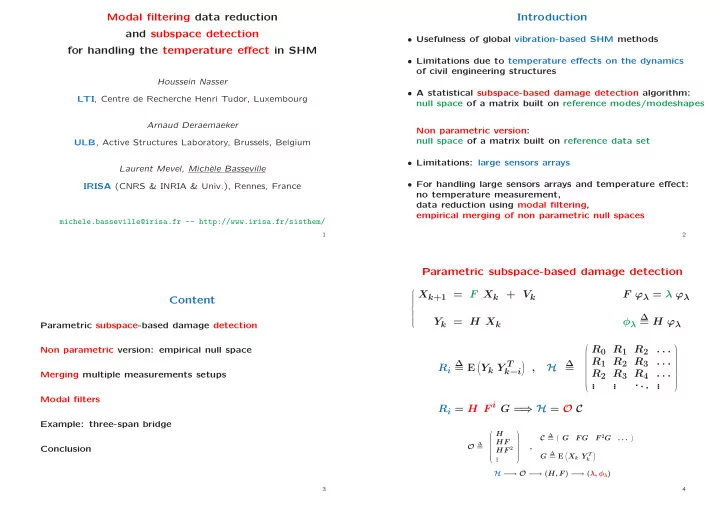
Modal filtering data reduction Introduction and subspace detection Usefulness of global vibration-based SHM methods for handling the temperature effect in SHM Limitations due to temperature effects on the dynamics of civil engineering


slide-1
SLIDE 1

Modal filtering data reduction and subspace detection for handling the temperature effect in SHM

Houssein Nasser LTI, Centre de Recherche Henri Tudor, Luxembourg Arnaud Deraemaeker ULB, Active Structures Laboratory, Brussels, Belgium Laurent Mevel, Mich` ele Basseville IRISA (CNRS & INRIA & Univ.), Rennes, France michele.basseville@irisa.fr -- http://www.irisa.fr/sisthem/

1

Introduction

  • Usefulness of global vibration-based SHM methods
  • Limitations due to temperature effects on the dynamics
  • f civil engineering structures
  • A statistical subspace-based damage detection algorithm:

null space of a matrix built on reference modes/modeshapes Non parametric version: null space of a matrix built on reference data set

  • Limitations: large sensors arrays
  • For handling large sensors arrays and temperature effect:

no temperature measurement, data reduction using modal filtering, empirical merging of non parametric null spaces

2

Content

Parametric subspace-based damage detection Non parametric version: empirical null space Merging multiple measurements setups Modal filters Example: three-span bridge Conclusion

3

Parametric subspace-based damage detection

                    

Xk+1 = F Xk + Vk F ϕλ = λ ϕλ Yk = H Xk φλ

= H ϕλ Ri

= E

 Yk Y T

k−i

  ,

H

=

              

R0 R1 R2 . . . R1 R2 R3 . . . R2 R3 R4 . . . . . . . . . ... . . .

              

Ri = H F i G = ⇒ H = O C

O ∆ =

        

H HF HF 2 . . .

        

, C ∆ =

G

F G F 2G . . .

  • G ∆

= E

  • Xk Y T

k

  • H −

→ O − → (H, F ) − → (λ, φλ)

4

slide-2
SLIDE 2

Canonical parameter : θ ∆ =

   

Λ vec Φ

   

modes mode shapes

Observability in modal basis : Op+1(θ) =

        

Φ Φ∆ . . . Φ∆p

        

θ0 : reference parameter for safe structure Left null space: ST S = Is, ST Op+1(θ0) = 0 Yk: N-size sample of new measurements Residual for SHM: ζN(θ0) ∆ = vec( ST (θ0) ˆ H )

J (θ0) : sensitivity of residual ζ w.r.t. modal changes

χ2-test: ζT

N Σ−1 J (J T Σ−1 J )−1 J T Σ−1ζN ≥ h

5

Non parametric version: empirical null space Reference data set for safe structure Left null space: ˆ ST

0 ˆ

S0 = Is, ˆ S0T ˆ H(0) = 0 Yk: N-size sample of new measurements Residual for SHM: ζN

= vec( ˆ S0T ˆ H )

Σ: covariance of ζ

χ2-test: ζT

NΣ−1ζN ≥h Non param. subspace detection

6

Merging multiple data sets at different temperatures J reference data sets : H (0)

p+1,q ∆

= 1/J

J

j=1 H (0),j p+1,q

Global empirical null space: S0 T H (0)

p+1,q = 0

Yk: N-size sample of new measurements Residual for SHM: ζN

= vec

 S0 T

ˆ H

 

Σ: covariance of ζ

χ2-test: ζT

N Σ−1 ζN ≥ h

Robust subspace detection

7

Data reduction using modal filtering

ë2 ë1

ë

n

+ ++ linear combiner

. . .

y1

z(

y) yn y2

structure

f

sensor array

  • s

s

zl orthogonal to the N modes in a frequency band of interest except mode l. More sensors than modes. ΦT α = I ; ΦT rank deficient − → SVD Z = α Y , dim(Z) < dim(Y ) Non parametric & robust subspace detection on Z.

8

slide-3
SLIDE 3

Example - Simulated three-span bridge

  • A simulator provided by ULB

Two materials: steel and concrete Excitation: uniform pressure on the first span Motion restricted to in-plane vibrations

  • Both hand sides subject to different temperature gradients
  • Four damage scenarios: stiffness reduction at three locations

Concrete Concrete DL1 DL2 DL3 Uniform pressure T=-15 to 0°C T=-15 to 45°C Damage Damage Damage

9

Non parametric subspace detection

−10 10 20 30 40 10

−1

10 10

1

10

2

Temperature

°C

Contrast Contrast of non−parametric test Contrast − level d4 Contrast − level d3 Contrast − level d2 Contrast − level d1 −10 10 20 30 40 10

−1

10 10

1

10

2

Temperature

°C

Contrast Contrast of non−parametric test Contrast − level d4 Contrast − level d3 Contrast − level d2 Contrast − level d1

Contrast between the undamaged and the four damage levels. Using 29 sensors (left). Using 10 filters (right).

10

Robust subspace detection

−10 10 20 30 40 10

6

10

7

10

8

10

9

Temperature

°C

Contrast Contrast of robust subspace detection Contrast − level d4 Contrast − level d3 Contrast − level d2 Contrast − level d1 −10 10 20 30 40 10

1

10

2

10

3

10

4

Temperature

°C

Contrast Contrast of robust subspace detection Contrast − level d4 Contrast − level d3 Contrast − level d2 Contrast − level d1

Contrast between the undamaged and the four damage levels. Using 29 sensors (left). Using 10 filters (right).

11

Conclusion

Temperature effect & large sensors arrays in vibration-based SHM Statistical non parametric approach Statistical subspace-based damage detection algorithm Empirical null space merging data at # temperatures Modal filters for data reduction Example: simulated three span bridge Ongoing: sensor noise effect Future: in-operation examples, comparison with other methods

12