Question: Rockets If there were no launch pad beneath the space - - PDF document

question rockets
SMART_READER_LITE
LIVE PREVIEW

Question: Rockets If there were no launch pad beneath the space - - PDF document

Rockets 1 Rockets 2 Question: Rockets If there were no launch pad beneath the space shuttle at lift-off, the upward thrust of its engines would be approximately unchanged. approximately half as much. approximately zero. Rockets


slide-1
SLIDE 1
  • 1

Rockets 1

Rockets

Rockets 2

Question:

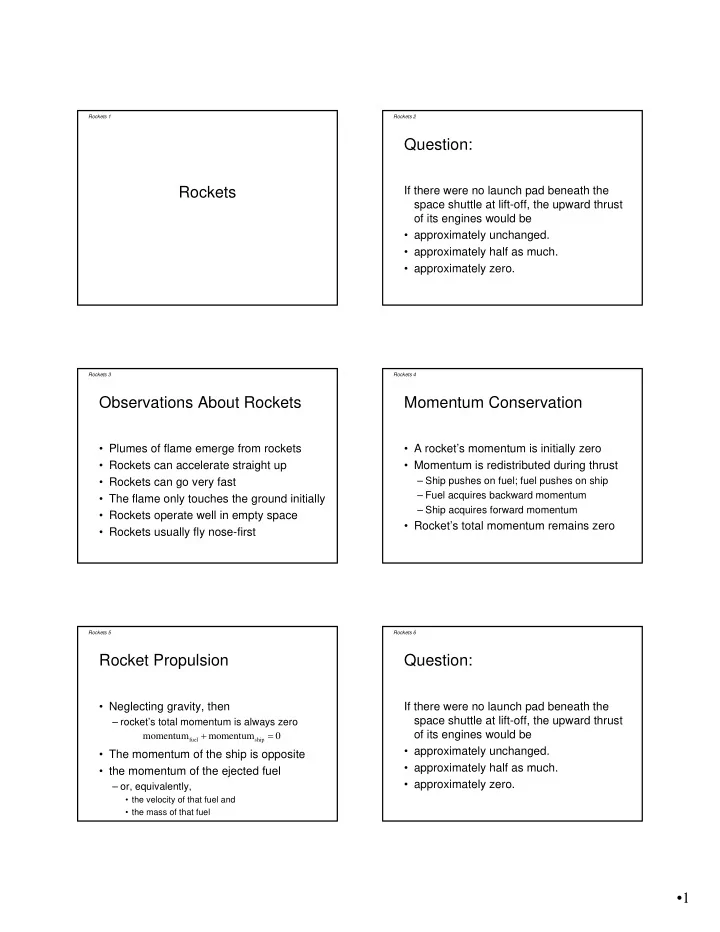
If there were no launch pad beneath the space shuttle at lift-off, the upward thrust

  • f its engines would be
  • approximately unchanged.
  • approximately half as much.
  • approximately zero.

Rockets 3

Observations About Rockets

  • Plumes of flame emerge from rockets
  • Rockets can accelerate straight up
  • Rockets can go very fast
  • The flame only touches the ground initially
  • Rockets operate well in empty space
  • Rockets usually fly nose-first

Rockets 4

Momentum Conservation

  • A rocket’s momentum is initially zero
  • Momentum is redistributed during thrust

– Ship pushes on fuel; fuel pushes on ship – Fuel acquires backward momentum – Ship acquires forward momentum

  • Rocket’s total momentum remains zero

Rockets 5

Rocket Propulsion

  • Neglecting gravity, then

– rocket’s total momentum is always zero

fuel ship

momentum momentum + =

  • The momentum of the ship is opposite
  • the momentum of the ejected fuel

– or, equivalently,

  • the velocity of that fuel and
  • the mass of that fuel

Rockets 6

Question:

If there were no launch pad beneath the space shuttle at lift-off, the upward thrust

  • f its engines would be
  • approximately unchanged.
  • approximately half as much.
  • approximately zero.
slide-2
SLIDE 2
  • 2

Rockets 7

Rocket Engines

  • Chemical reactions produce hot, high-

pressure gas

  • Gas speeds up in nozzle
  • Gas reaches sonic speed

in throat of de Laval nozzle

  • Beyond throat, supersonic

gas expands to speed up further

Rockets 8

Stability and Orientation

  • On ground, rocket needs static stability
  • In air, rocket needs aerodynamic stability

– Center of dynamic pressure behind c.o.m.

  • In space, rocket is a freely rotating object

– Orientation governed by angular momentum – Rocket’s orientation doesn’t affect its travel

Rockets 9

Ship’s Ultimate Speed

  • Increases as

– ratio of fuel mass to ship mass increases – fuel exhaust speed increases

  • If fuel were released with rocket at rest,

fuel ultimate exhaust ship

mass speed speed mass = ⋅

  • Because rocket accelerates during thrust,

ultimate speed is less than given above

Rockets 10

Gravity, Part 1

  • The earth’s acceleration due to gravity is
  • nly constant for small changes in height
  • When the distance between two objects

changes substantially, the relationship is:

1 2 2

gravitational constant mass mass force = (distance between masses) ⋅ ⋅

Rockets 11

Gravity, Part 2

  • An object’s weight is only constant for

small changes in height

  • When its height changes significantly, the

relationship is:

  • bject

earth 2

gravitational constant mass mass weight = (distance between centers of object and earth) ⋅ ⋅

Rockets 12

Gravity, Part 3

  • Even far above earth, an object has weight
  • Astronauts and satellites have weights

– weights are somewhat less than normal – weights depend on altitude

  • Astronauts and satellites are in free fall
slide-3
SLIDE 3
  • 3

Rockets 13

Orbits, Part 1

  • An object that begins to fall

from rest falls directly toward the earth

  • Acceleration and velocity

are in the same direction

Rockets 14

Orbits, Part 2

  • An object that has a

sideways velocity follows a trajectory called an orbit

  • Orbits can be closed
  • r open, and are

ellipses, parabolas, and hyperbolas

Rockets 15

Current Rocket Technology

  • X-Prize Rockets
  • Single State to Orbit Rockets
  • Improbable Dreams

– Rockets that rarely require refueling – Rockets that can land and leave large planets – Rockets that can turn on a dime in space

Rockets 16

Summary About Rockets

  • Rockets are pushed forward by their fuel
  • Total rocket impulse is the product of

exhaust speed times exhaust mass

  • Rockets can be stabilized aerodynamical
  • Rockets can be stabilized by thrust alone
  • After engine burn-out, rockets can orbit