Quantum Neural Network (QNN) - Connecting Quantum and Brain with - - PowerPoint PPT Presentation

quantum neural network qnn
SMART_READER_LITE
LIVE PREVIEW

Quantum Neural Network (QNN) - Connecting Quantum and Brain with - - PowerPoint PPT Presentation

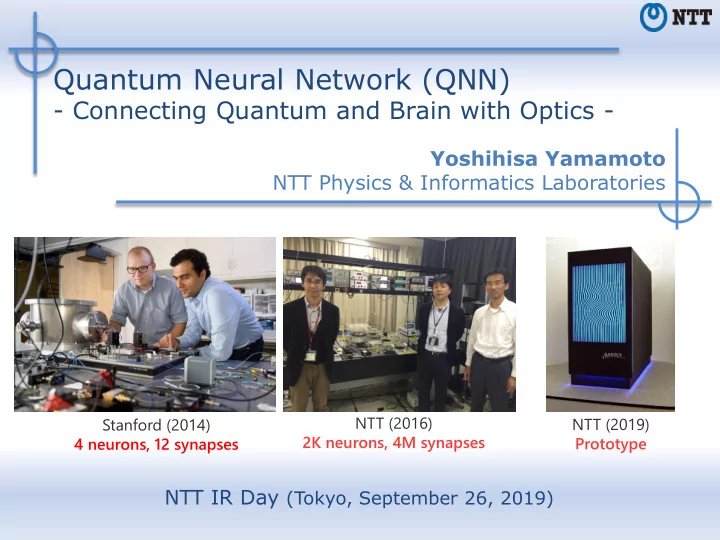
Quantum Neural Network (QNN) - Connecting Quantum and Brain with Optics - Yoshihisa Yamamoto NTT Physics & Informatics Laboratories NTT (2016) NTT (2019) Stanford (2014) 2K neurons, 4M synapses 4 neurons, 12 synapses Prototype NTT IR

slide-1
SLIDE 1

Quantum Neural Network (QNN)

  • Connecting Quantum and Brain with Optics -

NTT (2016) 2K neurons, 4M synapses NTT (2019) Prototype

Yoshihisa Yamamoto NTT Physics & Informatics Laboratories NTT IR Day (Tokyo, September 26, 2019)

Stanford (2014) 4 neurons, 12 synapses

slide-2
SLIDE 2

2

What problems to be solved?

slide-3
SLIDE 3

Resource optimization in  wireless communication  logistics  scheduling Lead optimization for discovery of  small molecule drug  peptide drug  biocatalyst

3

Combinatorial Optimization Problems

Compressed sensing (sparse coding) in  Astronomy  Magnetic Resonance Imaging (MRI)  Computed Tomography (CT) Deep machine learning in  Self-driving cars  Healthcare  Voice and image recognition

https://iartificial.net/rede s-neuronales-desde-cero- i-introduccion/ https://ja.wikipedia.org/wiki https://www.semanticscho lar.org/paper/Filamentous

  • supramolecular-peptide-

drug-conjugates-Yang- Xu/a3062f178bde8f7b3156 309a3042e199f86cb5e7 https://ja.storyblocks.com/stock- image/smart-city-and-wireless- communication-network- abstract-image-visual-internet-of- things-mono-blue-tone-- roiwpowejgj044z2ev

slide-4
SLIDE 4

Lead Optimization

4

 Biocatalyst discovery: Identify a group of proteins that can capture most stably a target compound. Search space ~ 10690 (proteins) Machine size ~ 60,000 (neurons)

Protein

 Drug discovery:

Identify a group of compounds that are attached most stably to a target protein. Search space ~ 1046 (compounds) Machine size ~ 4000 (neurons)

compound

There are only 1080 atoms in the observable universe!

Energy

Sampling by QNN Theoretical Boltzmann distribution

Density of states Histgram

 small molecule drug (6 sites/6 atomic species)

slide-5
SLIDE 5

Identify non-zero components (N0) (support estimate)

  • bservation data (M)
  • bservation (scattering) matrix
  • riginal data (N)

Compressed Sensing (Sparse Coding)

5

Black Hole MRI/CT

Solve N0 unknowns (inverse matrix computation) iteration

QNN saturates the theoretical limit (Optimum) by deep compressed sensing.

Optimum (QNN) Approximate (Classical Computer) QNN

Recovery Efficiency a = Τ 𝑂0 𝑂 Observation Efficiency 𝛽 = Τ 𝑁 𝑂

slide-6
SLIDE 6

6

Quantum Computing – Dream or Nightmare -

slide-7
SLIDE 7

7

The Idea of Quantum Computing

① ② ③

Classical computer

  • utput 1
  • utput 2
  • utput 2N

input 1 input 2 input 2N

Brute Force Search Quantum computer

N qubits compute a cost function simultaneously for 2N input states.

Simultaneous computation

  • ver 2N inputs

Read out? input 1 input 2 input 2N 2N outputs (superposition)

Single Run

 Superposition

1 2 ȁ ۧ 0 + ȁ ۧ 1

1 ⊗ 1

2 ȁ ۧ 0 + ȁ ۧ 1

2 ∙∙∙∙∙∙∙∙∙∙∙∙⊗ 1

2 ȁ ۧ 0 + ȁ ۧ 1

𝑂

= 1 2𝑂 ȁ ۧ 0 1ȁ ۧ 0 2 ∙∙∙ ȁ ۧ 0 𝑂 + ȁ ۧ 0 1ȁ ۧ 0 2 ∙∙∙ ȁ ۧ 1 𝑂 ∙∙∙∙∙∙∙∙∙∙∙∙ +ȁ ۧ 1 1ȁ ۧ 1 2 ∙∙∙ ȁ ۧ 1 𝑂

state 2 state 1 State 2N first qubit second qubit N-th qubit A gate voltage in classical computer is either 0(V) or 1(V), while qubit in quantum computer is simultaneously l0> state and l1> state. N qubits can represent 2N different states simultaneously, while N classical gates can represent only one state.

slide-8
SLIDE 8

8

Weakness of Quantum Computing

Optimum solution 1 2 3 2N Solution candidates Probability =1 Amplitude

1 2𝑂

Linear increase of amplitude by

1 2𝑂

2𝑂 repetitions → exponential scaling Probability Amplitude

Grover (optimum) algorithm (1997) Optimum algorithm is still highly inefficient.

Time-to-Solution by an ideal quantum computer for the Combinatorial Optimization Problem (Ising model) Problem Size N (bits) Time-to-Solutions Ts 20 4 x 10⁻³ s 50 6 x 10² s 100 2 x 10¹⁰ s (~700 years) 150 6 x 10¹⁷ (s) (~20B years)

An ideal quantum computer, with no decoherence, no gate error and all- to-all qubit coupling with 1 ns gate time, cannot find a solution even for small-size combinatorial

  • ptimization problems.
slide-9
SLIDE 9

9

NTT’s Vision

  • Let’s try a fundamentally different approach -
slide-10
SLIDE 10

10

Quantum Neural Network (QNN)

 From quantum only to quantum and classical simultaneously

Quantum Classical Digital Analog Quantum Classical Digital Analog above threshold below threshold Thin-Film periodically poled LiNbO3 waveguide Superconducting circuit

Optical parametric oscillator @ 300 K Artificial two-level atom @ 10 mK

Quantum computer Quantum neural network

 From local (sequential) computation to global (parallel) computation

Time

https://optoelectronics.ece. ucsb.edu/sites/default/files/ 2017-06/C1007_0.pdf https://web.physics.ucsb.edu/~ martinisgroup/photos/SurfaceCo deThreshold.jpg

slide-11
SLIDE 11

11

Why do we need classical resources ?

  • Irreversible Decision Making and Exponential Amplitude Amplification -

Yoichiro Nambu

This process is triggered by quantum correlation and completed by classical effects. Quantum correlation induced collective symmetry breaking for decision making This critical phenomenon is completed in a time interval of a photon lifetime (μsec ~ msec) (OPO)1 (OPO)2 (OPO)N

above threshold below threshold

ȁ ۧ 1 𝑂 ȁ ۧ 0 2 ȁ ۧ 1 1

Optimum solution Probability =1

Exponential amplitude amplification in optical parametric oscillators

1 2 3 2N Exponential increase

  • f amplitude at
  • ptical parametric
  • scillator (DOPO)

threshold

Amplitude

1 2𝑂

All candidates No repetition required

Probability Amplitude

Spontaneous symmetry breaking

slide-12
SLIDE 12

Problem Size Theoretical Quantum Computing Experimental Quantum Heuristic Machines Quantum Computing Quantum Annealing Quantum Neural Network N = 20 4 x 10⁻³ (s) 6 x 10² (s) 1.1 x 10⁻⁵ (s) 1.0 x 10⁻⁴ (s) N = 55 6 x 10² (s)

  • 2.0 x 10³ (s)

3.7 x 10⁻⁴ (s) N = 100 2 x 10¹⁰ (s) (~700 years)

  • 2.5 x 10⁻³ (s)

N = 150 6 x 10¹⁷ (s) (~20B years)

  • 5.4 x 10⁻² (s)

* Theoretical limit (no decoherence, no gate error, all-to-all connections, 1 ns gate time) ** Rigetti Quantum Computer (Quantum Approximate Optimization Algorithm, Dec. 2017) *** D-WAVE 2000Q @ NASA Ames (March 2019)

* *** **

12

Time-to-Solution for the Combinatorial Optimization Problems (Ising model)

~107 ~107

12

slide-13
SLIDE 13

13

NTT Laboratories

  • Past 40 years and next 40 years -
slide-14
SLIDE 14

14

1980 1990 2000 2010 2020

Basic Research on Quantum Computing at NTT Laboratories – Past 40 years –

Coherent optical communications proposed

1979

Measurement- induced control of quantum states

1986

Optical parametric

  • scillator with

measurement- feedback proposed

1988

Differential Phase Shift (DPS) quantum communication proposed

2002

Scalable quantum neural network demonstrated

2016

Benchmark against QC and QA

2019

Squeezed vacuum state pulses from PPLN-OPO

1995

Coherent Ising machine (CIM)

2014

slide-15
SLIDE 15

Basic Research on Quantum Computing at NTT Laboratories

  • Next 40 Years -

15

Industry-Academia Open Laboratory Next Frontier

slide-16
SLIDE 16

16

Future Prospect

slide-17
SLIDE 17

17

A human brain is already a quantum computer? At the oscillation threshold of Ising spin networks,

  • 1. spin-to-spin correlation occurs across all scales (→ communication)
  • 2. randomness is maximum (→ information storage)
  • 3. responsibility is maximum (→ signal amplification)

Ising Spin Network at Phase Transition Point Human Brain at Default Mode (f-MRI data) correspondence

How large number of neurons collectively interact to produce emergent properties like cognition and consciousness? Editorial: John Beggs, Phys. Rev Lett. 114 220001 (2015).

  • A. Levina et al., Nat. Phys. 3, 857 (2007); D. R. Chialvo et al., Nat. Phys. 6, 744 (2010)

Frequency Frequency Correlation Length (k) Correlation Length (k)

slide-18
SLIDE 18

Scalability of Three Quantum Machines and Human Brain

Number of Neurons Problem size Number of Synapses Computational Capability

19

Number of Neurons (Spins) Number of Synapses

slide-19
SLIDE 19

19

Thank you

NTT Physics & Informatics Laboratories https://ntt-research.com/phi/ NTT Basic Research Laboratories https://www.brl.ntt.co.jp/e/index.html