Quantum Computing Kitty Yeung, Ph.D. in Applied Physics Creative - - PowerPoint PPT Presentation

quantum computing
SMART_READER_LITE
LIVE PREVIEW

Quantum Computing Kitty Yeung, Ph.D. in Applied Physics Creative - - PowerPoint PPT Presentation

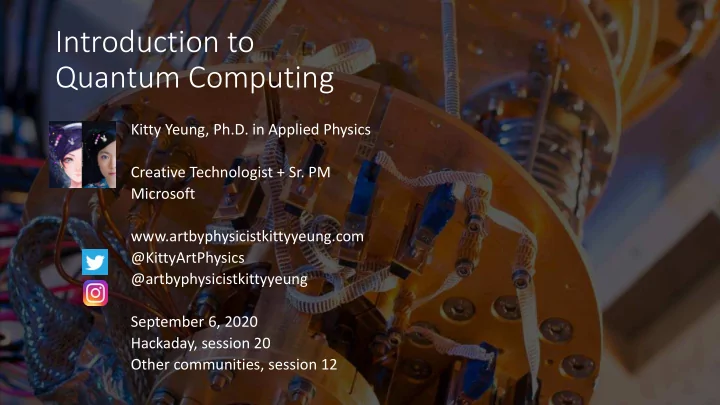
Introduction to Quantum Computing Kitty Yeung, Ph.D. in Applied Physics Creative Technologist + Sr. PM Microsoft www.artbyphysicistkittyyeung.com @KittyArtPhysics @artbyphysicistkittyyeung September 6, 2020 Hackaday, session 20 Other


slide-1
SLIDE 1

Introduction to Quantum Computing

Kitty Yeung, Ph.D. in Applied Physics Creative Technologist + Sr. PM Microsoft www.artbyphysicistkittyyeung.com @KittyArtPhysics @artbyphysicistkittyyeung September 6, 2020 Hackaday, session 20 Other communities, session 12

slide-2
SLIDE 2

Class structure

  • Comics on Hackaday – Quantum Computing

through Comics every Sun

  • 30 mins – 1 hour every Sun, one concept (theory,

hardware, programming), Q&A

  • Contribute to Q# documentation

http://docs.microsoft.com/quantum

  • Coding through Quantum Katas

https://github.com/Microsoft/QuantumKatas/

  • Discuss in Hackaday project comments

throughout the week

  • Take notes
slide-3
SLIDE 3

Session 6 May 3

slide-4
SLIDE 4
slide-5
SLIDE 5
slide-6
SLIDE 6
slide-7
SLIDE 7
slide-8
SLIDE 8

Topological quantum computer

https://www.nature.com/articles/nature26142 Quantized Majorana Conductance Majorana Fermions – particle equals anti-particle Fractional quantum Hall conductance Low temperature in magnetic field https://arxiv.org/pdf/cond-mat/0412343.pdf

slide-9
SLIDE 9
slide-10
SLIDE 10
slide-11
SLIDE 11
slide-12
SLIDE 12
slide-13
SLIDE 13
slide-14
SLIDE 14
slide-15
SLIDE 15
slide-16
SLIDE 16
slide-17
SLIDE 17

Quasiparticles

  • Collective interactions between many microscopic particles
  • Approximately be described as an unperturbed particle travelling in

free space with an effective mass differing from its original electron mass

slide-18
SLIDE 18

Majorana quasiparticles - anyons

slide-19
SLIDE 19

Dimensionality

slide-20
SLIDE 20

Non-abelian anyons

  • There are two kinds of anyons, abelian and non-abelian. The terminology comes from group theory, in which an abelian

group obeys commutative operations. This means that when applying a group operation to two group elements in an abelian group, the result does not depend on the order in which the elements are written. Interchanging two elements is effectively adding an overall phase (can be complex) to the state, which does not have a measurable effect. A non-abelian group, however, does depend on the order of elements. An operation on a non-abelian group needs to be a unitary

  • matrix. Remember our quantum gates are unitary matrices. Interchanging two non-abelian anyons is equivalent to

applying a quantum gate to the state.

slide-21
SLIDE 21
slide-22
SLIDE 22

Low temperature

slide-23
SLIDE 23

Superconductors

slide-24
SLIDE 24

Reading: Topological Quantum Computer

  • https://scipost.org/SciPostPhys.3.3.021/pdf
  • https://arxiv.org/abs/cond-mat/0010440
  • https://arxiv.org/abs/cond-mat/9906453
slide-25
SLIDE 25

Guest lectures

  • Sept 13, Prof. Terrill Frantz, Harrisburg

University of Science and Technology, Quantum Cryptography

  • Sept 20, Prof. Chris Ferrie, University of

Technology Sydney, Quantum Tomography – time-change announcement

slide-26
SLIDE 26

Contribute and demonstrate your skills

  • microsoft/Quantum: Samples and tools to help get started with the Quantum

Development Kit.

  • microsoft/QuantumLibraries: Standard and domain-specific libraries for the

Quantum Development Kit.

  • microsoft/QuantumKatas: Self-paced programming exercises for learning

quantum computing and the Q# programming language.

  • microsoft/qsharp-compiler: The Q# compiler, Visual Studio extension, and

Visual Studio Code extension.

  • microsoft/qsharp-runtime: Simulation framework, code generation, and

simulation target machines for the Quantum Development Kit.

  • microsoft/iqsharp: Jupyter kernel and Python host functionality for Q#, as well as

Docker images for using IQ# in cloud environments.

  • MicrosoftDocs/quantum-docs-pr: Source code for the documentation

published at https://docs.microsoft.com/quantum.

slide-27
SLIDE 27

Q# Community

  • https://qsharp.community/