Quantitative Information O I U N Program / Flow Analysis T P - - PDF document

quantitative information
SMART_READER_LITE
LIVE PREVIEW

Quantitative Information O I U N Program / Flow Analysis T P - - PDF document

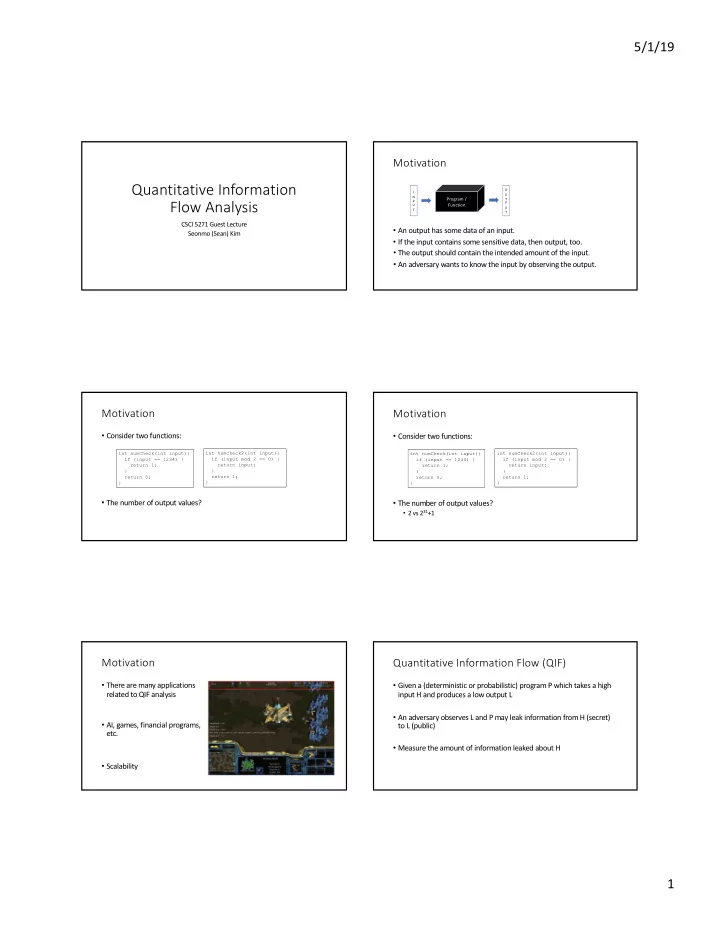
5/1/19 Motivation Quantitative Information O I U N Program / Flow Analysis T P P Function U U T T CSCI 5271 Guest Lecture An output has some data of an input. Seonmo (Sean) Kim If the input contains some sensitive data,


slide-1
SLIDE 1

5/1/19 1

Quantitative Information Flow Analysis

CSCI 5271 Guest Lecture Seonmo (Sean) Kim

Motivation

  • An output has some data of an input.
  • If the input contains some sensitive data, then output, too.
  • The output should contain the intended amount of the input.
  • An adversary wants to know the input by observing the output.

Program / Function

I N P U T O U T P U T

Motivation

  • Consider two functions:
  • The number of output values?

int numCheck(int input){ if (input == 1234) { return 1; } return 0; } int numCheck2(int input){ if (input mod 2 == 0) { return input; } return 1; }

Motivation

  • Consider two functions:
  • The number of output values?
  • 2 vs 231+1

int numCheck(int input){ if (input == 1234) { return 1; } return 0; } int numCheck2(int input){ if (input mod 2 == 0) { return input; } return 1; }

Motivation

  • There are many applications

related to QIF analysis

  • AI, games, financial programs,

etc.

  • Scalability

Quantitative Information Flow (QIF)

  • Given a (deterministic or probabilistic) program P which takes a high

input H and produces a low output L

  • An adversary observes L and P may leak information from H (secret)

to L (public)

  • Measure the amount of information leaked about H
slide-2
SLIDE 2

5/1/19 2

Early models of QIF

  • Used the Shannon mutual information I(X;Y)
  • Uncertainty
  • I(H; L) = H(H) − H(H ∣ L)
  • information leaked = initial uncertainty − remaining uncertainty
  • the adversary’s initial uncertainty before observing L
  • the adversary’s remaining uncertainty after observing L
  • H(H) - I(H; L) = H(H ∣ L)

Shannon entropy: initial uncertainty

  • 𝐼 𝑌 = −∑'∈𝒴 Pr[X=𝑦] 0 log4 Pr[X=𝑦]
  • If H is a 32-bit integer and L := H
  • Pr[H=𝑦]= ⁄

1 294, log4 Pr[H=𝑦] = log4 2:94 = −32

  • 𝐼 𝐼 = −294

⁄ 1 294 −32 = 32

Shannon entropy: information leaked

  • 𝐽 𝑌;𝑍 = 𝐼 𝑌 − 𝐼 𝑌 | 𝑍 = 𝐼 𝑌 + 𝐼 𝑍 − 𝐼 𝑌,𝑍
  • If X is determined by Y, then H(X|Y)=0.
  • 𝐽 𝐼;𝑀 = 𝐽 𝑀;𝐼 = 𝐼 𝑀 − 𝐼 𝑀 | 𝐼 = 𝐼 𝑀
  • If H is a 32-bit integer and L := H
  • 𝐽 𝐼;𝑀 = 𝐼 𝑀 = 𝐼 𝐼 = 32
  • Pr[H=𝑦]= ⁄

1 294, log4 Pr[H=𝑦] = log4 2:94 = −32

  • 𝐼 𝐼 = −∑'∈𝒴 Pr[X=𝑦] 0 log4 Pr[X=𝑦] = −294

⁄ 1 294 −32 = 32

  • Remaining uncertainty: 𝐼 𝐼|𝑀 = 32 − 32 = 0

Shannon entropy

  • 𝐼 𝑌 = −∑'∈𝒴 Pr[X=𝑦] 0 log4 Pr[X=𝑦]
  • If H is a 32-bit integer and L := H, H(H) = 32
  • 𝐼 𝑌 | 𝑍 = 𝐼 𝑌 − 𝐽 𝑌;𝑍
  • If H is a 32-bit integer and L := H, H(H | L) = 0
  • 𝐽 𝑌;𝑍 = 𝐽 𝑍;𝑌 = 𝐼 𝑍 − 𝐼 𝑍 | 𝑌 = 𝐼(𝑍), if Y is determined by

X

  • If H is a 32-bit integer and L := H, I(H ; L) = 32
  • Exercise
  • Assume that H is a uniformly-distributed 32-bit integer

Program H (H) I (H ; L) H (H | L) L := 0 L := H & 0x0000ffff

Shannon entropy

  • 𝐼 𝑌 = −∑'∈𝒴 Pr[X=𝑦] 0 log4 Pr[X=𝑦]
  • If H is a 32-bit integer and L := H, H(H) = 32
  • 𝐼 𝑌 | 𝑍 = 𝐼 𝑌 − 𝐽 𝑌;𝑍
  • If H is a 32-bit integer and L := H, H(H | L) = 0
  • 𝐽 𝑌;𝑍 = 𝐽 𝑍;𝑌 = 𝐼 𝑍 − 𝐼 𝑍 | 𝑌 = 𝐼(𝑍), if Y is determined by

X

  • If H is a 32-bit integer and L := H, I(H ; L) = 32
  • Exercise
  • Assume that H is a uniformly-distributed 32-bit integer

Program H (H) I (H ; L) H (H | L) L := 0 32 32 L := H & 0x0000ffff 32 16 16

Alternative measurement

  • Consider two programs:
  • if H mod 8 == 0 then L := H

else L := 1

  • An adversary can guess H with probability 1/8
  • P[L = 1] = 7/8, P[L = 8n] = 1/232 where 0 ≤ n < 29
  • 𝐽 𝐼;𝑀 = 𝐼 𝑀 = F

Glog G F+ 4HI 4JH log294 ≈ 0.169 + 4

  • L := H & 0x0000001f
  • An adversary can guess H with probability 1/227
  • 𝐽 𝐼;𝑀 = 𝐼 𝑀 = 5
  • Which one is more secure?
slide-3
SLIDE 3

5/1/19 3

Alternative measurement

  • Vulnerability
  • 𝑊 𝑌 = 𝑛𝑏𝑦'∈𝒴Pr[X=𝑦]
  • min-entropy
  • 𝐼T(𝑌) = −log4 𝑊(𝑌)
  • 𝐼T 𝑌 𝑍) = −log4 𝑊 𝑌 𝑍)
  • information leaked = 𝐼T 𝐼 − 𝐼T 𝐼 𝑀)
  • Let |X| be the number of possible values of X
  • 𝑊 𝐼 = U

|V| ,𝑊 𝐼 𝑀 = |W| |V|

  • 𝐼T 𝐼 − 𝐼T 𝐼 𝑀) = log4|𝐼| − log4(|𝐼|/|𝑀|) = log4|𝑀|

Alternative measurement

  • Consider two programs:
  • if H mod 8 == 0 then L := H

else L := 1

  • 𝑀 = 294:9 + 1
  • Information Leakage = log4 𝑀 ≈ 29
  • L := H & 0x0000001f
  • 𝑀 = 2Y
  • Information Leakage = log4 𝑀 = 5

Applications

  • Image anonymization and Kbattleship (PLDI 2008)
  • Computing a maximum flow of information
  • Error reporting system (ASPLOS 2008)
  • Heartbleed (VMCAI 2018)
  • Using the model counting technique to measure the leakage

Image Anonymization Image Anonymization KBattleship

slide-4
SLIDE 4

5/1/19 4

Flowcheck

  • Dynamic analysis tool to measure an upper-bound estimate of the

amount of information leaked

  • Dynamic tainting
  • Static control-flow regions
  • c = d = a + b

Error Reporting System

  • Scenario

Error Reporting System

  • Symbolic Execution
  • Generates path conditions based on symbolic or concrete inputs

Measuring privacy loss

  • For each condition (op f(.) g(.)), compute a summary for f and g
  • Use a set of rules to compute the bound given the summaries
  • Example
  • (add (bitwise-and x 1) 3)
  • (bitwise-and x 1) -> 0 or 1
  • (add (bitwise-and x 1) 3) -> 3 or 4

Heartbleed Exact Model Counting

  • Brute-force counting
  • Go through every seat
  • Simple, but hard to scale

WHITE BOARD

  • ccupied

empty

slide-5
SLIDE 5

5/1/19 5

Exact Model Counting

  • Brute-force counting
  • Go through every seat
  • Simple, but hard to scale
  • DPLL-style counting
  • Detect a region that is empty
  • Faster, but still accounts for every seat

WHITE BOARD

  • ccupied

empty

Approximate model counting

  • Random sampling
  • Randomly pick a region
  • Count the number and

scale up

WHITE BOARD

  • ccupied

empty

Approximate model counting

  • Random sampling
  • Randomly pick a region
  • Count the number and

scale up

  • Random hashing(AAAI 2006)
  • Everyone flips a coin 𝑙 times
  • Leave if a tail is ever shown
  • Count the persons 𝑜
  • Approximately 2\ 0 𝑜 persons

WHITE BOARD

  • ccupied

empty

Q & A

Thank You:)