
SLIDE 1
1
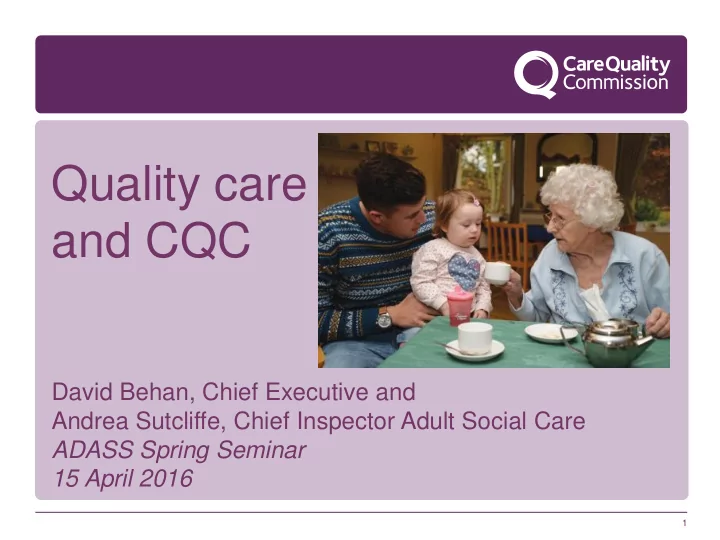
Quality care and CQC David Behan, Chief Executive and Andrea - - PowerPoint PPT Presentation
Quality care and CQC David Behan, Chief Executive and Andrea Sutcliffe, Chief Inspector Adult Social Care ADASS Spring Seminar 15 April 2016 1 Current overall ratings Source: CQC ratings data at 6 April 2016 2 Overall ratings key question
1
2
Source: CQC ratings data at 6 April 2016
3
Source: CQC ratings data at 6 April 2016 Note: Figures in chart are percentages
4
Source: CQC ratings data at 6 April 2016
Community social care (744) Domiciliary care agencies (2,755) Residential homes (7,546) Nursing homes (3,278)
5
Source: CQC ratings data at 6 April 2016 Note: Figures in chart are percentages
6
Source: CQC ratings data at 6 April 2016
them a life not just a service
and those values are cascaded to inspire staff
relatives shared views and issues
7
Aims
1. Spot if a ‘Southern Cross’ could happen again 2. Protect people in vulnerable circumstances 3. Monitor finances of ‘difficult to replace’ providers 4. Provide early warning to local authorities and assist in coordinating system response if failure occurs
MO does not:
1. Protect providers from failure 2. Pre-empt failure through disclosure of information
Mechanism – analysis of quarterly financial and quality
information to provide the necessary notification to LA(s) so they can invoke contingency planning arrangements 50 providers in the scheme
8
Market Oversight is operational but providers can and will exit the market without triggering an LA notification Market Trends – domiciliary care agencies increasing, residential homes reducing since 2010. Nursing homes and beds increased until September 2015 now reducing Total residential and nursing beds decreased in the 12 months to September 2015 for first time since 2010 Financial Trends – since 2006/07 profitability has decreased by almost 20%. Providers leaving where not profitable and exiting entire markets in some places.
9
Great care despite the stresses and strains Dedicated and committed staff delivering great care – sometimes despite the system not supported by it Variability is rife Services are improving on re-inspection – is that sustainable?
10
Finance an ongoing pressure and resilience in sector increasingly fragile Small operators at risk and not included in market oversight Supply is reducing while demand is increasing Economies of scale are reducing the quality of care
We have common purpose in ensuring good quality, person-centred care for people using services You are under increasing financial pressure, but we will not compromise on our assessment of quality We need to work better together: to share information to act on each other’s findings to encourage improvement to sustain market stability There is good practice nationally and locally but not universal One example – care home closures….
11
12
1. Prevention is better than cure 2. If quality failure happens, all parties need to know what to do and to work effectively together 3. The needs of people using services must be at the heart of everything we do 4. Communication is key
Plan to publish guidance in June 2016
13
We want to become more efficient and effective to stay relevant and sustainable for the future The public, and organisations that deliver care, have told us we have improved but we know there is more to do
Use and delivery of regulated services is changing CQC must deliver its purpose with fewer resources
Quality regulation can and does make a real and positive difference – it helps to achieve a health and care system where:
14
about the quality of care
identified and action taken where necessary so they are protected
quality
efficiently as possible to deliver high-quality care
1. Encourage improvement, innovation and sustainability in care 2. Deliver an intelligence-driven approach to regulation 3. Promote a single shared view
4. Improve our efficiency and effectiveness
15
16
www.cqc.org.uk enquiries@cqc.org.uk @CareQualityComm David Behan Chief Executive Andrea Sutcliffe Chief Inspector of Adult Social Care @CrouchEndTiger7