Qualitative Data Analysis with Dedoose Lindsay Bayham Department - - PDF document

qualitative data analysis with dedoose
SMART_READER_LITE
LIVE PREVIEW

Qualitative Data Analysis with Dedoose Lindsay Bayham Department - - PDF document

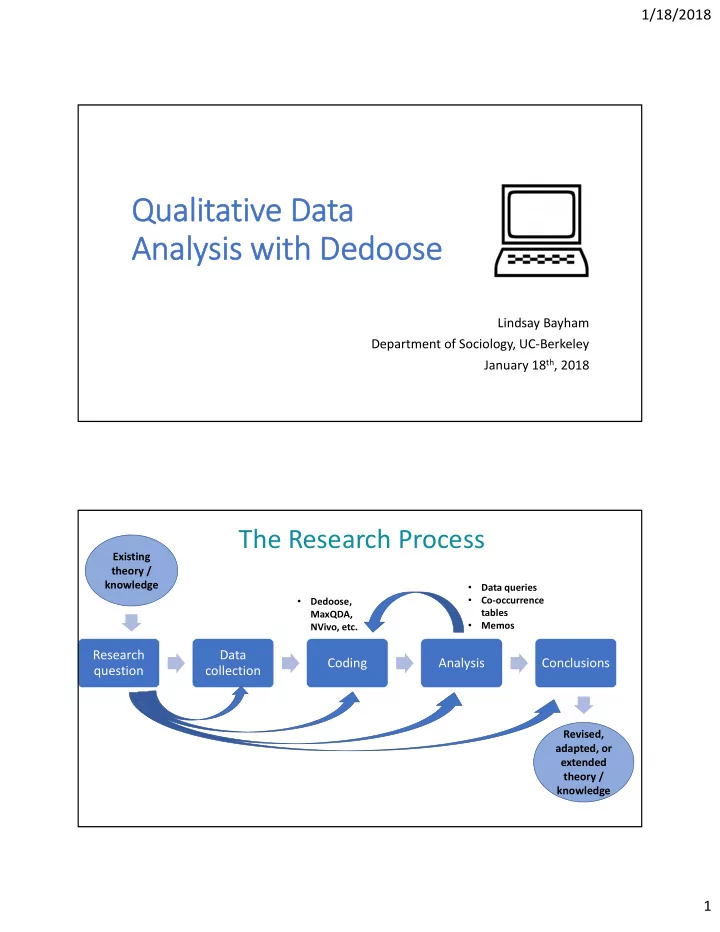
1/18/2018 Qualitative Data Analysis with Dedoose Lindsay Bayham Department of Sociology, UCBerkeley January 18 th , 2018 The Research Process Existing theory / knowledge Data queries Cooccurrence Dedoose, tables


slide-1
SLIDE 1

1/18/2018 1

Qualitative Data Analysis with Dedoose

Lindsay Bayham Department of Sociology, UC‐Berkeley January 18th, 2018 Research question Data collection Coding Analysis Conclusions

Existing theory / knowledge Revised, adapted, or extended theory / knowledge

  • Data queries
  • Co‐occurrence

tables

  • Memos

The Research Process

  • Dedoose,

MaxQDA, NVivo, etc.

slide-2
SLIDE 2

1/18/2018 2

What is qualitative data?

  • Ethnographic field notes
  • Interview transcripts
  • Focus group transcripts
  • Video or audio recordings
  • Archival data
  • Open‐ended survey data
  • Meeting transcripts
  • Organizational

documents

  • Court proceedings
  • Newspapers

Why Dedoose?

  • Online‐based, with iPad and desktop versions
  • Very collaboration‐friendly; good for groups
  • Pricing:
  • Pay for every month that you use after a 30‐day free trial
  • Price depends on number of users in a group
  • Individual is $14.95/month; small group is $12.95 per

person/month; large group is $10.95/month; student is $10.95/month

  • Free webinars available online approximately twice a month
  • Automatic software updates
slide-3
SLIDE 3

1/18/2018 3

Descriptors

  • A descriptor is “information that describes the source of your data.”

(e.g. documents, research participants, etc.)

  • You can think of descriptors as variables that describe your data sources
  • A descriptor set is a collection of information that describes the

source of your data at a particular level of analysis. (e.g. families,

  • rganizations, schools, neighborhoods or communities, other

settings, etc.)

  • For example, your research question may compare student outcomes across

schools, which would require you to look at descriptors for individual students and different schools

Coding your data

What is “coding”?

  • Categorizing and organizing data: breaking it down into analyzable parts
  • Identifying ideas and concepts in your data that may apply across your different

sources

  • Descriptors apply to documents and data sources; codes apply to excerpts or

passages within documents.
slide-4
SLIDE 4

1/18/2018 4

Coding your data

  • Coding is an iterative process!
  • Start with a list of codes and apply them to a portion of your documents
  • Refine or add new codes if you think you’re missing any big themes or ideas
  • Refining = separating some codes into two and consolidating others
  • Keep track of your codes!

Reading by mother

  • Root

code

Routine

  • Child

code

Morning routine

  • Grandchild

code

slide-5
SLIDE 5

1/18/2018 5

Analyzing your data

What is “analysis”?

  • Analyzing means interpreting, synthesizing, and looking for patterns in data in
  • rder to draw a conclusion
  • Which aspects of your data will best answer your research question?
  • You will never use all of your data!
  • Identify which units of analysis, codes, and comparisons or relationships are most important
slide-6
SLIDE 6

1/18/2018 6

Analyzing your data

  • Descriptors help you select sub‐groups, which facilitate comparisons
  • Help you see forces at work in your data
  • Look for similarities, and differences, and connections between categories
  • Which codes and categories frequently co‐occur? Which codes and categories never

co‐occur?

  • You may look for particular relationships between codes and descriptors
  • Relationships of similarity (A and B both say X)
  • Relationships of difference (A says X but B says Y)

Memos

slide-7
SLIDE 7

1/18/2018 7

Thank you!

Lindsay Bayham lindsay.bayham@berkeley.edu