
SLIDE 1
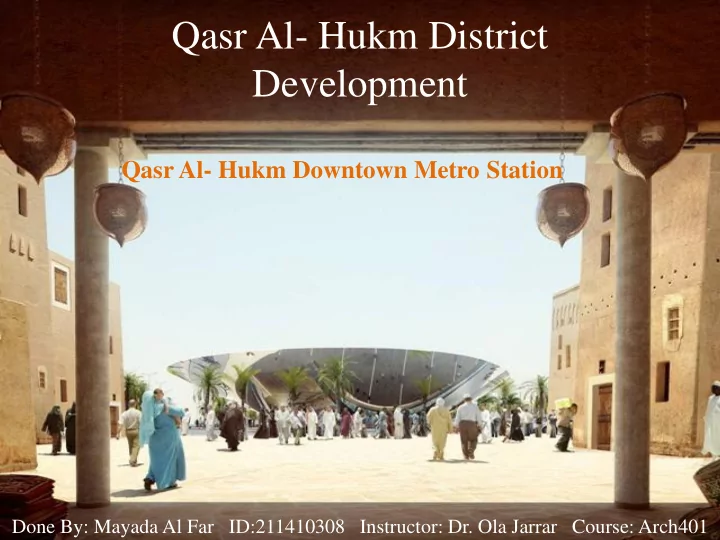
Qasr Al- Hukm District Development Qasr Al- Hukm Downtown Metro - - PowerPoint PPT Presentation
Qasr Al- Hukm District Development Qasr Al- Hukm Downtown Metro Station Done By: Mayada Al Far ID:211410308 Instructor: Dr. Ola Jarrar Course: Arch401 Abstract This paper studies the impact of globalization on architecture through its
This paper studies the impact of globalization on architecture through its great influence on society and culture, economy and politics. It shows how cities are changing their identity to follow the polemics of globalization and attract global tourism and investment. To study the impact of globalization on architecture, public buildings designed by international starchitects should be studied as one sub-phenomenon associated with the large phenomenon of globalization. Architectures designed by the international starchitects adhering to the global image tend to detach itself from the circumstances of the local context creating a schism between the building and its immediate context. The Middle East countries are largely affected by globalization which results in changing their architecture identity and restructuring its urban structure by rather imitating the architecture extravaganza of neighboring emergent global cities. Saudi Arabia is one of these countries that are reshaping their urban tissue in order to create a remarkable new image for the city. As an investigation tool, this paper aims to study the development of Riyadh downtown taking Qasr Al- Hukm Metro station as a case study to explore how the High Commission
the integrity of both.
Riyadh city is the capital of the kingdom of Saudi Arabia, and the largest in the kingdom in term of area and number of population. During the past decades, the city of Riyadh is repositioning itself on the global map as a global capital through erecting international architecture and urban
growth of the city continues to be a subject of debate, little attention has been paid to the nature of change and intervention in the old city core.
Hypothesis The building of the Qasr Al- Hukm metro station designed by Snohetta in inspired by the local context of Qasr Al- Hukm District (Riyadh Downtown). Research Question Is the building of the Qasr Al- Hukm metro station designed by Snohetta in inspired by the local context of Qasr Al- Hukm District (Riyadh Downtown)?
is the process
international incorporation
different communities all over the world socially, economically and politically.
coined in the latest half of the 20th century, but the expression and its concepts did not penetrate the popular consciousness until the latest half of the 1980s
commentators describe globalization as ‘high-modernity’ and the realization of the ideals of the Enlightenment while
commentators believe it to be a new phenomenon of equal but different significance from the Enlightenment.
Anthony Gidden describe globalization in his book (The Consequences of Modernity, 1991) as: “globalization is the intensification of worldwide social relations linking distant localities in such a way that local happenings are shaped by events occurring many thousands of miles away and vice versa”.
Jürgen Habermas, summarized globalization in his book (The Divided West, 2006) as:” The cumulative processes of a worldwide expansion of trade and production, commodity and financial markets, fashions, the media and computer programs, news and communications networks, transportation systems and flows
migration, the risks engendered by large-scale technology, environmental damage and epidemics, as well as organized crime and terrorism”.
dominance of Modernism. In 1919 Walter Gropius said, “One day there will be a worldview, and then there will also be its sign, its crystal architecture”.
that response to the new industry, technologies, mobility, and social and political orders. Thus “International Style” was born by the German architects: Walter Gropius, Mies van der Rohe, and others.
two sources:
culture
commerce: Is presented through iconic, chains of standardized hotels, sky-scraping banking towers, restaurants, and shopping malls.
through studying and analyzing different architects work. By photographs in magazines and journals, designers can scan and span the globe, sharing high-style concepts rendered in modern materials. Glass, stainless steel, aluminum, copper, titanium, and natural stone are available.
Frank Lloyd Wright-S.C. Johnson Research Tower, open in 1950
into idols of the architecture worldwide which necessarily gives them major privileges in the field. To mention few there is: Zaha Haddid, Franck Lloyd Wright, Franck Gehry, Mies Van Der Rohe, Peter Eisenman, Louis Khan, Daniel Libeskind, Norman Foster, Rem Koolhaus, Santiago Calatrava, Jean Nouvel and Renzo Piano.
acknowledged for students, lectures, juries, competitions, teaching posts, master classes, interviews and conferences.
by the design type and style of the buildings, even before they are built. Being limited in numbering the request for the extraordinary and symbolic buildings is beyond the capacity
may carry.
characteristics of the star product such as; the spiral or twisted forms, globular glass, planar intersection and so on, to develop and reproduce their concepts.
architectural profession and has affected architecture more generally than the global origins
Sydney Opera House in Australia, by Jorn Utzon
This new architectural image has been named as Figure 5: Sydney Opera House in Australia, by Jorn Utzon ‘Supermodern’ by the Dutch critic Hans Ibelings when he states: “For this architecture the surroundings constitute neither legitimation nor inspirations for these are derived from what goes on inside the building, from the program. This autonomy is in many cases reinforced by the fact that the building has an inscrutable exterior that betrays nothing of what happens inside. In many instances these buildings look as if they might house just about anything: an office or a school, a bank or a research centre, a hotel or apartments, a shopping mall or an airport terminal”.
against the heavy-handed ’80s-era promotion and deconstruction. This movement transfer places that are made up out of social interactions between people to a non place with a meaningless environment that we pass through during our solitary lives. These non-places, are expression of ‘In the age of globalization’, and with the fall of time and space, everything can happen everywhere and anywhere, thus undermining of the postmodern confession that architecture must have a unique, authentic relationship with its context, of identity and meaning.
shaped through different periods of economic growth transforming from pre- industrial to industrial and post-industrial society in fifty years.
image for the city, iconic architectures such as Burj Khalifa, Burj Al Arab, and global scale mega-projects such as Palm Jumeirah are being constructed and are symbolizing the national identity. As the urban development has been shaped by mega projects, the spatial incorporation
layout becomes critical.
distinct areas. Deira is the largest and the main commercial centre. On the western bank, Bur Khalifa and Al Shindagha are separated by a wide stretch of sand called Ghubaiba. Al Shindagha, situated on a narrow strip of land detaching the sea from the creek, is a small area and a main residential district, while Bur Khalifa is the smallest settlement.
Dubai development with a new road system, town centre and zones of different land use areas.
Dubai Creek, and most
the urban development started to take place around the district of Deira. Since the formation of the United Arab Emirates, Dubai has expanded toward the east.
stretched incoherently on the outer edges of the city and along the road to Abu Dhabi, transforming the city into a linear one
social, economical and physical development of the city. One of the key challenges
investments.
dividing the city's sectors according to their specific functions and programs, and incorporate scales that range from super blocks to land-use zones. This concept results in having a series of ‘cities within the city’ mega-projects. This concept attracts foreign investors that lead to a rise in the real estate market
The Beirut Central District was demolished during the Lebanese War which extended from 1975 to 1990. Unable to reconstruct the center city, the Lebanese government turned to private Real Estate Company known by SOLIDERE, to take over the task
downtown reconstruction project fashioned by SOLIDERE was presented to the public as the main post-war reconstruction effort.
Environmentally, the SOLIDERE was positive in resolving the problem that had been created by the dumping site on Beirut Central District coastline, which extended over an area of 250,000 square meters and a height of 14 meters. The landfill was treated and integrated into the project to be transformed into development land, comprising a promenade, two marinas and a public park covering 80,000 square meters.
SOLIDERE Clock Tower, Beirut, Lebanon
During the reconstruction of Beirut Central District, many buildings that are left from the war were destroyed. Researches on the city center showed that the amount of buildings demolished after the war exceeded the amount destroyed during the
Building, the Pan American Building, or the various cinemas and cafes on Hamra Street were all destroyed by the government in order to have a new modern
leading to the destruction and disfiguring
the valuable heritage that
represented a true certification to the region’s temporal depth and crucial public sphere .
prepared to transform Qasr Al- Hukm District into a culture center, national historical and administrative. These programs where divided into three phases:
Headquarters Buildings were ready.
This phase included Imam Turki bin Abdullah Mosque, Qasr Al-Hukm, Al-Adl Plaza, Assafah Plaza, Imam Mohammed bin Saud Plaza, Al-Musmak Plaza, Al-Thumairi Gate, and Dekhna Gate, Ad-Deerah Tower, sections of the city old wall, as well as public service networks, internal and surrounding road network, and commercial and office buildings.
private sector to be actively involved in the development
60% of the total area of Qasr Al- Hukm District.
The plan also includes construction of tracks for a planned public transport system (metro/bus routes and stations), while the local intersections, pedestrian walkways and car parks are going to be renovated. The area will host a main metro station designed by Snohetta that connect two main metro lines; Al-Olaya-Al-Batha line and Al-Madinah Al-Munawarah line
The station is inspired from the idea of merging between traditional character and modern design, to form a focal point and a center to highlight Qasr Al- Hukm district. It is located in the middle of Qasr Al- Hukm District and adjacent to many historical landmarks, such as: Qasr Al- Hukm, Imam Turki bin Abdullah Mosque, Al- Masmak Fort, Sheikh Mohammed bin Ibrahim Mosque and Al- Zol Market, and will be established on an area of 47,646 square meters, with seven floor plans at a depth of 33 meters.
The station is designed as an urban plaza with a large canopy that provides shade to the surrounding public spaces and channeling daylight down to the underground train station. The polished stainless steel canopy functions as a landmark that signals the station's entrance. It was designed in a sustainable level of: environmentally sustainable in water conservation, daylight harvesting, providing energy, natural shading and ventilation; economically sustainable in providing a functional public transport in a densely populated district to reduce traffic congestion, and socially sustainable in providing a vibrant public space with a lot of palm trees and a mosque.
Through the stainless steel reflective canopy, the levels of the metro are visually linked, reflecting the outside inwards and the inside outward. The canopy sits on a large sloping wall that carries the indirect light to the underground levels, while this wall is acting as a unifying element and reference space in the building. The two metro lines extend through this void space in glazed tubes, giving them a strong clarity, presence and sense of way-finding.
The central atrium features a garden that can be accessed from the underground levels of the station. The Red line platform and the Blue line platform provide an access to the garden, allowing the passengers to wait for their train while seated in the shaded lush garden. The inside surface of the canopy is covered with a daylight harvesting system. Daylight is channeled to light fittings in the underground levels through fiber optic cables. In this method, lighting can be maintained during the day time without consuming energy and without bringing heat into the building.
The public plaza is given a human scale through the planting of palm trees in a linear pattern following the direction of the mosque and Mecca. The planting pattern of the palm trees is used to provide shadow to the plaza. Irrigation channels scheme the plaza floor, they serve as a flood-and-drain watering system for the trees, and as a water feature during the day
The station include public parking for 550 car, ticket sales outlets, commercial services, shops, restaurants and cafes, sites for investment and customer service offices.
The trains will run automatically (without a driver) and a central control rooms will be used to operate and monitor trains with high precision. These trains are separated internally to accommodate different service classes in addition to the family class. The cars also support the communication and information exchange services
Qasr Al- Hukm Metro Station is one
by starchitects such as; Al- Olaya Metro Station designed by Gerber Architekten from Germany, King Abdullah Financial (KAFD) District Metro Station designed by Zaha Hadid Architects from the UK and Western Metro Station designed by Omrania & Associates. In addition to the four main metro stations, Riyadh Metro project includes the establishment
41 sub-metro stations where a number of network paths meet, and are designed on several levels with a global architectural designs.
The High Commission of the Development of Arriyadh worked on a transportation plan for meeting the existing and future transportation needs of Riyadh city and keeping up with its continuous population growth. According to studies done by the High Commission for the Development of Arriyadh, the population of Riyadh is expected to rise from 5.7 million in 2012 to more than 8.3 million by 2028 with city urban expansion already reached 1297 km2 in 2012; this would mean heavier and longer traffic in the future.