Q = A (O + S) health care lacks an effective management approach - - PDF document

q a o s
SMART_READER_LITE
LIVE PREVIEW

Q = A (O + S) health care lacks an effective management approach - - PDF document

The Challenge of Healthcare Poor Quality3% defect rate Engaging Physicians in Impact on individuals100% defect Cost of poor qualityBillions of dollars Meaningful Change


slide-1
SLIDE 1 Estes Park Institute January 2012 Gary S. Kaplan, MD Chairman and CEO Virginia Mason Medical Center

Engaging Physicians in Meaningful Change

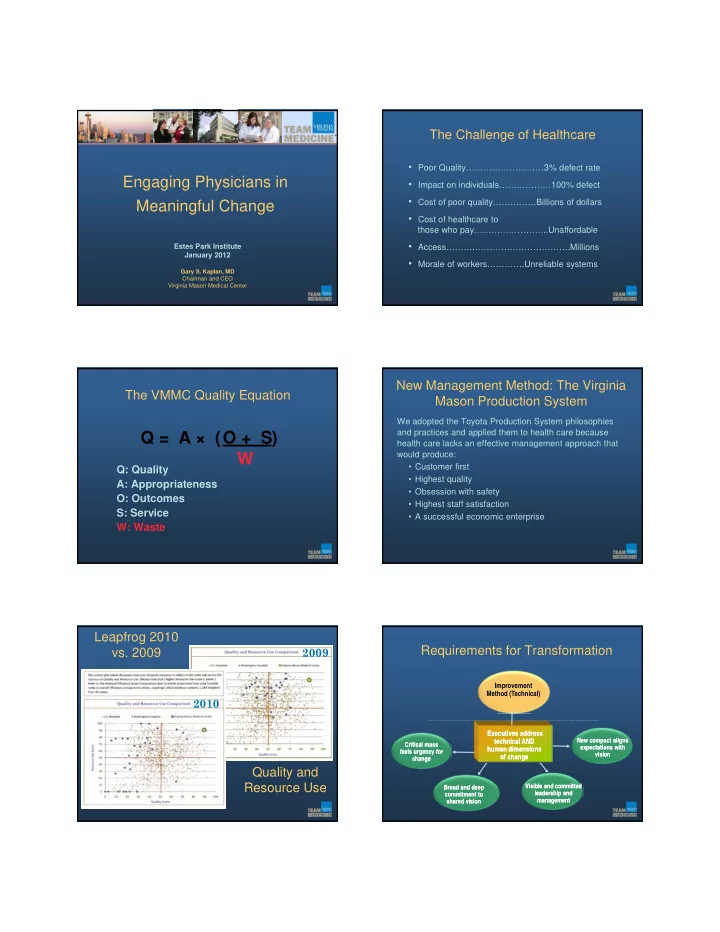
The Challenge of Healthcare

  • Poor Quality………………………3% defect rate
  • Impact on individuals………………100% defect
  • Cost of poor quality……………Billions of dollars
  • Cost of healthcare to

those who pay……………………..Unaffordable

  • Access…………………………………….Millions
  • Morale of workers………….Unreliable systems

The VMMC Quality Equation

Q: Quality A: Appropriateness O: Outcomes S: Service W: Waste

Q = A × (O + S) W

New Management Method: The Virginia Mason Production System

We adopted the Toyota Production System philosophies and practices and applied them to health care because health care lacks an effective management approach that would produce:

  • Customer first
  • Highest quality
  • Obsession with safety
  • Highest staff satisfaction
  • A successful economic enterprise

2009 2010

Leapfrog 2010

  • vs. 2009

Quality and Resource Use

Critical mass feels urgency for change Critical mass feels urgency for change Visible and committed leadership and management Visible and committed leadership and management Improvement Method (Technical) Executives address technical AND human dimensions
  • f change
Executives address technical AND human dimensions
  • f change

Requirements for Transformation

Broad and deep commitment to shared vision Broad and deep commitment to shared vision New compact aligns expectations with vision New compact aligns expectations with vision
slide-2
SLIDE 2

Two Kinds of Challenges Ronald Heifetz

Technical

  • Problem is well defined
  • Solution is known can be

found

  • Implementation is clear

Adaptive

  • Challenge is complex
  • To solve requires

transforming long-standing habits and deeply held assumptions and values

  • Involves feelings of loss,

sacrifice (sometimes betrayal to values)

  • Solution requires learning

and a new way of thinking, new relationships

Technical Change Adaptive Challenge Urgency: Make the Invisible Visible

  • HOW
  • Self-discovery” – experiential
  • More than facts: John Kotter’s
see/feel/change approach
  • WHAT
  • Cost of doing nothing exceeds cost
  • f change
  • Cold, hard facts on performance
and lack of sustainability
  • Gap between aspiration and reality
  • The personal impact of incidents

Urgency for Change at VMMC

—Gary Kaplan, VMMC Professional staff meeting, October 2000

“ ”

We change or we die.

Ongoing Urgency

  • In a time of constant

and tumultuous change, avoid complacency

slide-3
SLIDE 3

Basis of Vision is Shared Interests

Organization’s Interests Doctors’ Interests Doctors’ Interests

SHARED I NTERESTS
  • Commitment to patients
  • Economic interests
  • Recruit and retain talent

Everyone Changes

  • It’s not just physician leaders who shift mindset

and actions

  • Working collaboratively with physicians

represents an adaptive change for many administrative leaders

  • Need to move away from language such as: “We

need to gain their buy-in” and “We’ll roll it out”

Some Leadership Styles Thwart Adaptive Work

  • Command and

control

  • Holding onto all

authority

  • Laissez Faire

Engagement as Key to Coming to Terms with New Realities

Engaging physicians (and other clinicians):

  • Surfaces their good ideas, input, and wisdom
  • Develops ownership for solutions
  • Is a critical opportunity for individuals to

personally process and come to terms with a change and its implications

You can’t impose anything on anyone and expect them to be committed to it.

̶ Edgar Schein, Professor Emeritus MIT Sloan School

Engage Stakeholders Bedrock of Fair Process: Three Principles

  • Engagement: involving individuals in decisions that

affect them. Not handing over control or decision- making authority

  • Not endless process
  • Not decision by consensus
  • Not getting agreement through compromise
  • Explanation: everyone involved and affected should

understand the rationale for final decision

  • Expectation clarity: when a decision means new “rules
  • f the game,” they are clearly articulated
slide-4
SLIDE 4

Compact

  • Expectations members of an organization

have that are:

  • Unstated yet understood
  • Reciprocal
  • The give
  • The get
  • Mutually beneficially
  • Set up & reinforced by society and the
  • rganization

GIVE GET

  • Autonomy
  • Protection
  • Entitlement
  • Treat

patients

  • Provide

quality care

(personally defined)

Traditional Physician Compact

  • Autonomy
  • Protection
  • Entitlement
  • Improve
safety/ quality
  • Implement EHR
  • Create service
experience
  • Be patient-focused
  • Improve access
  • Improve efficiency
  • Recruit/retain quality
staff Traditional “ Promise” Legacy Expectations Imperatives

Clash Of “Promise” And Imperatives Proactively Develop New Expectations

  • When old deal crumbles without

conversation, anger and frustration result

  • Dialogue about what is changing

and why accelerates support for new deal, new behaviors

Vision Is Context for Compact

  • Societal needs
  • Local market
  • Competition
  • Organization’s

strengths

Physicians give:
  • What the
  • rganization
needs to achieve the vision Organization gives:
  • What helps
physicians meet commitment
  • What is
meaningful to physicians

Old Compact at VMMC Not Working

  • Despite the fact things weren’t working, most

physicians clung to the fundamental “gets” they felt due them

  • Protection
  • Autonomy
  • Entitlement
  • Physician-centered world view prevailed
slide-5
SLIDE 5

Physician Retreat

(Fall 2000)

Physician Retreat

(Fall 2000)

VMMC Compact Process

  • Broad based committee of providers:

primary care, sub-specialists

  • Focus of retreat: physicians-changing

expectations, tools to manage change

  • Jack Silversin served as our consultant
  • Spent time at VMMC talking to

physicians

Compact committee drafts compact

(Winter 2001)

Compact committee drafts compact

(Winter 2001)

VMMC Compact Process

  • Broad based group of providers
  • Administrative Involvement: CEO, JD, HR, Board

Member (also a patient)

  • Starting point:
  • “Gives” and “gets” from the Retreat
  • Evolving Strategic Plan: patient centered

Physician Retreat

(Fall 2000)

Physician Retreat

(Fall 2000)

Departmental meetings for input

(Spring 2001)

VMMC Compact Process

  • Committee met weekly
  • Reality Checks
  • Management Committee
  • Physicians
  • Multiple Drafts until we reached the “final draft”

Compact committee drafts compact

(Winter 2001)

Compact committee drafts compact

(Winter 2001)

Physician Retreat

(Fall 2000)

Physician Retreat

(Fall 2000)

Virginia Mason Medical Center Physician Compact

Organization’s Responsibilities Foster Excellence
  • Recruit and retain superior physicians and staff
  • Support career development and professional satisfaction
  • Acknowledge contributions to patient care and the
  • rganization
  • Create opportunities to participate in or support research
Listen and Communicate
  • Share information regarding strategic intent,
  • rganizational priorities and business decisions
  • Offer opportunities for constructive dialogue
  • Provide regular, written evaluation and feedback
Educate
  • Support and facilitate teaching, GME and CME
  • Provide information and tools necessary to improve
practice Reward
  • Provide clear compensation with internal and market
consistency, aligned with organizational goals
  • Create an environment that supports teams and
individuals Lead Manage and lead organization with integrity and accountability Physician’s Responsibilities Focus on Patients
  • Practice state of the art, quality medicine
  • Encourage patient involvement in care and treatment decisions
  • Achieve and maintain optimal patient access
  • Insist on seamless service
Collaborate on Care Delivery
  • Include staff, physicians, and management on team
  • Treat all members with respect
  • Demonstrate the highest levels of ethical and professional
conduct
  • Behave in a manner consistent with group goals
  • Participate in or support teaching
Listen and Communicate
  • Communicate clinical information in clear, timely manner
  • Request information, resources needed to provide care
consistent with VM goals
  • Provide and accept feedback
Take Ownership
  • Implement VM-accepted clinical standards of care
  • Participate in and support group decisions
  • Focus on the economic aspects of our practice
Change
  • Embrace innovation and continuous improvement
  • Participate in necessary organizational change

Compact Supports Alignment with Vision

  • Compact discussions as foundational – basic to

moving us toward vision

  • Compact is revisited, made alive, reinforced
  • Periodic assessments/dialogue as to how both

“sides” are living up to compact commitments

Hardwiring Compact

  • Recruitment
  • Orientation
  • Job Descriptions
  • Chief
  • Section Heads
  • Physicians
  • Feedback
slide-6
SLIDE 6

VMMC Leadership Compact

Organization Responsibilities Leader Responsibilities Foster Excellence  Recruit and retain the best people  Acknowledge and reward contributions to patient care and the
  • rganization
  • Provide opportunities for growth of leaders
  • Continuously strive to be the quality leader in health care
  • Create an environment of innovation and learning
Lead and Align
  • Create alignment with clear and focused goals and strategies
  • Continuously measure and improve our patient care, service and
efficiency
  • Manage and lead organization with integrity and accountability
  • Resolve conflict with openness and empathy
  • Ensure safe and healthy environment and systems for patients and staff
Listen and Communicate
  • Share information regarding strategic intent, organizational priorities,
business decisions and business outcomes
  • Clarify expectations to each individual
  • Offer opportunities for constructive open dialogue
  • Ensure regular feedback and written evaluations are provided
  • Encourage balance between work life and life outside of work
Educate
  • Support and facilitate leadership training
  • Provide information and tools necessary to improve individual and staff
performance Recognize and Reward
  • Provide clear and equitable compensation aligned with organizational
goals and performance
  • Create an environment that recognizes teams and individuals
Focus on Patients
  • Promote a culture where the patient comes first in everything we do
  • Continuously improve quality, safety and compliance
Promote Team Medicine
  • Develop exceptional working-together relationships that achieve results
  • Demonstrate the highest levels of ethical and professional conduct.
  • Promote trust and accountability within the team
Listen and Communicate
  • Communicate VM values
  • Courageously give and receive feedback
  • Actively request information and resources to support strategic intent,
  • rganizational priorities, business decisions and business outcomes
Take ownership
  • Implement and monitor VM approved standard work
  • Foster understanding of individual/team impact on VM economics
  • Continuously develop one’s ability to lead and implement the VM
Production System
  • Participate in and actively support organization/group decisions
  • Maintain an organizational perspective when making decisions
  • Continually develop oneself as a VM leader
Foster Change and Develop Others  Promote innovation and continuous improvement
  • Coach individuals and teams to effectively manage transitions
  • Demonstrate flexibility in accepting assignments and opportunities
  • Evaluate, develop and reward performance daily
  • Accept mistakes as part of learning
  • Be enthusiastic and energize others

First Challenge is Changing the Mind of Medicine

  • Provider First
  • Waiting is Good
  • Errors are to be Expected
  • Diffuse Accountability
  • Add Resources
  • Reduce Cost
  • Retrospective Quality Assurance
  • Management Oversight
  • We Have Time
  • Patient First
  • Waiting is Bad
  • Defect-free Medicine
  • Rigorous Accountability
  • No New Resources
  • Reduce Waste
  • Real-time Quality Assurance
  • Management On Site
  • We Have No Time

FROM TO

“If you are dreaming about it… you can do it.”

  • Sensei Chihiro Nakao