
SLIDE 1
Attractive GUIs with PySimpleGUI
Ruud van der Ham, salabim.org
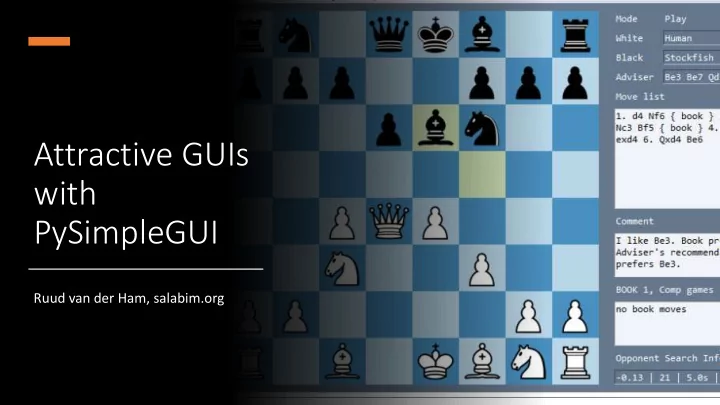
PySimpleGUI Ruud van der Ham, salabim.org Quite a lot of experience - - PowerPoint PPT Presentation
Attractive GUIs with PySimpleGUI Ruud van der Ham, salabim.org Quite a lot of experience in the animation part of tkinter, because of my salabim package My interest But, practically no experience with GUIs I was in contact with the sole
Ruud van der Ham, salabim.org
Quite a lot of experience in the animation part
But, practically no experience with GUIs I was in contact with the sole developer and maintainer of PySimpleGUI And I had some projects that could use an attractive GUI. So I started ... And .. I am still a beginner in this field. So, please don’t shoot the messenger ...
Brief overview of GUIs in the Python world Introduction PySimpleGUI Two sample applications (hands on) Gallery of PySimpleGUI application Pros and cons Conclusion
GUIs are important End users don’t want to /can’t use command line tools (especially under Windows) Even for simple tasks an attractive GUI can be important But ... GUIs are complicated and the domain of experts
while True: number_1 = input("number 1? ") if number_1 == "": break number_1 = float(number_1) number_2 = float(input("number 2? ")) print(f"{number_1} + {number_2} = {number_1 + number_2}")
Usage: black [OPTIONS] [SRC]... The uncompromising code formatter. Options:
[default: 88]
Python versions that should be supported by Black's output. [default: per-file auto- detection]
input files. This will put trailing commas in function signatures and calls also after *args and **kwargs. Deprecated; use
auto-detection]
Format all input files like typing stubs regardless of file extension (useful when piping source on standard input).
Don't normalize string quotes or prefixes.
would be reformatted. Return code 123 means there was an internal error.
diff for each file on stdout.
directories that should be included on recursive searches. An empty value means all files are included regardless of the
are calculated first, inclusions later. [default: \.pyi?$]
directories that should be excluded on recursive searches. An empty value means no paths are excluded. Use forward slashes for
Comes with most Python installations Feature-rich Flexible Learning curve Not very intuitive API
import tkinter as tk def add_numbers(): number_1 = float(entry_1.get()) number_2 = float(entry_2.get()) res = f"{number_1} + {number_2} = {number_1 + number_2}" result.set(res) master = tk.Tk() result = tk.StringVar() tk.Label(master, text="Number 1").grid(row=0) tk.Label(master, text="Number 2").grid(row=1) tk.Label(master, text="Result:").grid(row=3) tk.Label(master, text="", textvariable=result).grid(row=3, column=1) entry_1 = tk.Entry(master) entry_2 = tk.Entry(master) entry_1.grid(row=0, column=1) entry_2.grid(row=1, column=1) b = tk.Button(master, text="Add", command=add_numbers) b.grid(row=0, column=2, columnspan=2, rowspan=2, padx=5, pady=5) tk.mainloop()
Powerful, learning curve, sometimes licensing costs
Not very popular in the Python world Interfacing rather complex Maintenance of both GUI part and application
Relatively new (start project 2 years ago) Very actively maintained (upto now) Open source Four platforms supported:
Let’s build the adder application in the tkinter version of PySimpleGUI
And now for another sample project: A GUI for the Black formatter to replace the CLI
We can even use PySimpleGUI run on Android phones:
Sample demo applications from the site:
Sample demo applications from the site:
Sample demo applications from the site:
Sample demo applications from the site:
I think I just know about 10% of the functionalitry of PySimpleGUI ... It has so many widgets and features Interfaces with matplotlib, OpenCV, PIL, ... Supports threading Cross platform (mostly) Other ports, including Web/Remi Very extensive and up-to-date documentation and cookbook Great for beginners, but also experts that don’t want to spend too much time on the nitty gritty of native GUI packages
You are limited to a number of prepackaged solutions, albeit many. Customization has its limits, by nature. You can’t fully control everything. No port for iPad/Pythonista (my favourite) You have to rely on a package developed/maintained by one (devoted) person.
PySimpleGUI is worth more than a try. Goto www.pysimplegui.com to find out for yourself.