Purpose & Meaning Presentation Wild Geese Background J Fields - - PDF document

purpose amp meaning presentation
SMART_READER_LITE
LIVE PREVIEW

Purpose & Meaning Presentation Wild Geese Background J Fields - - PDF document

Purpose & Meaning Presentation Wild Geese Background J Fields 1. Psycho-therapist ~ Taiji instructor 2. Cancer a. Two Sides of Cancer b. Feeling(s) that word brings up Truth 1. My truths a. Body b. 9 Senses + Awareness c. All


slide-1
SLIDE 1

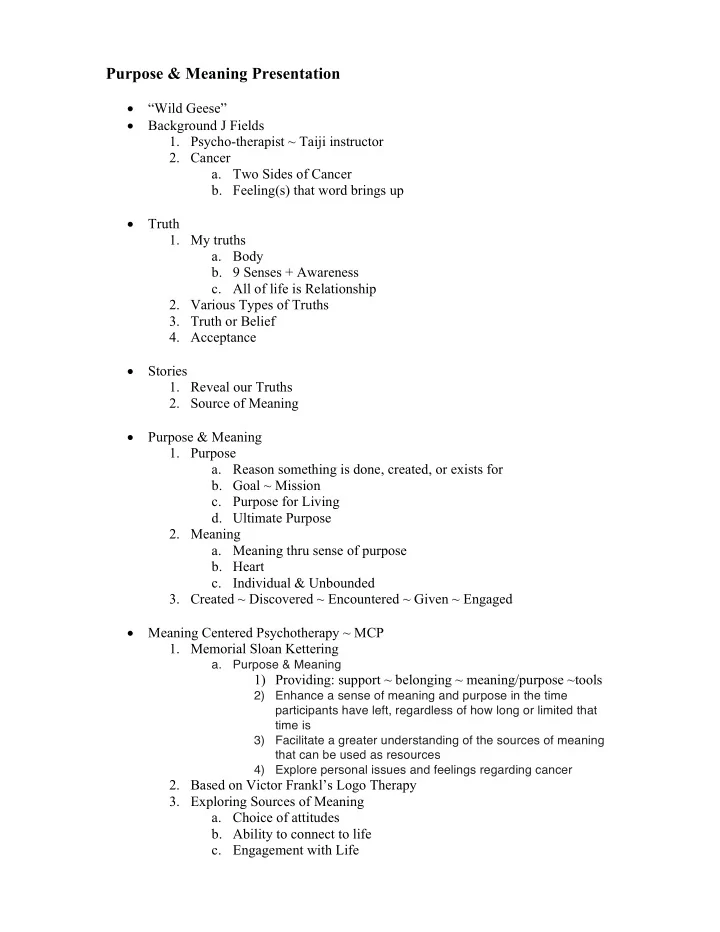
Purpose & Meaning Presentation

  • “Wild Geese”
  • Background J Fields
  • 1. Psycho-therapist ~ Taiji instructor
  • 2. Cancer
  • a. Two Sides of Cancer
  • b. Feeling(s) that word brings up
  • Truth
  • 1. My truths
  • a. Body
  • b. 9 Senses + Awareness
  • c. All of life is Relationship
  • 2. Various Types of Truths
  • 3. Truth or Belief
  • 4. Acceptance
  • Stories
  • 1. Reveal our Truths
  • 2. Source of Meaning
  • Purpose & Meaning
  • 1. Purpose
  • a. Reason something is done, created, or exists for
  • b. Goal ~ Mission
  • c. Purpose for Living
  • d. Ultimate Purpose
  • 2. Meaning
  • a. Meaning thru sense of purpose
  • b. Heart
  • c. Individual & Unbounded
  • 3. Created ~ Discovered ~ Encountered ~ Given ~ Engaged
  • Meaning Centered Psychotherapy ~ MCP
  • 1. Memorial Sloan Kettering
  • a. Purpose & Meaning

1) Providing: support ~ belonging ~ meaning/purpose ~tools

2) Enhance a sense of meaning and purpose in the time participants have left, regardless of how long or limited that time is 3) Facilitate a greater understanding of the sources of meaning that can be used as resources 4) Explore personal issues and feelings regarding cancer

  • 2. Based on Victor Frankl’s Logo Therapy
  • 3. Exploring Sources of Meaning
  • a. Choice of attitudes
  • b. Ability to connect to life
  • c. Engagement with Life
slide-2
SLIDE 2
  • d. Understanding of one’s past, present, future
  • e. Awareness & gratitude for life itself
  • f. Experience of connectedness
  • 4. MCP Translated
  • a. Purpose:

1) To increase: an individual’s sense of meaning and spiritual well being. 2) By bringing awareness: to one’s truths to our ability to connect and engage in life to our healing

  • b. Based on Victor Frankl & Etty Hillesum
  • Terminal Illness
  • 1. Definition:
  • a. “incurable ~ deadly ~ fatal”
  • b. an airport, train or bus station that allows transfer from one mode
  • f travel to another and/or from one destination to another
  • 2. Deadly ~ Death ~
  • a. Confronting our Relationship to

1) Unknown 2) Fear 3) Readiness ~ or Denial

  • 3. Dying ~ the Process
  • 4. Saying Goodbye
  • a. Loss
  • b. Grief
  • 4. In the end only three things matter:
  • a. How well have I lived?
  • b. How well have I learned to let go? (accept, release, let be)
  • c. How well have I loved?
  • Life Is
  • 1. Mother Teresa’s question
  • a. Life is ________, _______it.
  • b. One’s experience
  • c. All life is relationship

1) Our relationship to Cancer 2) Our relationship to Healing 3) Our relationship to Control

  • Living
  • 1. Resilience
  • a. Response
  • b. Expression
  • c. “Will to Live”

1) Desire & reason to live

  • 2. Hope (incurable)
  • 3. The Present
slide-3
SLIDE 3
  • a. A gift
  • b. Moments
  • c. Our Presence
  • 4. Questions: Coming Home
  • Spirituality ~ Oneness
  • Love & Belonging
  • 1. Aimless
  • 2. Legacy
  • 3. Components
  • Home-work

Coming Home to Myself

  • 1. What are two experiences or moments when life has felt particularly

meaningful to you?

  • 2. Who am I? (4 answers)
  • 3. How has Cancer affected who you are?
  • 4. Looking back on your life, what has made the greatest impact on who you

are today? (memories, relationships, teachers)

  • 5. Today, what are the meaningful activities, roles or accomplishments that

you are proud of?

  • 6. What are three ways that you “connect with life”
  • 7. What brings you feel most alive?
  • 8. What is your relationship to the experience of love, beauty and humor…?

9.

  • 10. In thinking about Death & Dying what thoughts and feelings come up?
  • 11. What would you consider a “good” or “meaningful” death?