
SLIDE 1
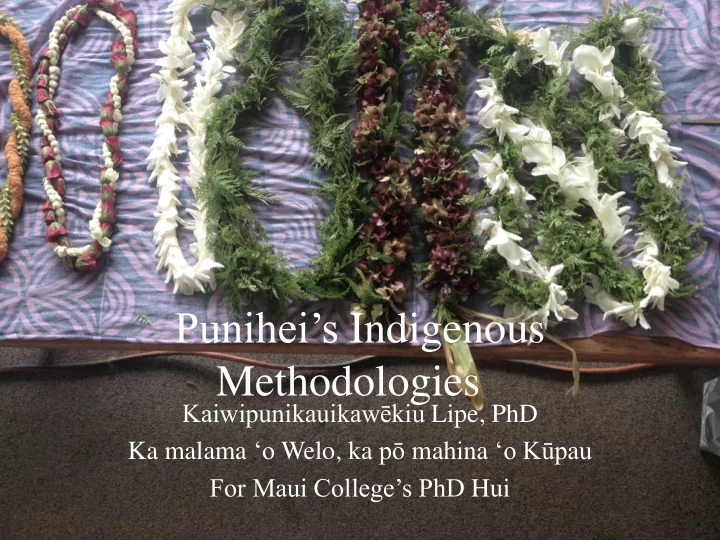
Puniheis Indigenous Methodologies Kaiwipunikauikawkiu Lipe, PhD Ka - - PowerPoint PPT Presentation
Puniheis Indigenous Methodologies Kaiwipunikauikawkiu Lipe, PhD Ka malama o Welo, ka p mahina o Kpau For Maui Colleges PhD Hui Why We Dont Know More Indigenous peoples Exist? Have knowledge systems? Do
https://intercontin entalcry.org/indige nous-peoples/
Collins III, J. W., & O’Brien, N. P. (2003). The greenwood dictionary of education. Westport, CT: Greenwood Press. Lipe, K. (2018). “Towards Equity & Equality: Transforming Universities Into Indigenous Places of Learning.” In R. Minthorn & H. Shotton (Eds.). Reclaiming Indigenous Research in Higher
Lipe, K. (2016). “Mo‘olelo for Transformative Leadership: Lessons from Engaged Practice.” In K. Oliveira & E. K. Wright (Eds.). Hawai‘inuiākea Book Series: Kanaka ‘Ōiwi Methodologies, 4. Honolulu, HI: University of Hawai‘i Press. Lipe, K. (2014). Aloha as fearlessness: Lessons from the mo‘olelo of eight Native Hawaiian female educational leaders on transforming the University of Hawai‘i at Mānoa into a Hawaiian place of
Lipe, K. and Lipe, D. (2016). “Living the Consciousness: Navigating the Academic Pathway for our Children and Communities.” In M. Guajardo, F. Guajardo, & L. Locke (Eds.) The International Journal of Qualitative Studies in Education, Ecologies of Engaged Scholarship: Stories of Activist Academics. Mihesuah, A. & Wilson, A. C. (2004). Indigenizing the academy : transforming scholarship and empowering
Honolulu, HI: Bishop Museum Press. Schertow, J. A. (2010).Indigenous peoples. Retrieved from https://intercontinentalcry.org/indigenous-peoples/ Tuhiwai Smith, L. (2012). Decolonizing methodologies (2nd ed.). New York, NY: Zed Books. Wilson, S. (2008). Research is ceremony: Indigenous research methods. Black Point, N.S: Fernwood Pub. United Nations declaration on the rights of indigenous peoples. (2008). Retrieved from http://www.un.org/esa/socdev/unpfii/documents/DRIPS_en.pdf.