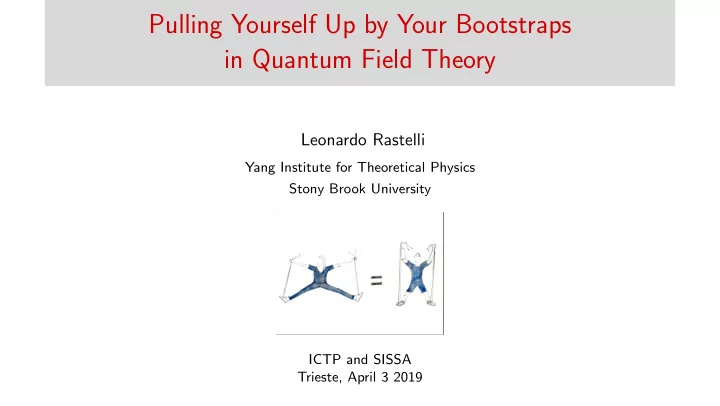
SLIDE 1
Pulling Yourself Up by Your Bootstraps in Quantum Field Theory
Leonardo Rastelli
Yang Institute for Theoretical Physics Stony Brook University ICTP and SISSA Trieste, April 3 2019
SLIDE 2
Quantum Field Theory in Fundamental Physics
Local quantum fields {ϕi(x)} x = (t, x), with t = time, x = space The language of particle physics: for each particle species, a field
SLIDE 3 Quantum Field Theory for Collective Behavior
Modelling N → ∞ degrees of freedom in statistical mechanics. Example: Ising model (uniaxial ferromagnet) σi = ±1, spin at lattice site i Energy H = −J
(ij) σiσj
Near Tc, field theory description: magnetization ϕ( x) ∼ σ( x), H =
∇ϕ + m2ϕ2 + λ ϕ4 + . . .
SLIDE 4 H =
∇ϕ + m2ϕ2 + λ ϕ4 + . . .
- The dots stand for higher-order “operators”: ϕ6, (
∇ϕ · ∇ϕ)ϕ2, ϕ8, etc. They are irrelevant for the large-distance physics at T ∼ Tc. Crude rule of thumb: an operator O is irrelevant if its scaling weight [O] > 3 (3 ≡ d, dimension of space). Basic assignments: [ϕ] = 1
2 ≡ d 2 − 1 and [
x] = −1 = ⇒ [ ∇] = 1. So [ϕ2] = 1, [ϕ4] = 2, [ ∇ϕ · ∇ϕ] =3, while [ϕ8] = 4 etc. First hint of universality: critical exponents do not depend on details. E.g., CT ∼ |T − Tc|−α, ϕ ∼ (Tc − T)β for T < Tc, etc.
SLIDE 5 QFT ≡ “Theory of fluctuating fields” (Duh!)
Traditionally, QFT is formulated as a theory of local “quantum fields”: Z =
x
dϕ(x) e− H[ϕ(x)]
g
In particle physics, x ∈ spacetime and g = (quantum) In statistical mechanics, x ∈ space and g = T (thermal). Difficult to calculate when g is not small.
SLIDE 6 Inadequacy of traditional viewpoint
More conceptually, indications that a better framework is needed: T [ϕ; g] ⇔ T ′[ϕ′; g′] , g′ = 1
g
T [ϕ; g] T ′[ϕ′; g′] Theories with no H[ϕ(x)]. Paradigm: 6d (2, 0) theory.
M5
{
N
SLIDE 7
Our vision: the Bootstrap
Determining Theory Space using Consistency: Symmetries & Quantum Mechanics. Sharp rigorous predictions without resorting to approximations. Ultimate goal: compile a complete catalogue of consistent QFTs.
[Wikipedia: Bootstrap is “a self-starting process that is supposed to proceed without external input” ]
SLIDE 8
A picture of Theory Space
Height = a measure of the number of degrees of freedom. Stationary points = Theories that look the same at all length scales, called Conformal Field Theories. They are defined by an abstract operator algebra. We “flow” from higher to lower points by “integrating out” short-distance d.o.f. This can be made rigorous in d = 2: the “height” is called the c-function.
SLIDE 9
Scale → Conformal
Physics simplifies when intrinsic length scales can be neglected: high/low energy regimes of QFTs and statistical systems near Tc. Scale invariance is “generically” enhanced to conformal invariance. A conformal transformation acts locally as rotation and dilatation.
SLIDE 10 Abstract Conformal Field Theory
A CFT is defined by the correlations O1(x1) . . . On(xn) of local operators {Ok(x)}. E.g., in Ising CFT we have: the spin operator σ(x), the energy operator ǫ(x), and infinitely many more. Scaling dimensions ∆i: Oi(x)Oi(y) = |x − y|−2∆i, related to critical exponents, e.g., α = 3−2∆ǫ
3−∆ǫ .
Operator Product Expansion OPE : Oi(x)Oj(y) =
cijk |x − y|∆k−∆i−∆j (Ok(y) + . . . ) . The sum converges (unlike in a general QFT).
SLIDE 11
Conformal bootstrap
The data {∆i, cijk} determine the theory. Old aspiration (1970s) Polyakov, Ferrara Gatto Grillo: Impose crossing symmetry to solve for these data. For a 4-point function:
SLIDE 12 “Madamina, il catalogo ` e questo: ...ma in Ispagna son gi` a mille e tre”
Famous success story in d = 2. Conformal symmetry is infinite dimensional. In some cases, only finite number of independent Oi ⇒ exact solution of the bootstrap. Complete catalogue of (unitary) CFTs Mp with c < 1. Labelled by an integer p ≥ 3, with c = 1 − 6 p(p + 1)
◮ p = 3, c = 1/2, Ising model. ◮ p = 4, c = 7/10, tricritical Ising model. ◮ p = 5, c = 4/5, three-state Potts model. ◮ . . .
SLIDE 13
The modern bootstrap program
Rattazzi Rychkov Tonni Vichi, 2008
Crossing + positive probability ⇒ inequalities for {∆i, cijk}. Bootstrap inequalities obtained numerically but perfectly rigorous: they may not be optimal but they are true.
SLIDE 14 Bootstrap of 3d Ising CFT
El-Showk Paulos Poland Rychkov Simmons-Duffin Vichi, Kos Poland S-D
CFT in d = 3 with up/down symmetry. σ odd, ǫ even, σ × σ = 1 + ǫ + . . . Assuming that σ, ǫ are the only relevant operators (∆ < 3)
allowed region with ∆σ′ ≥ 3 (nmax = 6) ∆σ ∆ 0.5 0.51 0.52 0.53 0.54 0.55 0.56 0.57 0.58 1 1.1 1.2 1.3 1.4 1.5 1.6 1.7
3d Ising gets cornered. Critical universality explained! Most precise determination of critical exponents. Rigorous error bars.
SLIDE 15 Charting Theory Space
The modern bootstrap is a very flexible tool: works for any dimension, any symmetry.
◮ The CFT genome project:
Find the list of CFTs with a small number of relevant operators. Some partial results. Adding symmetries makes theories more rigid and more tractable. Supersymmetry (fermions ↔ bosons) is a theorist’s favorite. SuperCFTs play a central role in modern physical mathematics.
◮ Full classification program for superCFTs.
They exist only for d ≤ 6 (Nahm ’77). Classification facilated by solvable subsectors identical to well-studied mathematical structures, such as vertex operator algebras.
SLIDE 16 The Great Mother: The Six-dimensional (2, 0) Theory
M5
{
N
(2, 0)N theory governs low-energy fluctuations of N five-branes in M-theory, a quantum gravity theory in 11 dimensions
◮ Maximally (super)symmetric QFT in highest dimension. ◮ Paradigm of a theory with no H[ϕ]. For fixed N, intrinsically quantum.
Surprising that an interacting field theory exists at all in d = 6. E.g., [ϕ] = 2 so [ϕ4] = 8 > d. No obvious microscopic description.
◮ “Mother” of huge landscape of QFTs in d < 6, by compactification.
SLIDE 17 (2, 0)N→∞ ∼ = 11d supergravity on
AdS7 S4
Canonical holographic duality: Local CFT in flat space ≡ quantum gravity theory in Anti-de Sitter, in one higher dim. For large N, bulk side is weakly coupled: classical 11d supergravity. CFT correlators = supergravity “scattering amplitudes” in AdS.
They are entirely fixed by symmetry LR Zhou
SLIDE 18 Bootstrap of (2, 0)N Theory Beem Lemos LR van Rees
Minimal physical input: ∃ a tower of OBPS
∆
with ∆ = 4, 6, . . . 2N. (∆ = conformal dimension)
◮ Bootstrap is solvable for a subalgebra {Oχ} ⊃ {OBPS} !
Protected subalgebra {Oχ}, with meromorphic correlators Oχ
1 (z1, ¯
z1) Oχ
2 (z2, ¯
z2) . . . Oχ
n(zn, ¯
zn) = f(zi) . Isomorphic to the left-moving sector of a 2d CFT (= vertex operator algebra). (2, 0)N → well-known WN algebra! Infinite dimensional symmetry. Exact 3-point functions of for any N. For N → ∞, striking agreement with supergravity on AdS7 × S4. One recovers non-linear supergravity purely from algebraic consistency. 1/N corrections ⇒ quantum M-theory corrections.
SLIDE 19 ◮ For “non-protected” operators (non-integer ∆), numerical bootstrap.
For N = 2, strong evidence that bootstrap has unique solution! Conjecturally true for all N, using more complicated correlators. A blueprint for defining and solving the (2, 0)N theory.
SLIDE 20 4d N = 2 SCFT − → 2d Chiral Algebra
Any 4d N = 2 SCFT has a protected subsector isomorphic to a 2d chiral algebra (aka a Vertex Operator Algebra). Beem Lemos Liendo Peelaers LR
◮ Always a Virasoro subalgebra with c2d = −12 c4d
c4d ≡ Weyl2 conformal anomaly coefficient.
◮ Global flavor symmetry of SCFT → Affine Kac-Moody algebra ◮ Conjecture (Beem LR): Higgs branch ≡ associated variety of the VOA ◮ Supersymmetric index of the SCFT ≡ vacuum character χ(q) of the VOA
Previous conjecture → χ(q) must obey a modular differential equation.
SLIDE 21 Some examples of VOAs from 4d SCFTs
◮ SU(2) super QCD with Nf = 4 ⇒ so(8)−2 AKM algebra. ◮ E6 SCFT ⇒ (e6)−3 AKM algebra. ◮ N = 4 SYM ⇒ N = 4 super W-algebra,
with generators given by chiral primaries of dimensions {hi = ri+1
2 },
{ri} ≡ exponents of gauge group G.
◮ (A1, A2k) Argyes-Douglas theories ⇒ Virasoro algebra of (2, 2k + 3) model
SLIDE 22 6 = 4 +2: class S(ix) theories Gaiotto
Put (2, 0) on R4 × C. C ≡ Riemann surface with punctures. ⇓ N = 2 SUSY CFT on R4. Theory space as a real physical space, the surface C! Consistency conditions in theory space. E.g., a TQFT valued in VOAs! Degeneration of C ⇒ Theory T [C] splits into decoupled theories.
[Roy Sato’s drawing]
SLIDE 23 I’ve emphasized two heuristic principles:
◮ Enlarge the view to the whole space of QFTs. ◮ Bootstrap approach:
Use internal consistency rules and symmetries to chart theory space, rather than solving detailed “microscopic” models.
(From the Salt Lake Tribune)
SLIDE 24
Concrete models...
As physicists, we often build detailed dynamical models: Identify relevant degrees of freedom {ϕi} ↓ Write a model H[ϕi] ↓ Solve it
SLIDE 25
...versus general constraints
A “meta” question: Which theories are in principle allowed? Not anything goes! Quantum mechanics + Spacetime symmetries and Specific symmetries of the problem ⇒ very constraining Ideally, find the complete catalogue of consistent theories. In some important physical situations, only one theory is possible, given some minimal physical input
SLIDE 26