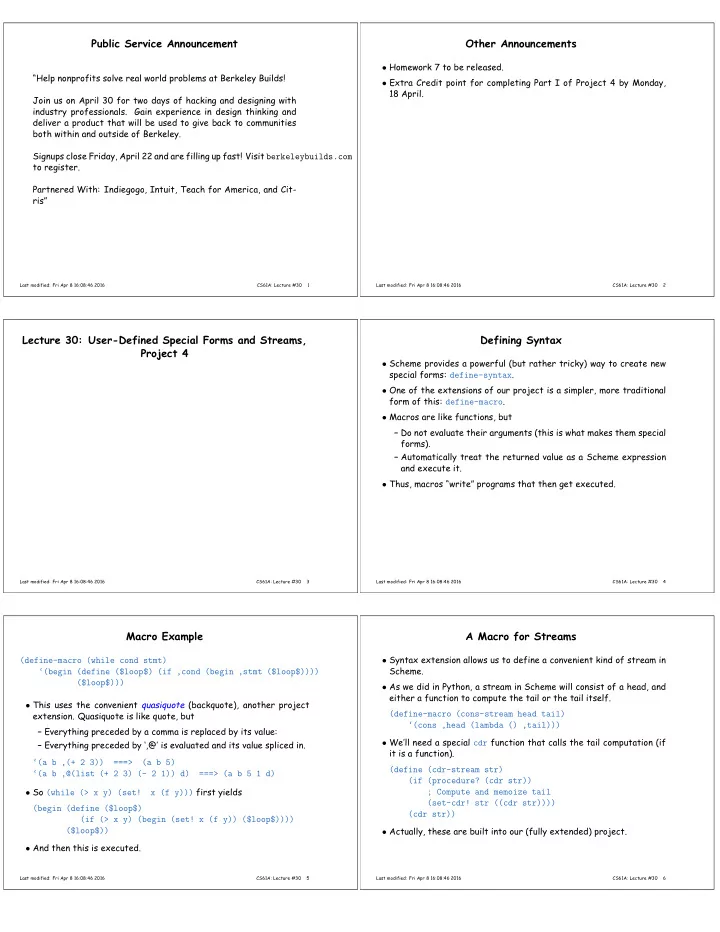
SLIDE 2 Streams in Scheme
;; The stream of all 1’s (define ones (cons-stream 1 ones)) (car ones) ===> 1 (car (cdr-stream ones)) ===> 1 (define (add-streams a b) ; Infinite streams, that is (cons-stream (+ (car a) (car b)) (add-streams (cdr-stream a) (cdr-stream b)))) ;; The stream 1 2 3 ... (define nums ) ;; The Fibonacci sequence (define fib (cons-stream 1 (cons-stream 1 )))
Last modified: Fri Apr 8 16:08:46 2016 CS61A: Lecture #30 7
Streams in Scheme
;; The stream of all 1’s (define ones (cons-stream 1 ones)) (car ones) ===> 1 (car (cdr-stream ones)) ===> 1 (define (add-streams a b) ; Infinite streams, that is (cons-stream (+ (car a) (car b)) (add-streams (cdr-stream a) (cdr-stream b)))) ;; The stream 1 2 3 ... (define nums (cons-stream 1 (add-streams ones nums))) ;; The Fibonacci sequence (define fib (cons-stream 1 (cons-stream 1 )))
Last modified: Fri Apr 8 16:08:46 2016 CS61A: Lecture #30 7
Streams in Scheme
;; The stream of all 1’s (define ones (cons-stream 1 ones)) (car ones) ===> 1 (car (cdr-stream ones)) ===> 1 (define (add-streams a b) ; Infinite streams, that is (cons-stream (+ (car a) (car b)) (add-streams (cdr-stream a) (cdr-stream b)))) ;; The stream 1 2 3 ... (define nums (cons-stream 1 (add-streams ones nums))) ;; The Fibonacci sequence (define fib (cons-stream 1 (cons-stream 1 (add-streams fib (cdr-stream fib)))))
Last modified: Fri Apr 8 16:08:46 2016 CS61A: Lecture #30 7
Project 4 Overview: General Comments
- This project is about reading programs as well as writing them. Don’t
just treat the framework you’re given as a bunch of magic incanta-
- tions. Try to understand and learn from it.
- Don’t allow yourself to get lost. Keep asking about things you don’t
understand until you do understand.
- You are always free to introduce auxiliary functions to help imple-
ment something. You do not have to restrict your changes to the specifically marked areas.
- You are also free to modify the framework outside of the indicated
areas in any other way you want, as long as you meet the require- ments of the project. – Feel free to add new Turtle methods (or others) to scheme_primitives.py. – Feel free to refactor code. – ALWAYS feel free to fix bugs in the framework (and tell us!).
- Stay in touch with your partner! If you’re having problems getting
along, tell us early, or we probably won’t be able to help.
Last modified: Fri Apr 8 16:08:46 2016 CS61A: Lecture #30 8
Interpreting Scheme
- Your project will have a structure similar to the calculator:
– Split input into tokens. – Parse the tokens into Scheme expressions. – Evaluate the expressions.
- Evaluation breaks into cases:
– Numerals and booleans evaluate to themselves. – Symbols are evaluated in the current environment (needs a data structure). – Combinations are either ∗ Special forms (like define or if), each of which is a special case, or ∗ Function calls
Last modified: Fri Apr 8 16:08:46 2016 CS61A: Lecture #30 9
Major Pieces
- read_eval_print is the main loop of the program, which takes over
after initialization. It simply reads Scheme expressions from an input source, evaluates them, and (if required) prints them, catching errors and repeating the process until the input source is exhausted.
- tokenize_lines in scheme_tokens.py turns streams of characters
into tokens. You don’t have to write it, but you should understand it.
- The function scheme_read parses streams of tokens into Scheme
- expressions. It’s a very simple example of a recursive-descent parser.
- The class Frame embodies environment frames. You fill in the method
that creates local environments.
- The class Evaluation is used in the extra-credit part for evaluating
expressions in tail contents.
- A hierarchy of classes represent functions.
- scheme_primitives.py defines the basic Scheme expression data
structure (aside from functions) and implements the “native” meth-
- ds (those implemented directly in the host language: Python, or in
- ther compilers, C).
Last modified: Fri Apr 8 16:08:46 2016 CS61A: Lecture #30 10
Function Calls
- The idea here is a “mutually recursive dance” between two parties
(just like the calculator): – scheme_eval, which evaluates operator and operands, and – scheme_apply, which applies functions to the resulting values.
- Interestingly, these just happen to be standard functions in the
language we are defining: we could in principle (and fact) interpret Scheme in Scheme metacircularly.
- But if we want to do this in Python, we have to deal with proper tail
recursion (i.e., its lack in Python vs. its presence in Scheme).
- That is, a purely tail-recursive function must be able to run arbi-
trarily long (without overflowing any internal stack).
Last modified: Fri Apr 8 16:08:46 2016 CS61A: Lecture #30 11
Dealing With Tail Recursion
- To handle tail recursion, you’ll actually implement a slightly modified
version of scheme_eval, one which partially evaluates its argument, performing one “evaluation step.”
- Each evaluation step returns either a value (in which case, evaluation
- f the expression is done), or another expression and the environ-
ment in which to evaluate it.
- So now Python can iterate. Conceptually:
while expr is still an unevaluated expression, expr, environ = eval_step(expr, expression) return expr
Last modified: Fri Apr 8 16:08:46 2016 CS61A: Lecture #30 12