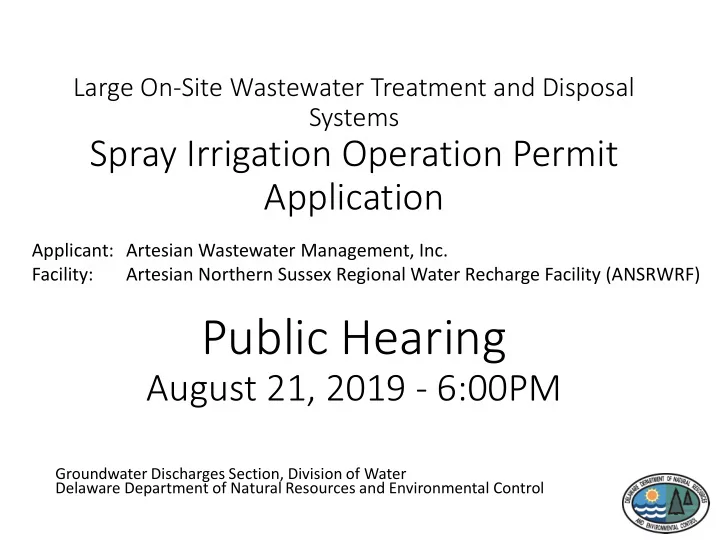
Public Hearing August 21, 2019 - 6:00PM Groundwater Discharges - - PowerPoint PPT Presentation

public hearing
SMART_READER_LITE
LIVE PREVIEW

Public Hearing August 21, 2019 - 6:00PM Groundwater Discharges - - PowerPoint PPT Presentation

Large On-Site Wastewater Treatment and Disposal Systems Spray Irrigation Operation Permit Application Applicant: Artesian Wastewater Management, Inc. Facility: Artesian Northern Sussex Regional Water Recharge Facility (ANSRWRF) Public Hearing


slide-1
SLIDE 1

Large On-Site Wastewater Treatment and Disposal Systems

Spray Irrigation Operation Permit Application

Public Hearing

August 21, 2019 - 6:00PM

Groundwater Discharges Section, Division of Water Delaware Department of Natural Resources and Environmental Control

Applicant: Artesian Wastewater Management, Inc. Facility: Artesian Northern Sussex Regional Water Recharge Facility (ANSRWRF)

slide-2
SLIDE 2

Overv rview

  • Artesian Wastewater Management, Inc., has

applied for a spray irrigation operations permit to receive treated wastewater effluent from Allen Harim WTP for storage, in a synthetically lined lagoon, and disposal, via spray irrigation at the ANSRWRF.

  • The design average daily flow is 1.5 MGD with a

peak flow of 2.0 MGD.

slide-3
SLIDE 3

Overv rview

  • The facility will utilize reclaimed wastewater for irrigation of

privately owned agricultural land under a lease held in perpetuity by Artesian.

  • The proposed irrigation sites (including current and future

phases) total approximately 1,714 acres of land which includes both wooded and agricultural area.

  • Current permit for allows spray on Fields F & G only until

completion of a Schedule of Compliance for Fields D & E construction completion.

  • These sites have been permanently placed in an Agricultural

Preservation Easement by the Delaware Agricultural Lands Preservation Foundation.

slide-4
SLIDE 4

Overv rview

  • The effluent will receive a high level of treatment

to meet the “Unlimited Public Access” requirement at the Allen Harim Wastewater Treatment Plant.

  • Nitrogen polishing will be accomplished through

crop uptake to meet Regulatory requirements.

  • The Artesian facility is also capable of disinfecting

the stored wastewater if additional treatment is required prior to spray irrigation.

slide-5
SLIDE 5

ANSRWRF – Sit ite Map

slide-6
SLIDE 6

Regulatory ry Requirements

  • Unlimited public access
  • All wastewater used for irrigation on unlimited access sites

must be biologically treated, filtered and disinfected.

  • The treated wastewater must meet the following daily

permissible average concentrations:

slide-7
SLIDE 7

Regulatory ry Requirements

  • Facility is required to achieve an average annual concentration of 10 mg/L

in the percolate beneath all spray fields as verified by in-field monitoring.

  • Percolate total nitrogen concentration must be estimated in a monthly

nitrogen balance spreadsheet which considers:

  • Average design wastewater loading
  • Nitrogen concentration in the effluent
  • Average annual precipitation and fixation
  • Application of all fertilizers
  • Propose crop cover and cover crop management scheme (i.e. crop uptake)
  • The design effluent total nitrogen concentration for a facility determines

the spray system design factors that will result in 10mg/L in the percolate (i.e. number of acres, application rate, type of crop, fertilizer usage, etc…)

slide-8
SLIDE 8

DRAFT Operation Permit Lim imitations

  • Design Effluent Nitrogen Concentration:
  • The facility has been designed for an effluent Total Nitrogen (TN)

concentration of 30 mg/L

  • TN > [Design Value + 25%] in this case 37.5 mg/L requires resampling and

submission of data to GWDS.

  • TN > 37.5 mg/L for over 3 months requires root cause analysis and

submission of a revised Design Engineering Report.

  • TN > [Design Value + 50%] in this case 45 mg/L may result in permit

revocation if corrective measures/redesign is not performed.

  • Nitrogen Loading Limitation:

The total amount of nitrogen that may be applied to each spray field acre shall not exceed the following.

Crop Type Nitrogen Loading Limit (lbs/acre-year) Cover – Corn - Barley 334.5 Barley – Soybean – Cover 388.8 Woods (Loblolly Pines) 435.4

slide-9
SLIDE 9

DRAFT Operation Permit Lim imitations

  • Effluent Volume Limitation:

Field Crop Type Maximum Annual Volume (MG) Acres Field D1 Crop without D4 Cover-Corn-Wheat 61.7 54.02 Field D1 Crop without D4 Wheat-Soybean-Cover 75.6 54.02 Field D1 Crop with D4 Cover-Corn-Wheat 66.2 58.03 Field D1 Crop with D4 Wheat-Soybean-Cover 81.2 58.03 Field D1 Woods Loblolly Pine Woods 56.8 32.69 Field E Crop Cover-Corn-Wheat 103.3 90.48 Field E Crop Wheat-Soybean-Cover 126.6 90.48 Field F Crop Cover-Corn-Wheat 126.1 110.48 Field F Crop Wheat-Soy-Cover 154.5 110.48 Field G Crop Cover-Corn-Wheat 315.1 276.06 Field G Crop Wheat-Soy-Cover 386.1 276.06 Field G Woods Loblolly Pines 348.6 200.47

slide-10
SLIDE 10

Storage Design Criteria

  • Storage provided in design
  • Normal operations only requires 65.2 MG of storage
  • 90 MG capacity provided
  • Excess capacity intended for Phase II expansion
  • Excess capacity can be utilized in case of emergency
  • Field G alone provides sufficient acreage, 471 acres, to

eliminate the average daily design flow and the total storage volume within a 90 day period via irrigation.

slide-11
SLIDE 11

Design Application Rate

  • ANSRWRF spray irrigation disposal system was designed at a

conservative maximum disposal rate of 1.65 inches per week.

  • The On-Site Regulations allow up to 2.5 inches per acre per

week; and, exceedance of 2.5 with written permission from the Department.

  • If necessary, the operators may seek temporary permission

to exceed the design spray limit of 1.65 inches per week provided groundwater levels are not excessive and nitrogen balance calculations allow.

slide-12
SLIDE 12

DRAFT Operation Permit Requirements

Parameter Unit Measurement Monitoring Frequency Sample Type Ammonia Nitrogen mg/L Monthly Composite Cadmium mg/L Annually Composite Copper mg/L Annually Composite Effluent Flow Gal/day per Field/Zone/Pivot Continuous Recorded Fecal Coliform Col/100 ml Twice per month Grab Lead mg/L Annually Composite Nickel mg/L Annually Composite Nitrate + Nitrite Nitrogen mg/L Monthly Composite Organic Nitrogen mg/L Monthly Calculation Total Nitrogen mg/L Twice per Month Composite Zinc mg/L Annually Composite

Effluent Monitoring Required at ANSRWRF

slide-13
SLIDE 13

O&M Pla lan Emergency and Contingency Pla lanning

  • An extra 15 days of storage at Phase 1 flow rates in the

storage lagoon and an additional 3 feet of freeboard that can be utilized in emergency conditions.

  • Diversion off offspec at the Allen Harim facility.
  • If offspec did reach ANSRWRF:
  • Spray operations will be temporarily suspended,
  • Additional monitoring will be performed at the lagoon,

and

  • If necessary, additional chlorination or portable

treatment will be used to bring effluent back to compliance prior to spray irrigation.

slide-14
SLIDE 14

O&M Pla lan Emergency and Contingency Pla lanning

  • The Phase 1 construction permit includes more

than the minimum required land for spray disposal

  • f the design flow rate.
  • These 110 additional acres are available to provide

flexibility in operations.

  • If challenging conditions arise, additional Fields D &

E can be brought into operational use.

slide-15
SLIDE 15

Conclusion:

To access this powerpoint and all hearing exhibits, please visit:

https://dnrec.alpha.delaware.gov/events/473/public-hearing-allen-harim- wasterwater-treatment-system-and-artesian-spray-irrigation-permit/

Thank You!