PT DSN Tbk Q1 14 Results Update PT Dharma Satya Nusantara Tbk Board - - PDF document

pt dsn tbk q1 14 results update
SMART_READER_LITE
LIVE PREVIEW

PT DSN Tbk Q1 14 Results Update PT Dharma Satya Nusantara Tbk Board - - PDF document

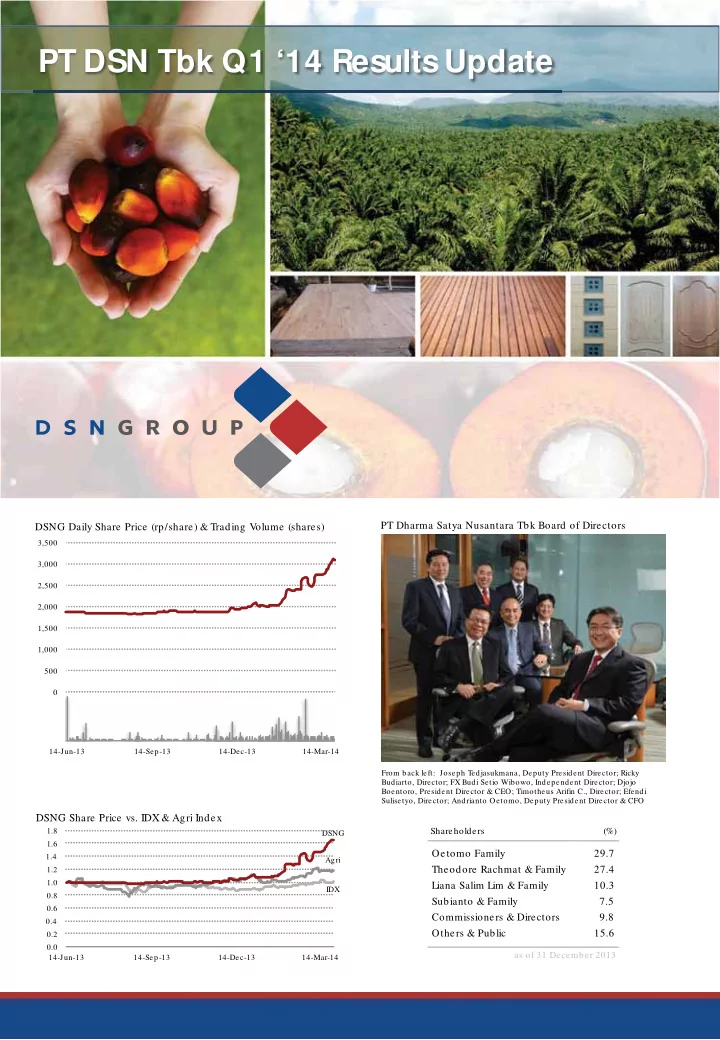
PT DSN Tbk Q1 14 Results Update PT Dharma Satya Nusantara Tbk Board of Directors DSNG Daily Share Price (rp/share) & Trading V olume (shares) 3,500 3,000 2,500 2,000 1,500 1,000 500 0 0 14-Jun-13 14-Sep-13 14-Dec-13 14-Mar-14


slide-1
SLIDE 1

PT DSN Tbk Q1 ‘14 Results Update

DSNG Daily Share Price (rp/share) & Trading V
  • lume (shares)
DSNG Share Price vs. IDX & Agri Index DSNG Agri IDX PT Dharma Satya Nusantara Tbk Board of Directors From back left: Joseph Tedjasukmana, Deputy President Director; Ricky Budiarto, Director; FX Budi Setio Wibowo, Independent Director; Djojo Boentoro, President Director & CEO; Timotheus Arifin C., Director; Efendi Sulisetyo, Director; Andrianto Oetomo, Deputy President Director & CFO 500 1,000 1,500 2,000 2,500 3,000 3,500 DSNG Share Price vs. IDX & Agri Index DSNG Agri IDX 0.0 0.2 0.4 0.6 0.8 1.0 1.2 1.4 1.6 1.8 14-Jun-13 14-Sep-13 14-Dec-13 14-Mar-14 14-Jun-13 14-Sep-13 14-Dec-13 14-Mar-14 Shareholders (%) Oetomo Family 29.7 Theodore Rachmat & Family 27.4 Liana Salim Lim & Family 10.3 Subianto & Family 7.5 Commissioners & Directors 9.8 Others & Public 15.6 as of 31 December 2013
slide-2
SLIDE 2 DSN’s primary businesses grow and process domestic agricultural products for global consumption PT Dharma Satya Nusantara Tbk (DSNG.JK) 2 Tie DSN Group was originally established as a wood products
  • manufacturer. We identified an opportunity to expand into the
plantation sector in 1997, building upon our established relationships within the local communities. Both of these business segments are showing growth, but the palm oil business is growing, and will continue to grow, at a higher rate. Palm oil accounted for 64% of total revenue in 2013, up from 59% in 2012, and 70% of Q1 2014 revenue driven by recently higher CPO average selling prices. Industry Company AKA Line of Business Palm Oil PT Dharma Agrotama Nusantara DAN 100.00% 1997 Oil palm plantation PT Dharma Intisawit Nugraha DIN 100.00% 1997 Oil palm plantation PT Swakarsa Sinarsentosa SWA 100.00% 2001 Oil palm plantation PT Pilar Wanapersada PWP 99.70% 2004 Oil palm plantation PT Dewata Sawit Nusantara DWT 99.90% 2007 Oil palm plantation PT Dharma Intisawit Lestari DIL 99.90% 2009 Oil palm plantation PT Kencana Alam Permai KAP 99.50% 2010 Oil palm plantation PT Karya Prima Agro Sejahtera KPS 99.99% 2011 Oil palm plantation PT Prima Sawit Andalan PSA 99.17% 2010 Oil palm plantation PT Dharma Persada Sejahtera DPS 99.17% 2010 Land Bank PT Mandiri Agrotama Lestari MAL 99.98% 2012 Land Bank PT Rimba Utara RUT 99.90% 2012 Land Bank PT Putra Utama Lestari PUL 99.80% 2012 Land Bank PT Dharma Buana Lestari DBL 90.00% 2013 Land Bank Wood Products PT Tanjung Kreasi Parquet Industry TKPI 65.00% 2012 Engineered flooring PT Nityasa Idola NI 92.50% 1989 Timber plantation Ownership / Control (%) Y ear Acquired

Crude Palm Oil Palm Kernel Palm Kernel Oil Block Board Engineered Doors Engineered Floors

Revenue Q1 '14 2013 2012 2011 2010 Palm Oil 70% 64% 59% 55% 55% Wood Products 30% 36% 41% 45% 45% Our history of expansion has accelerated in recent years, with the acquisition of eight new oil palm estates since 2010. We also took a controlling interest in Tanjung Kreasi Parquet Industry, a manufacturer of globally branded engineered flooring in 2012. Tiese subsidiaries provide long-term
  • pportunities for expansion in both of our core
businesses.
slide-3
SLIDE 3 cpo/ha certifi fied cpo cash cost/t unplanted ha ffb y-o-y Our performance and long-term prospects consistently demonstrate several key investment themes Q1 2014 Results Update 3 ey investment themes

Efficient:

cpo cash cost/t Disciplined and consistent implementation of appropriate agronomic practices allows DSN to achieve industry-leading productivity in FFB and CPO, with 6.4 tons of CPO per hectare produced in 2013. We have received RSPO certification at three of
  • ur five mills, and are in advanced stages of
certification for all remaining mills. Environmental certification is also critical to the global distribution of our wood products. Tie locations of our estates and mills, as well as our management practices, allow us to maintain a highly competitive cost position, with a 2013 cash cost per ton of Rp3.76 million. Our current unplanted landbank includes 114,000 hectares spread across the provinces of Kalimantan and Papua, which we expect will prove sufficient to support our planting schedule for the next seven to eight years. We saw growth across a broad range of metrics for 2013. FFB production was up 22% despite slow-downs across the sector. We expect this trend to continue, supported by growth in planted and mature hectares, output per hectare, milling capacity and CPO sales in the years to come.
slide-4
SLIDE 4 We began in palm oil in 1997 with the acquisition of 19,766 ha in East Kalimantan & have been expanding ever since PT Dharma Satya Nusantara Tbk (DSNG.JK) 4

14

estates

5 CPO mills 2,000,000

tons /annum

200 tons

/day PKO mill Tiese estates are supported by 5 CPO mills with an aggregate capacity of 2 million tons per year, along with a newly completed Palm Kernel Oil
  • mill. As we look to keep pace with the
increasing productivity of our young estates, additional CPO mills are currently under development. We are a fully integrated CPO producer, with 14 estates spanning 172,533 hectares, located across Kalimantan and in Papua. Nine estates have already been planted to some degree, with 6 estates already producing FFB. In total, we have 58,755 hectares of nucleus estates planted by the end of Q1, 2014, with an additional 13,254 hectares of plasma. Tie areas not yet planted provide us with an additional 114,000 hectares for future expansion in both nucleus and plasma operations. Given our recent acceleration in planting activity, we exhibit a very young age profile for our planted
  • area. Of our total planted area, 45.8% is
considered Young Mature and 18.2% remains
  • Immature. While these proportions are likely to
decline somewhat, we expect nearly 60% of our enlarged planted area to be either Immature or Young Mature by 2016. p g

172,500

hectares
slide-5
SLIDE 5 10 20 30 40 50 60 West Kalimantan Central Kalimantan North Kalimantan East Kalimantan Our estates are clustered across East, West and Central Kalimantan, with planting to date concentrated in the East Q1 2014 Results Update 5 Estate DBL DIL SWA DAN DIN DWT KPS MAL RUT KAP PSA DPS PUL PWP Land Area ('00 Total Planted 16.7
  • 8.0
1.6 16.9 15.3 10.0 9.0 9.8 8.7 13.6 9.9 6.2 4.7 15.0
  • 12.7
  • 14.9
0.8 10.6 0.3 6.1 0.0 17.0
  • 15.2
8.4 172.5 58.8 00 Ha) Available HGU Panitia B Ijin Lokasi 16.7
  • 6.3
  • 1.6
  • 1.0
  • 1.0
  • 3.7
  • 1.5
  • 15.0
  • 12.7
  • 14.1
  • 10.4
  • 6.1
  • 17.0
  • 6.8
  • 113.8
38% 8% 54% Land Rights Status Papua Papua Papua In total, our nucleus estates incorporate 58,755 planted hectares, of which 48,038 are already
  • mature. Our most developed cluster, with 5
estates, is near the center of East Kalimantan, while our next largest producing estate lies in Central Kalimantan. Our three largest estates, SWA, DAN and DIN are fully comprised of mature trees, with limited additional area available for new planting. Subsequent expansion will increasingly focus on Central and West Kalimantan, with Papua an
  • ption still several years out.
Total & Planted Hectares by Cluster Q1 2014 Conversion of land rights status progresses in line with our intended planting program. Mature estates are HGU: Planted / Unplanted = 5,000ha
slide-6
SLIDE 6 MYS Conversion of Planting Schedule to Age Profile Planting Schedule Age Profile Y ear FY H1 H2 Total Ha Age*
  • 1,151
704 2,283 441 284 71 1,147 428 80 992 1,189
  • 535
2,636 664 2,614 1,365 3,329 1,231 2,358 3,247 4,349 1,243 3,728 2,292 4,288 995 3,294 1,100 1,419 1,378 1,228 2,658 3,141 4,394 2,797 3,886
  • 3,979
4,560 5,605 5,592 6,020 5,283 1 1,855 2,724 355 1,575 1,072 1,189 535 3,300 7 6 5 4 3 2 13 12 11 10 9 8 18 17 16 15 14 6,580 4,289 2,519 2,607 5,799 3,171 3,278 4,694 3,589 7,596 4,971 1,151 2,987 725 1,218 508 2,181
  • 2008
2009 2010 2011 2012 2013 2007 1996 1997 1998 1999 2000 2001 2002 2003 2004 2005 2006 * As of year-end 2014
  • 1,151
704 2 283 441 284 71 1 147 2,283 441 428 80 992 1 189 1,147 428
  • 535
2 636 1,189 995 3,294 1,100 1 419 1,231 2,358 3,247 4 349 664 2,614 1,365 3 329 2,636 664 3,329 1 231 1,243 3,728 2,292 4 288 4,288 995 4,349 1 243 1,378 1,228 2,658 3,141 1,419 1 378 Our planting history has established a young age profile that will continue to deliver productivity growth in coming years PT Dharma Satya Nusantara Tbk (DSNG.JK) 6 Planted / Planned = 500 ha Mid-Y ear vs. Y ear-End Standard In 2011, the Company switched from the common Y ear-End Standard (YES) to a Mid- Y ear Standard (MYS) approach to establishing the age of our plantations for accounting purposes. In the YES approach, all trees planted during a given calendar year will be considered 1- year old at the close of that year. On average, however, these trees will have been in the ground for roughly 6 months. With the MYS approach, trees planted in H2 of the previous year and H1 of the current year will be considered 1-year old at the close of the year – a more accurate reflection
  • f the average amount of time these trees have been in the ground.
We have presented our planting history with an H1/H2 breakdown, should you care to re-apply the YES approach. All of the data presented within our financial reports and this presentation make use of the MYS from 2011 to the present. We added 5,800 hectares of nucleus in 2013, out of a total of 9,170 hectares planted during the year. In Q1 2014, we have planted an additional 893 hectares of nucleus and 588 hectares of plasma. We intend to maintain the current pace of nucleus expansion over the next three years, with additional areas of 6,400, 7,000 and 7,700 hectares respectively. In total, our 58,755 hectares of planted nucleus were an average age of 7.6 years at the end of Q1 2014. Tiis will drop to 7.0 years by year-end based upon our proposed our planting schedule. Tirough 2016, our average age is expected to increase slowly to 7.5 years.

7. Years

by the end 2014 DSN Planting History (‘000 ha) 2 4 6 8 '16 '15 '14 '13 '12 '11 '10 '09 '08 '07 '06 '05 '04 '03 '02 '01 '00 '99 '98 '97 '96
slide-7
SLIDE 7 42% of our planted area is classified as Y
  • ung Mature, with
expected annual FFB yield growth of between 8% -100% Immature Y
  • ung
Mature Prime Mature Old Mature 7 Tree Age FFB Y ield by Soil Type (tons/ha) (Yr) Class I Class II Class III 1
  • 2
  • 3
0.6 0.6 0.6 4 9.0 8.0 7.0 5 17.0 16.0 14.0 6 22.5 21.0 18.0 7 27.0 24.5 21.0 8 29.0 27.0 24.5 9 31.5 28.0 26.5 10 32.0 30.0 27.0 11 32.0 30.0 27.0 12 32.0 30.0 27.0 13 32.0 30.0 27.0 14 31.5 29.5 26.5 15 31.5 28.5 25.5 16 30.0 27.5 25.0 17 29.0 26.5 24.0 18 28.0 26.0 23.0 19 27.0 24.5 22.5 20 26.0 23.5 21.0 21 25.0 22.5 20.5 22 23.5 21.5 19.5 23 22.0 20.5 18.5 24 21.0 19.5 17.5 25 19.5 18.5 17.0 26 18.5 17.5 16.5 Age Growth Maturity Class (Yr) (Avg) Characteristics Immature 0-3
  • No Fruit
Y
  • ung Mature
4-8 40% Rapid growth in FFB/OER Prime Mature 9-18
  • 1%
Stable productivity Old Mature 19+
  • 5%
Steady decline We typically evaluate our performance and productivity against a set of external standards, based upon controlled growing conditions over the lifecycle of an oil palm tree. DSN Maturity Classifications are not universally shared, but best reflect our experience to date: Assuming no planting after 2016 Standard FFB Y ield by tree age and soil class Q1 2014 Results Update 2 4 6 8 10 12 14 5 10 15 20 25 30 35 2 4 6 8 10 12 14 16 18 20 22 24 26 = 500 ha Age of Trees FFB Y ield (t/ha) Age Profile (‘000 ha) Summary Maturity Profile (Mid-Y ear Standard), in % Mature Y ear-End Immature Y
  • ung
Prime Old Total 2010 43.0 38.3 18.7
  • 57.0
2011 34.6 46.6 18.8
  • 65.4
2012 26.3 49.5 24.2
  • 73.7
2013 24.6 46.8 28.7
  • 75.4
2014 25.2 41.9 32.9
  • 74.8
2015 28.7 33.8 34.9 2.6 71.3 2016 30.7 28.3 35.2 5.8 69.3 2017 23.5 27.9 42.3 6.2 76.5 2018 15.1 29.7 47.0 8.2 84.9 2019 5.9 33.3 51.2 9.6 94.1 2020
  • 35.6
53.3 11.1 100.0 Source: Indonesian Palm Oil Research Institute Class II Class III Class I
slide-8
SLIDE 8 Our target is to achieve lab standard FFB yields on a commercial scale within each of our estates 8 Our target is to achieve lab standard FFB yields o Our target is to achieve lab standard FFB yie commercial scale within each of our estates commercial scale within each of our estates

26.4

tons/ha

in 2013 For the full year, DSN produced 1,153 thousand tons FFB from
  • ur nucleus plantations, with an additional 88 thousand tons
coming from plasma operations. In aggregate, FFB output increased by 22% during the year. We achieved an aggregate output of 26.4 tons per hectare (based
  • n the Mid-Year Standard) versus 25.5 tons in the preceding
year. In Q1 2014, our nucleus estates produced 279 thousand tons FFB, up from 244 thousand tons in the previous year. Tiis aggregate increase of 14% comes from higher yields (up 3.7%) and a larger mature area (up 10.1%). Plasma yields rose by 25.1% from the same period in 2013, with mature areas growing by 26.2% and total output up by 57.9%. Production Performance Product Period Nucleus %Δ Y ield Plasma %Δ Y ield FFB Q1 '14 279 14 5.8 25 61 3.8 ('000 t, t/ha) Q1 '13 244
  • 5.6
16
  • 3.1
2013 1,153 18 26.4 88 104 17.5 2012 977 32 25.5 43 1,184 10.9 2011 738 38 22.4 3
  • 4.4
2010 536
  • 19.8
  • PT Dharma Satya Nusantara Tbk (DSNG.JK)
slide-9
SLIDE 9 0.0 0.5 1.0 1.5 2.0 2010 2011 2012 2013 2014 2015 2016 2017 2018 2019 2020 FFB V
  • lume (mn t)
5 Immature Y
  • ung Mature
Prime Mature 5 10 15 20 25 30 35 2 4 6 8 10 12 14 Our planting schedule through 2016 implies an average 10% annual growth in FFB to 2 million tons in 2020 9 Standard yield curve with planting through 2016 Our young estates consistently out-perform standard yields Our five largest estates (DAN, DIN, SWA, PWP and DWT) have been comfortably higher than the standard expected yields
  • ver the past four years. DSN’s estates are generally a
combination of Class II and Class III type soils. We have neither Class I soil (largely found in volcanic areas such as Sumatera) nor Class IV soil. As a matter of policy, we do not plant in peat soil. Our performance is driven by a disciplined approach to standard agronomic practices, meticulously implemented across our planted areas. Tiese range from selecting the best seeds, to formulating multiple unique fertilizer blends, to the use of cover crops to retain soil and natural predators to control mice and caterpillars, thereby allowing us to minimize the use of harmful pesticides. Q1 2014 Results Update Class II Class III = DSN Annual Nucleus Y ield Average Age (mature ha only) FFB Y ield (t/ha, 2010-2013) Y ear '000 ha % Δ Avg Age 2010 26.7 7.5 2011 32.3 21% 7.7 2012 38.4 19% 8.0 2013 43.6 14% 8.4 2014 48.0 10% 8.9 2015 50.8 6% 9.6 2016 54.7 8% 10.1 2017 60.4 10% 10.4 2018 67.1 11% 10.7 2019 74.3 11% 10.9 2020 82.2 11% 11.2 Mature Area Class II Class III % Δ 20.9 18.5 21.5 19.0 3% 21.9 19.5 2% 22.8 20.3 4% 23.7 21.2 4% 24.9 22.3 5% 25.3 22.7 2% 25.0 22.5
  • 1%
24.6 22.2
  • 1%
24.3 21.8
  • 1%
24.1 21.6
  • 1%
FFB/ha by Soil Type A standard yield curve derived from our plantation age profile, rather than simply our average age, can establish more realistic medium-term yield expectations. Tiese standards suggest average yields could continue to increase through 2016, barring external environmental factors. At the same time, our mature plantation area will increase from 43,644 hectares in 2013 to 54,721 hectares in 2016 (25.4%), with subsequent annual growth rates of 10% or better through 2020, with over 82,000 mature hectares at that time.
slide-10
SLIDE 10 Our most developed cluster - with 5 estates, 4 CPO Mills and 56,000 ha - is nearly the size of Singapore 10 Mill 2 Mill 3 DWT SWA DAN Mill 1 Mill 4 Mill 6 Mill 7 Trans - East Kalimantan Road Existing CPO Mills Planned CPO Mills DIN Mill 7 DIN KPS 3 81% of our planted area, in five estates, is located in a single contiguous area in East Kalimantan. Tiese 47,700 planted hectares encompass an area nearly the size of Singapore. Four out of our five existing palm oil mills are located within these estates, and we expect to complete the construction of two additional palm oil mills in 2015. Our mill capacity is designed to accommodate annual peak
  • utput from the associated estates. As a result, mills servicing
rapidly developing estates (such as Mill 5 in PWP) will appear to be underutilized, and may rely on significant external FFB purchases. Tie proximity of the palm oil mills to the fruit allows us to establish an 8-hour standard for harvest-to-mill, resulting in minimal spoilage of FFB and lower FFA. Our redundant capacity also minimizes disruption due to maintenance. Tie cluster approach allows us to achieve efficiencies in a number
  • f areas:
lower transportation costs centralization of logistics, such as housing, schools, clinics and security maximum use of infrastructure (mills, roads, jetties and ports) CPO mill capacity is designed for peak production months East Kalimantan cluster encompasses 88% of our mature area PT Dharma Satya Nusantara Tbk (DSNG.JK) Capacity Max Monthly Y ear Location Estate (Tons/Hour) Utilization* RSPO Mill 1 2002
  • E. Kal.
SWA 90 67% Certified Mill 2 2009
  • E. Kal.
DAN 60 101% Certified Mill 3 2010
  • E. Kal.
DIN 60 112% Certified Mill 4 2011
  • E. Kal.
SWA 60 110% Audited Mill 5 2011
  • C. Kal.
PWP 60 96% Audited Mill 6 2015
  • E. Kal.
DWT 60 Mill 7 2015
  • E. Kal.
KPS 60 In Progress Total Capacity 450 *2013 Estate Land Area (Ha) Average Age (Yrs) Y ield Planted (Q1 '14) Mature (2014) Total Area Mature Area* 2013 (t/ha) DIL SWA DAN DIN DWT KPS 1,625
  • 0.6
  • 15,282
15,282 13.7 13.7 30.4 9,000 8,919 7.9 7.9 25.9 8,749 8,749 7.9 7.9 28.2 9,914 7,254 4.3 5.2 22.4 4,739 2,105 3.2 5.4 12.7 KAP PSA DPS 793
  • 1.5
  • 260
  • 1.0
  • 9
  • 1.0
  • PWP
8,384 5,729 4.4 5.2 19.7 58,755 48,038 7.6 8.9 26.4 * As of year-end 2014
slide-11
SLIDE 11 Our 5 mills achieved an aggregate OER of 24.3% last year, resulting in a CPO yield of 6.4 tons per mature hectare 11 In total, FFB processed and CPO produced each increased by 31% in 2013, yielding a stable Oil Extraction Rate (OER) of 24.3%. Palm Kernel production rose 21% to 43,000 tons in 2013. Sales declined, however, to 12,000 tons as our newly commissioned Palm Kernel Oil mill began to utilize this output directly. In our first year of operation, our PKO mill produced 13,500 tons, and generated sales of 9,400 tons of PKO. For Q1 2014, we achieved an OER of 23.6%, in line with the previous year’s Q1 performance. Palm kernel production rose 24.3% to 11 thousand tons, while PKO output reached 3.8 thousand tons, up from 468 tons in 2013. an aggregate OER of 24.3% last year, an aggregate OER of 24.3% last y ld of 6.4 tons per mature hectare ld of 6 4 tons per mature hectare

24.3

% OER

in 2013 We processed a total of 1,381 thousand tons of FFB in 2013, 90% of which was sourced from our own nucleus or plasma estates. External purchases increased by nearly 120% in
  • rder to better utilize capacity at our newest Mill 5,
servicing the PWP estate. For Q1 2014, we processed 374 thousand tons of FFB, up 34.8% from Q1 2013. Of that total, 82% was sourced from our nucleus and plasma
  • perations.
Our CPO production quality remained exceptional
  • ver the course of 2013, with aggregate Free Fatty
Acid (FFA) levels of just 2.65%. In all, over 90% of our production could be classified as Super CPO, with FFA levels below 3%. Tiis output services refiners’ higher-quality products, and as such we receive a minimum of a 1.0% premium over spot prices for these sales. Our remaining production achieves excellent quality as well. Tie maximum monthly FFA level from mills primarily processing our own production, was just 3.06% in 2013. Y ear Q1 '14 Q1 '13 2013 2012 2011 2010 FFA (%) 2.87% 2.73% 2.65% 2.67% 2.55% 2.62% Q1 2014 Results Update Production Performance - Estates Fresh Fruit Bunches (FFB) ('000 tons) Y ear Produced Plasma Purchased Processed Q1 '14 279 25 71 374 Q1 '13 244 16 18 278 2013 1,153 88 143 1,381 2012 977 43 65 1,052 2011 738 3 40 767 2010 536 26 542 Production Performance - Mills Product Period Nucleus %Δ Y ield CPO Q1 '14 88 35 23.6% ('000t, OER) Q1 '13 66
  • 23.7%
2013 336 31 24.3% 2012 257 36 24.4% 2011 189 41 24.6% 2010 134
  • 24.7%
PK Q1 '14 11 24 2.9% ('000 t, KER) Q1 '13 9
  • 3.2%
2013 43 21 3.1% 2012 36 50 3.4% 2011 24 50 3.1% 2010 16
  • 2.9%
PKO Q1 '14 3.8 703 41.9% ('000 t, PKOER) Q1 '13 0.5
  • 2013
13.5
  • 42.4%
*Nucleus Only 90% of our CPO production has FFA levels below 3%. This “ Super CPO” can command a premium
  • f 1-4% versus standard CPO.
slide-12
SLIDE 12 Expanding domestic refining capacity, coupled with our high-quality product, ensures robust demand for our CPO 12 Our customers are primarily Indonesian CPO refineries located in Kalimantan and Java, close to DSN’s operations. Regular customers include Smart, Wilmar, Kuala Lumpur Kepong, Musim Mas and Dermaga Kencana Indonesia. We expect Astra’s new refinery on Sulawesi Island to become a customer in 2014 as well. Our contracts are open tender, with SMART and Wilmar typically offering better pricing - due to refinery location –and terms than other buyers. For Q1 2014, we sold 90 thousand tons of CPO, 22% higher than the same period in 2013. Our average selling price of Rp8.8 million per ton was 40% above that in Q1 2013, and 24.6% higher than the average for the full year. Refineries DSN plantations DSN customers DSN Ports 600 650 700 750 800 850 900 950 1,000 Jun-12 Sep-12 Dec-12 Mar-13 Jun-13 Sep-13 Dec-13 Mar-14 2nd Month Malaysia CPO Contract (US$/t) 2nd Month Indonesia CPO Contract (US$/t) Indonesian CPO trading at a premium to Malaysia since mid-2013 PT Dharma Satya Nusantara Tbk (DSNG.JK) Sales Performance Period Sales %Δ Sales %Δ PKO Q1 '14 90 22 3
  • 63
7 Q1 '13 73
  • 7
  • 2013
336 33 16
  • 55
9 2012 253 33 35 61
  • 2011
190 40 21 24
  • 2010
135
  • 17
  • Q1 '14
786 71 14
  • 14
69 Q1 '13 458
  • 17
  • 2013
2,369 29 42
  • 63
66 2012 1,840 30 115 24
  • 2011
1,411 57 93 63
  • 2010
901
  • 57
  • Q1 '14
8.78 40 5.59 134 10.30 Q1 '13 6.26
  • 2.39
  • 2013
7.05
  • 3
2.70
  • 19
7.07 2012 7.29
  • 2
3.33
  • 23
  • 2011
7.44 12 4.32 31
  • 2010
6.66
  • 3.29
  • V
  • lume
(k tons) Revenue (rp bn) ASP (rp mn/t) CPO PK
slide-13
SLIDE 13 Our cash cost of sales for CPO declined 11% in 2013, partially offsetting the broadly lower ASPs 13

3.8

million rp/t

in 2013 Cost of Sales 2013 2012 2011 2010 CPO Sales ('000 t) 336.2 252.5 189.7 135.3 Fertilizer 288.7 326.7 193.7 161.1 Labor 336.0 274.3 166.1 107.2 Others 244.7 224.3 227.4 210.8 FFB Purchased 294.1 179.1 69.0 30.1 Milling 99.5 65.1 33.6 39.4 Total cash cost 1,263.0 1,069.5 689.7 548.6 Cash Cost/Ton 3.76 4.23 3.64 4.05 % of total 2013 2012 2011 2010 Fertilizer 22.9% 30.5% 28.1% 29.4% Labor 26.6% 25.6% 24.1% 19.5% Others 19.4% 21.0% 33.0% 38.4% FFB Purchased 23.3% 16.7% 10.0% 5.5% Milling 7.9% 6.1% 4.9% 7.2% Cash Cost of Sales (IDR bn) Our cash cost in 2013 declined to Rp3.76 million per ton of CPO sold, a drop of 11.3% from 2012. Absolute fertilizer costs fell by nearly 12%, despite an increase in planted and mature hectares, and account for roughly 23% of total cash costs. We purchase compound fertilizer – comprised of potash, nitrogen, and phosphate – under annual contracts with four- monthly delivery. Our unit costs per ton ranged from $525 to $570 in 2013. New contracts covering our entire 2014 supply have already been concluded at prices between $320 and $425 per ton. Purchases of external FFB – both plasma and unrelated estates - were up 64%. Tiis was due to the rapid increase in plasma productivity with increasing maturity of the estates, as well as higher external purchases in support of Mill 5 operations. Labor costs were up 22.5% for the year on the back of an expanded workforce as well as modest adjustments in wages. Labor accounts for nearly 27% of the total cash cost of sales. Q1 2014 Results Update
slide-14
SLIDE 14 We offer a Build-Operate-Transfer model for our plasma program & currently manage over 75% of plasma hectarage 14 Plasma % Y ear
  • f Nucleus
Plasma Nucleus Total 2008 6% 2.0 3.7 5.7 2009 6% 0.7 6.5 7.2 2010 8% 0.9 4.1 5.0 2011 9% 1.0 2.6 3.6 2012 17% 2.2 2.6 4.8 2013 22% 3.4 5.8 9.2 2014E 26% 4.2 6.4 10.6 2015E 29% 3.7 7.0 10.7 2016E 29% 2.3 7.7 10.0 Planting Schedule ('000 ha) Plasma Nucleus Total 2.0 35.5 37.6 2.7 42.1 44.8 3.6 46.2 49.8 4.6 50.9 55.5 8.8 52.1 60.8 12.7 57.9 70.5 16.9 64.2 81.1 20.6 71.2 91.8 22.9 78.9 101.8 Planted Area ('000 ha) Our strong relationships with our plasma holders is one critical element in the success of DSN’s palm oil activities, generally fostering easier acquisition of land, facilitating title conversion, and minimizing the prospect of local disturbances
  • r social unrest.
Our BoT model has resulted in higher FFB yields for plasma estates, and thereby higher revenues for our plasma cooperatives. DSN still benefits from the ~50% milling margin and gains assurance that the loans to plasma holders can be repaid. 5% of total FFB revenues are retained by DSN as a management fee. Of the remainder, 30% is paid to the plasma holder, while 70% services bank loans and funds extended by DSN for upkeep and maintenance of the estate prior to breaking even. DSN typically funds the development of plasma estates through bank loans with repayment schedules comprising a 4-year grace period and 6- year repayment. We had planted 13,254 hectares of plasma by the end of Q1 2014. In total, 6,371 hectares had reached maturity and produced 24,512 tons of FFB in Q1 2014.

plasma to nucleus

by the end of 2014 y by the end of

26

%

PT Dharma Satya Nusantara Tbk (DSNG.JK) An ambitious planting schedule will result in plasma areas totaling 26% of our nucleus hectarage by the end of 2014
slide-15
SLIDE 15 Our commitment to social and environmental responsibility is integral to the sustainability of our operations Q1 2014 Results Update 15 Corporate Social Responsibility DSN is committed to a wide range of CSR programs, and we continuously engage and support the communities within which we operate. We maintain active partnerships with more than 20 cooperatives
  • f smallholders near our plantations to manage a total of 12,666
ha of planted area under our Plasma Program. Tiis program helps increase the productivity of our plasma by leveraging on DSN’s expertise in plantation operations. We exclusively employ local contractors and cooperatives for all of
  • ur transportation, construction, and other non-core services. We
have been instrumental in fostering the development of these small businesses and rely on them to the extent that we do not
  • wn any trucks for the transport of FFB to our mills.
We continue to promote literacy by making education accessible through the establishment of schools in our plantation areas as well as community learning centers in the surrounding villages with the help of the University of Sanata Dharma. We have also provided free medical services to all our employees and our local communities since we started operations, with a network of clinics across our estates. Our successful implementation of these and other CSR programs has resulted in no demonstrations or operational disturbances over the last 3 years by the local population or NGOs. Environmental Responsibility We and our subsidiaries involved in the palm oil business are members of the Roundtable on Sustainable Palm Oil (RSPO), and strive to comply with global RSPO and the Indonesian Sustainable Palm Oil (“ISPO”) principles. We have received RSPO certification for our SWA, DAN and DIN palm oil plantations along with their respective mills, and have completed the RSPO and ISPO audit process in December 2013 for all our mills and their respective estates. We expect to receive the remaining RSPO certifications by this year. We are also committed to protecting our environment. We have set aside 6,600 hectares of land, or an area roughly equivalent to 10% of our total planted area, for conservation purposes. We comply with various domestic and international environmental standards in our wood products manufacturing processes, and seek to ensure that all the logs and sawn timber purchased for our operations are produced from sustainable forest resources. We were awarded the Certification of Legal Wood certifying our use of legally sourced logs and have also obtained the Forest Stewardship Council (FSC) Chain-of-Custody and Program for the Endorsement of Forest Certification (PEFC) certifications. We meet the Conformité Européenne (CE) labeling standards for products exported to Europe and have received certifications from the California Air Resources Board (CARB) and the Japanese Agricultural Standard (JAS).
slide-16
SLIDE 16 DSN is also a leading wood products manufacturer with reputable brand names &long-standing client relationships PT Dharma Satya Nusantara Tbk (DSNG.JK) 16 Sales V
  • lume
Q1 '14 Q1 '13 Q-o-Q % Δ FY2013 Panel ('000 m3) 58 65
  • 11.3%
245 Engineered Products Doors ('000 Pcs) 10 15
  • 32.7%
52 Flooring ('000 m2) 304 253 20.5% 1,073 Panels (per m3) 4,318 3,595 20.1% 3,974 Engineered Products Doors (per pc) 1,284 976 31.5% 1,059 Flooring (per m2) 347 295 17.8% 314 A Average Selling Price ('000 Rp) Customer Name Type Products Relationship Geography S.A. Shahab & Company Pte Ltd Trader Panels 11 years Middle East Sumitomo Forestry Company Ltd. Trader Panels 8 years Japan Vintage Hardwood Flooring Distributor Engineered Flooring 9 years Canada Jiangsu Skyrun Arser Co., Ltd Trader Panels 3 years China Asia Trading, Inc Trader Panels 7 years Japan Associated Lumber & Trading, Ltd Trader Panels 5 Y ears Japan PKF Global Trader Engineered Doors 15 years UK Plyquet Holzimport Distributor Engineered Flooring 17 years Europe Teka Korea Co., Ltd Distributor Engineered Flooring 12 years South Korea Beijing Teka Holy Eagle Corporation Distributor Engineered Flooring 11 years China Top 10 Industrial and Commercial Customers DSN is the fourth largest wood products manufacturer in Indonesia, producing panels, engineered floors and doors. We have initiated a move into higher value, higher margin products through the recent acquisition of TKPI, which specializes in engineered flooring. We continue to leverage on our long standing relationships with customers to across the world to leverage this new business initiative. Our diverse exposure to customers in different segments and geographies has protected us to from adverse economic impacts as we maintain and grow our wood products business.

4,000,000

m2/annum

floori n g c a pa c i ty

450,000

m3/annum panel c

apac ity
slide-17
SLIDE 17 Our capital expenditures in 2013 totaled Rp663 billion, primarily for new planting & the construction of mills Q1 2014 Results Update 17

5-5.5k/ha

cos t to maturity

18 mn

for each 60 ton/hour mill

$

Wood Products For wood products, we have sufficient capacity to meet our current growth plans. We intend to more than double production volume in engineered flooring from 1.1 million m2 in 2012 to 2.6 million m2 by 2015, while our plant currently has capacity to produce up to 4 million m2. We will be optimizing our wood products efficiency by relocating and consolidating our
  • perations in Surabaya and Gresik to a new
panel products processing plant in Lumajang by
  • 2015. Tiis is closer to our satellite plants and
will reduce our transportations costs Capital Expenditures 2013 2012 2011 2010 Immature Plantations 335 294 353 224 Construction in Progress 182 482 282 128 Others 146 131 308 133 Total 663 907 942 485 Palm Oil As our plantations mature, we expect to implement a planting schedule sufficient to maintain a favorable long-term maturity
  • profile. In general, our cost to maturity for new planting is
roughly $5,000 to $5,500 per hectare. We also plan to match the increased FFB production over time with appropriate increases in CPO processing capacity. A new mill is required for every 10,000 additional mature hectares. We expect to complete construction of two new palm oil mills with total capacity of 720,000 tons / annum in 2015. Tie cost of each 60 ton/hour mill, which is comprised of two lines of 30 ton/hour capacity is approximately US$18 million. (Does not include capitalized interest or loans/advances to plasma)

$

slide-18
SLIDE 18 In total, DSN generated revenue of Rp3,842 billion in 2013, with EBITDA growing by 33% and EBITDA margins of 23% PT Dharma Satya Nusantara Tbk (DSNG.JK) 18 The decline in Net Profit in 2013, despite significant increases in revenue and EBITDA, is largely due to the impact of year-end depreciation of the rupiah against the dollar. The mark-to-market of our $70 million FX loans outstanding resulted in an unrealized FX loss of Rp172 billion. DSN generated revenue of Rp3,842 billion in 2013, DSN generated revenue of Rp3,842 billion in 2013, TDA growing by 33% and EBITDA margins of 23% TDA growing by 33% and EBITDA margins of 23%

888bn

EBITDA

in 2013 Note: Annual Financial Statements are audited by Siddharta & Wijaja, Registered Public Accountants, and a Member Firm of KPMG International. T Total (IDR bn) Q1 '14 2013 2012 2011 2010 Revenue 1,238 3,842 3,411 2,778 1,751 EBITDA 270 888 666 665 297 EBITDA Margin 21.8% 23.1% 19.5% 24.0% 17.0% Net Profit 151 216 252 374 162 Net Margin 12.2% 5.6% 7.4% 13.5% 9.3% P Palm Oil Revenue 869 2,478 1,997 1,524 971 EBITDA 259 885 614 652 307 EBITDA Margin 29.8% 35.7% 30.8% 42.8% 31.7% Profit Before Tax 208 517 416 547 260 PBT Margin 23.9% 20.9% 20.9% 35.9% 26.8% W Wood Products Revenue 369 1,364 1,414 1,254 780 EBITDA 30 73 123 63 26 EBITDA Margin 8.2% 5.4% 8.7% 5.0% 3.3% Profit Before Tax 28 (80) 33 12 (5) PBT Margin 7.6%
  • 5.9%
2.3% 0.9%
  • 0.6%
Loan Facilities IDR Bn US$ MM Working Capital 370 35 Investment 1,678 38 Finance Leases 3 2 Total 2,051 74 Interest Rate Range Low 2.75% 2.00% High 10.65% 5.75% Total Debt 2,899 Net Debt 2,429 Equity 1,830 EBITDA 270 Financial Ratios: Debt/Equity 1.6 Net Debt/Equity 1.3 Net Debt/EBITDA 2.3 Q1 2014

Rp

slide-19
SLIDE 19 Total Consolidated (IDR bn) Q1-2014 Q1-2013 QoQ Δ% 2013 2012 Y
  • Y Δ%
Revenue 1,238 799 3,842 3,411 % growth 54.9% 12.6% 22.8% Gross Profit 341 191 78.7% 1,190 961 23.8% % margin 27.5% 23.8% 31.0% 28.2% Operating Profit 205 81 153.4% 657 494 32.9% % margin 16.6% 10.1% 17.1% 14.5% EBITDA 270 132 105.0% 888 666 33.2% % margin 21.8% 16.5% 23.1% 19.5% Net Profit 151 27 464.7% 216 252
  • 14.6%
% margin 12.2% 3.3% 5.6% 7.4% Forex gain (loss) from financing 55 (3) (184) (34) Adjusted Profit 96 30 220.3% 400 287 39.5% % margin 7.8% 3.8% 10.4% 8.4% T Total Palm Oil (IDR bn) Q1-2014 Q1-2013 QoQ Δ% 2013 2012 Y
  • Y Δ%
Revenue 869 475 2,478 1,997 % growth 83.0% 24.1% 31.0% Gross Profit 290 155 87.0% 1,046 820 27.6% % margin 33.4% 32.7% 42.2% 41.1% Operating Profit 209 91 130.3% 707 496 42.6% % margin 24.1% 19.1% 28.5% 24.8% EBITDA 259 128 103.2% 885 614 44.0% % margin 29.8% 26.9% 35.7% 30.8% Profit Before Tax 208 66 214.2% 517 416 24.1% % margin 23.9% 13.9% 20.9% 20.9% Forex gain (loss) from financing 27 (2) (91) (13) Adjusted PBT 181 68 165.2% 608 429 41.7% % margin 20.8% 14.4% 24.5% 21.5% T Total Wood Products (IDR bn) Q1-2014 Q1-2013 QoQ Δ% 2013 2012 Y
  • Y Δ%
Revenue 369 324 1,364 1,414 % growth 13.9%
  • 3.5%
12.7% Gross Profit 51 36 42.6% 144 141 2.0% % margin 13.7% 11.0% 10.5% 10.0% Operating Profit 16 5 245.9% 20 70
  • 71.1%
% margin 4.4% 1.5% 1.5% 4.9% EBITDA 30 18 65.6% 73 123
  • 40.4%
% margin 8.2% 5.7% 5.4% 8.7% Profit Before Tax 28 (3) na (80) 33
  • 345.9%
% margin 7.6%
  • 1.1%
  • 5.9%
2.3% Forex gain (loss) from financing 21 (1) (68) (13) Adjusted PBT 7 (3) na (12) 46
  • 127.4%
% margin 2.0%
  • 0.9%
  • 0.9%
3.2% F Financial Positions Q1-2014 QoQ Δ% 2013 2012 Y
  • Y Δ%
Total debt 2,899
  • 2.1%
2,961 2,733 8.4% Net debt 2,429
  • 1.8%
2,474 2,195 12.7% Total Asset 6,118 3.3% 5,921 5,141 15.2% Total Equity 1,830 9.0% 1,679 1,406 19.4% Total debt / equity 1.6x 1.8x 1.9x Net debt / equity 1.3x 1.5x 1.6x Net debt / EBITDA 2.3x 2.8x 3.3x

Q1 2014 Summary Financials

Q1 2014 Results Update 19 Note: Annual Financial Statements are audited by Siddharta & Wijaja, Registered Public Accountants, and a Member Firm of KPMG International.
slide-20
SLIDE 20

Q1 2014 Operations Summary

PT Dharma Satya Nusantara Tbk (DSNG.JK) 20 DISCLAIMER: This presentation may contain forward-looking statements that involve risks and uncertainties. Actual future performance, outcomes and results may differ materially from those expressed in forward-looking statements as a result of a number of risks, uncertainties and assumptions. Although the Company believes that such forward- looking statements are based on reasonable assumptions, it can give no assurance that such expectations will be met. Y
  • u are cautioned not to place undue reliance on these
forward looking statements, which are based on the current view of the management on future events. Unless otherwise stated, the Company is the source for all data contained in this presentation. Such data is provided as at the date of this presentation and is subject to change without notice. No reliance may be placed for any purposes whatsoever on the information contained in this presentation, or any other material discussed at the presentation, or
  • n the completeness, accuracy or fairness thereof.
The information in this presentation has not been independently verified. No representation, warranty, express or implied, is made as to, and no reliance should be placed on, the fairness, accuracy, completeness or correctness of the information and opinions in this presentation. None of the Company or any of its agents or advisers, or any of their respective affiliates, advisers or representatives, undertake to update or revise any forward-looking statements, whether as a result of new information, future events or otherwise and none of them shall have any liability (in negligence or otherwise) for any loss howsoever arising from any use of this presentation or its contents or otherwise arising in connection with this presentation. This presentation also contains certain statistical data and analyses which have been prepared by the Company and/or other sources. Numerous assumptions were used in preparing the Statistical Information, which assumptions may or may not appear herein. As such, no assurance can be given as to the Statistical Informations accuracy, appropriateness or completeness in any particular context, nor as to whether the Statistical Information and/or the assumptions upon which they are based reflect present market conditions or future market performance. P Palm Oil Summary Q1-2014 Q1-2013 QoQ Δ% 2013 2012 Y
  • Y Δ%
Plantations FFB Production (t) 303,231 259,762 16.7% 1,240,818 1,019,923 21.7% FFB nucleus (t) 278,719 244,235 14.1% 1,152,611 976,711 18.0% FFB plasma (t) 24,512 15,527 57.9% 88,207 43,212 104.1% Mills FFB Processed (t) 373,813 277,500 34.7% 1,380,528 1,052,490 31.2% CPO Production (t) 88,385 65,644 34.6% 335,730 256,971 30.6% PK Production (t) 10,988 8,838 24.3% 43,277 35,716 21.2% PKO Production (t) 3,760 468 703.4% 13,482
  • FFB Y
ield - nucleus (t/ha) 5.8 5.6 3.6% 26.4 25.5 3.7% FFB Y ield - plasma (t/ha) 3.8 3.1 24.9% 17.5 10.9 60.6% CPO OER (%) 23.6% 23.7%
  • 0.1%
24.3% 24.4%
  • 0.4%
KER (%) 2.9% 3.2%
  • 8.9%
3.1% 3.4%
  • 7.6%
FFA (%) 2.87% 2.73% 5.1% 2.65% 2.67%
  • 0.7%
Sales Volume (tons) CPO 89,554 73,266 22.2% 336,240 252,536 33.1% PK 2,533 6,924
  • 63.4%
15,622 34,589
  • 54.8%
PKO 6,701
  • na
9,400
  • Average Selling Price (IDR mn/ton)
CPO 8.78 6.26 40.3% 7.05 7.29
  • 3.3%
PK 5.59 2.39 134.3% 2.70 3.33
  • 18.7%
PKO 10.31 na 7.07
  • Mature Land (ha)
Nucleus 48,038 43,644 10.1% 43,644 38,361 13.8% Plasma 6,371 5,047 26.2% 5,047 3,972 27.1% Total 54,409 48,691 11.7% 48,691 42,333 15.0% Wood Products Summary Q1-2014 Q1-2013 QoQ Δ% 2013 2012 Y
  • Y Δ%
Sales Volume Panel (m3) 58,019 65,391
  • 11.3%
244,642 334,512
  • 26.9%
Engineered doors (pcs) 10,273 15,258
  • 32.7%
51,989 91,102
  • 42.9%
Engineered floors (m2) 304,252 252,578 20.5% 1,073,412 1,166,657
  • 8.0%
Average Selling Price (IDR mn) Panel (m3) 4.32 3.60 20.1% 3.97 3.10 28.1% Engineered doors (pcs) 1.28 0.98 31.5% 1.06 0.69 53.6% Engineered floors (m2) 0.35 0.29 17.8% 0.31 0.27 14.8%