Psoriasis Mark A. Bechtel, M.D. Director of Dermatology The Ohio - - PDF document

psoriasis
SMART_READER_LITE
LIVE PREVIEW

Psoriasis Mark A. Bechtel, M.D. Director of Dermatology The Ohio - - PDF document

Psoriasis Mark A. Bechtel, M.D. Director of Dermatology The Ohio State University College of Medicine Psoriasis Psoriasis is a chronic skin disorder resulting from a polygenic predisposition combined with triggering factors including


slide-1
SLIDE 1

1

Psoriasis

Mark A. Bechtel, M.D.

Director of Dermatology The Ohio State University College of Medicine

Psoriasis

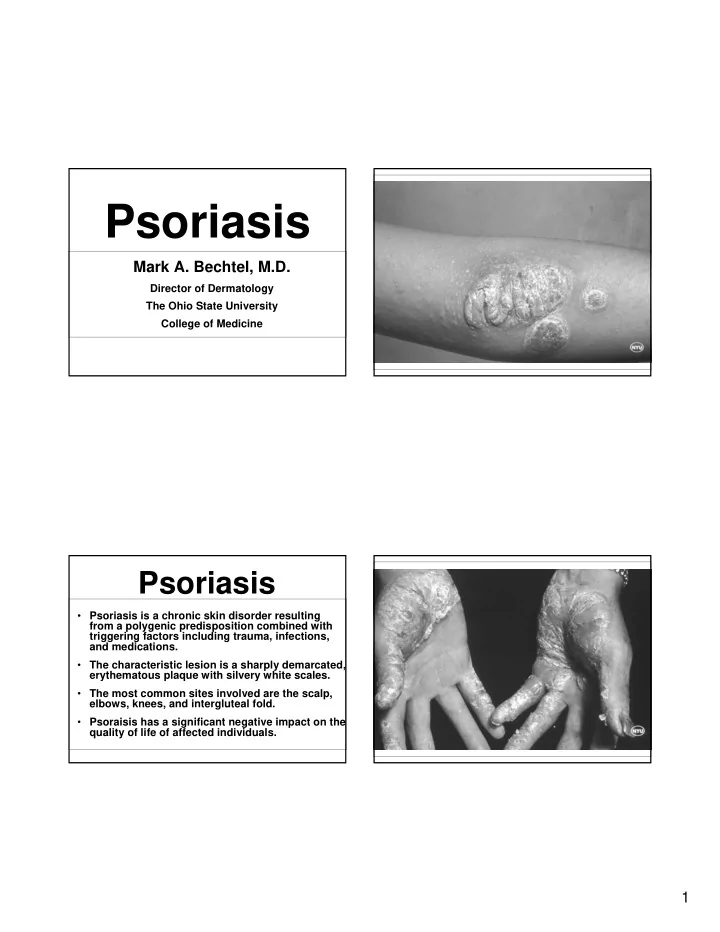
  • Psoriasis is a chronic skin disorder resulting

from a polygenic predisposition combined with triggering factors including trauma, infections, and medications.

  • The characteristic lesion is a sharply demarcated,

erythematous plaque with silvery white scales.

  • The most common sites involved are the scalp,

elbows, knees, and intergluteal fold.

  • Psoraisis has a significant negative impact on the

quality of life of affected individuals.

slide-2
SLIDE 2

2

Psoriasis-Epidemiology and Genetics

  • Psoriasis involves 2% of the world’s population.
  • In the U.S., the prevalence may be as high as

4.6%.

  • It is estimated that 4.5 million Americans suffer

from psoriasis.

  • Approximately 1.5 million Americans have

moderate to severe psoriasis.

  • Psoriatic arthritis occurs in 5-30% of patients,

depending on diagnostic criteria utilized.

  • An immune mediated disorder
  • Predominant TH1 cytokine profile
  • Memory effector T-cells (CD45RO+) play a

major role

  • TNF-alpha is important in psoriatic arthritis

and cutaneous psoriasis

Psoriasis - Immunology

Triggering Factors

  • Koebner phenomenon – injury to the

skin, sunburn

  • Infections – especially streptococcal

infections, HIV, hepatitis C

  • Psychogenic stress
  • Medications – lithium, interferon, B-

blockers, antimalarials, rapid tapers of corticosteroids

slide-3
SLIDE 3

3

Psoriasis - Associated Medical Conditions

  • Patients have an increased risk of lymphoma
  • Psoriasis may confer an independent risk of

myocardial infarction with the greatest risk in young patients with severe psoriasis.

  • Increased incidence of obesity
  • Increased incidence of depression
  • Increased incidence of metabolic syndrome

Psoriatic Arthritis – Clinical Patterns

  • Distal interphalangeal joints of hands and feet
  • Oligoarthritis – asymmetrical, 4 or fewer joints
  • Polyarthritis – symmetrical, similar to RA, > 5

joints

  • Arthritis mutilans
  • Spondyloarthropathy
slide-4
SLIDE 4

4

Psoriatic Arthritis

  • Patients complain of morning stiffness, usually >

45 minutes in duration.

  • Enthesitis – inflammation at tendon insertion into

bone

  • Dactylitis – inflammation and swelling of a whole

digit

  • Nail involvement in > 80% of patients
  • HLA-B-27 positive in > 80%
  • Some anemia, leukopenia, thombocytopenia

Chronic Plaque Psoriasis

  • The most common variant of psoriasis
  • Symmetric distribution of sharply

defined, erythematous, scaling plaques

  • The scalp, elbows, knees, presacrum,

hands, and feet are sites of predilection

slide-5
SLIDE 5

5

Guttate Psoriasis

  • A common presentation in children
  • Often preceded by strep pharyngitis or

severe upper respiratory infection

  • > 50% of patients have elevated ASO, anti-

DNase B, or streptozyme titers

  • Presents as multiple widespread discrete

papules and plaques with white scales

Erythrodermic Psoriasis

  • Characterized by generalized erythema

and scaling

  • Onset may be acute or gradual
  • Need to rule out atopic dermatitis, T-cell

lymphoma, and pityriasis rubra pilaris

Pustular Variants

  • Von Zumbusch pattern – generalized

pustules, fever, leukocytosis

  • Annular pattern
  • Pustulosis of palms and soles
  • Acrodermatitis continua of Hallopeau
slide-6
SLIDE 6

6

Nail Psoriasis

  • Incidence varies from 10-80%
  • Psoriasis affects the nail matrix, nail bed,

hyponychia

  • May produce nail pits, oil spot sign,

leukonychia, subungual hyperkeratosis

  • Nail involvement is common in psoriatic

arthritis

  • Topical corticosteroids – first line as

monotherapy or in combination

  • Vitamin D analogues
  • Anthralin
  • Topical retinoids
  • Coal tar derivatives

Treatment - Topical Therapies

slide-7
SLIDE 7

7

Treatment - Phototherapy

  • Broadband UVB
  • Narrow band UVB (311-313 nm)
  • PUVA – photochemotherapy with UVA
  • Excimer laser 308 nm
  • Methotrexate
  • Cyclosporine
  • Systemic retinoids

Systemic Therapies Methotrexate - Indications

  • Chronic plaque psoriasis (> 20% BSA)
  • Pustular psoriasis
  • Erythrodermic psoriasis
  • Psoriatic arthritis

Methotrexate - Contraindications

  • Creatinine clearance < 60 ml/min
  • Trimethoprim-sulfamethoxazole
  • Pregnancy and lactation
  • Significant liver abnormalities
  • Severe anemia, leukopenia,

thrombocytopenia

slide-8
SLIDE 8

8

Cyclosporine - Indications

  • Severe psoriasis
  • Conventional therapies ineffective or

inappropriate

Cyclosporine - Contraindications

  • Impaired renal function
  • Uncontrolled hypertension
  • Past or present malignancy
  • History of excessive light therapy
  • Active infections

Systemic Retinoids

  • Indications
  • Severe psoriasis which cannot be

managed by topical therapies or light therapy

  • Erythrodermic or pustular psoriasis

Systemic Retinoids - Contraindications

  • Moderate to severe liver disease
  • Severe kidney dysfunction
  • Pregnancy and lactation
  • Women of childbearing age who cannot

guarantee adequate contraception during therapy and up to 3 years following discontinuation of therapy

  • Hyperlipidemia
slide-9
SLIDE 9

9

Biologic Agents - Indications

  • Patients with moderate to severe

psoriasis eligible for systemic treatment

  • Psoriatic arthritis

Biologic Agents - Contraindications

  • Active tuberculosis
  • Significant viral, bacterial, or fungal infections
  • Increased risk for developing sepsis
  • Malignancy within the past 5 years
  • With anti-TNF agents – autoimmune disease,

blood dyscrasias, hepatitis B, congestive heart failure, demyelinization disorders

Biologic Agents – Anti TNF Alpha Targeted Therapy

  • Etanercept – human fusion protein,

receptor inhibitor

  • Infliximab – chimeric monoclonal antibody
  • Adalimumab – human monoclonal antibody

Biologic Agents – Inhibit T-cells

  • Alefacept – human fusion protein

targets CD2

  • Efalizumab – humanized antibody –

targets CD11a