
SLIDE 1
Harnessing evolution to make medicines James Tim Peter Rosaria - - PowerPoint PPT Presentation
Harnessing evolution to make medicines James Tim Peter Rosaria Detlef Sally Andrew John Marks Clackson Jones Orlandi Gussow Ward Griffiths McCafferty Gerald Robert Steven Laurent Hendricus Ian Sam Ahuva Walter Hawkins
Greg Winter Peter Jones Rosaria Orlandi Detlef Gussow Sally Ward Andrew Griffiths Tim Clackson James Marks John McCafferty Hendricus Hoogenboom Ian Tomlnso n Sam Williams Robert Hawkins Steven Russell Ahuva Nissim Laurent Jespers Gerald Walter
recruits effector functions
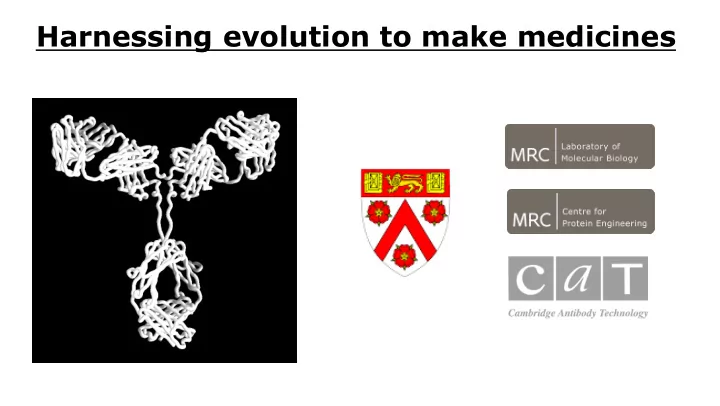
IgG mAbs are large (150,000 Da) Y-shaped protein molecules with two (H/L) chains. Associated VH/VL domains (=Fv at end of Fab arms) come together to form antigen binding site comprising a scaffold with six loops of variable sequence. Variability created by combinations of multiple genetic segments. Ab binds to infectious agent and can block infection, also can kill infectious agent by recruiting effector functions through Fc domains (stem).
binds target Fv Fab Fc
VH D JH VK JK VH VK
Unrearranged V-gene segments Rearranged V-genes antigen B cell B cell plasma memory
B cell
antibodies
(1) random rearrangement (combination) of V- gene segments. (Tonegawa 1976); (2) surface display of antibody on B-cell; (3) antigen-driven selection; (4) secretion of soluble antibody from plasma cell; (5) affinity maturation. 1, 2 3 4 5 VH, D, JH VL, JL VH VL
4
Year 2016. Source: from genengnews.com. antibodies red, chemicals black, others green BRAND DISEASE COMPANY SALES ($bn)
rheumatoid arthritis AbbVie 16.1
hepatitis C Gilead 9.1
rheumatoid arthritis Amgen/Pfizer 8.9
NHL Roche/Biogen 8.6
rheumatoid arthritis J&J/Merck 7.8
multiple myeloma Celgene 7.0
cancers Roche 6.7
breast cancer Roche 6.7
diabetes (insulin) Sanofi 6.0
pneumonia (vaccine) Pfizer 5.7
Mouse monoclonal antibodies (mAbs) 1975 Humanized mAbs 1986 Simple chimeric mAbs 1984 CD20 Rituxan 1996 EGFR Erbitux 2006 HER2 Herceptin 1998 VEGF Avastin 2004 PD-1 Keytruda 2014 PD-L1 Tecentriq 2016
VH VL PCR PCR
Frequency of most common nucleotide From hybridoma cDNA. (Orlandi 1989).
Phage vector. VH/VL from anti-HEL D1.3 mAb.
(McCafferty 1990). g3 coat protein VH/VL E.coli V-genes
F1ori
Phage ELISA
sheep anti-M13 Ig goat anti-sheep Ig HRP HEL- coated surface HEL = hen egg lysozyme phage
Model selection: rare binders (scFv D1.3 to target HEL) isolated by multiple rounds of
affinity selection. (McCafferty 1990).
immune mouse library
(Clackson 1991) 106 clones from mouse immunized with
non-immune human library
(Marks 1991, Griffiths 1993) VL VH VH VL spleen B-cells
new new
random combinatorial [Huse 1989]
107 clones from human donors, Kd = 10 µM
binding affinity
300-fold increase Ka (Kd phOx 300 nM to 1 nM) Mutator host mutations
1 2 3 4
100-fold increase Ka (Kd phOx 300 nM to 3 nM)
Mutation in vivo. (Low 1996) Chain shuffling in vitro. (Marks 1992)
V-genes su+ E.coli helper phage
2 1
colE1ori M13ori
am
Kd capture equilibrium Ag-biotin Streptavidin- coated beads
Low [Ag] & capture (Hawkins 1992) “Monomeric display”
[Bass 1990], (Hoogenboom 1991)
Binding specificities and affinities from
large primary synthetic Fab library >1010 clones. (Griffiths 1994) VH D JH VK JK
Synthetic V-gene repertoires. V-segment
building blocks (Tomlinson, 1992; Williams 1994, Cox 1994): assembly into synthetic libraries (Hoogenboom 1992, Nissim 1994, Griffiths 1994)
PCR
synthetic rearranged V-genes
mouse (Knoll – Abbott) human MRC – CAT Adalimumab (Humira). Developed through Cambridge Antibody Technology and Knoll (BASF
Pharma), later sold to Abbott. First human therapeutic antibody approved by US FDA for rheumatoid
Necitumumab (EGFR/NSCLC) Ramucirumab (VEGFR2/Cancer) Raxibacumab (Anthrax) Moxetumumab (CD22/HCL)
Adalimumab (TNF/Autoimmune) Avelumab ( PDL1/Cancer) Belimumab (BAFF/Lupus) Guselkumab (IL23/Psoriasis) Phage antibodies on the market.
>60 antibodies from phage display have entered clinical trials; J. Osbourne, Medimmune
Human pharma target classes