PROVIDE A SECOND LIFE FOR THE DRAUGEN FIELD Draugen, Subsea - - PowerPoint PPT Presentation

provide a second life for the
SMART_READER_LITE
LIVE PREVIEW

PROVIDE A SECOND LIFE FOR THE DRAUGEN FIELD Draugen, Subsea - - PowerPoint PPT Presentation

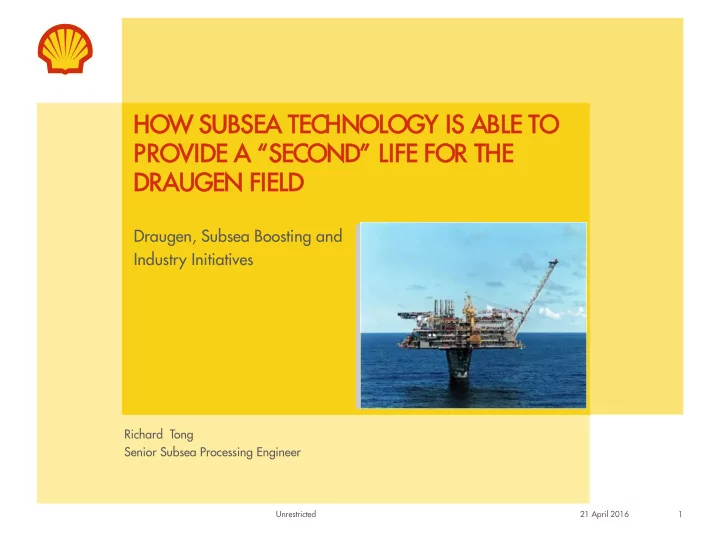
HO HOW S SUBSEA T TECHN HNOLOGY I IS ABLE T TO PROVIDE A SECOND LIFE FOR THE DRAUGEN FIELD Draugen, Subsea Boosting and Industry Initiatives Use this area for cover image (height 6.5cm, width 8cm) Richard Tong Senior Subsea


slide-1
SLIDE 1

HO HOW S SUBSEA T TECHN HNOLOGY I IS ABLE T TO PROVIDE A “SECOND” LIFE FOR THE DRAUGEN FIELD

Draugen, Subsea Boosting and Industry Initiatives

Richard Tong Senior Subsea Processing Engineer

1 21 April 2016

Use this area for cover image (height 6.5cm, width 8cm)

Unrestricted

slide-2
SLIDE 2

AGENDA

1.0 Introduction to Draugen 2.0 Draugen Infill Project 3.0 Subsea Pumping System

  • Scope of Supply - Testing - Technology Qualification API 17N

4.0 Technology & Industry Initiatives on Subsea Boosting 5.0 Field Screening of Subsea Boosting

21 April 2016 2

Courtesy of: Heine Schjølberg

Unrestricted

slide-3
SLIDE 3

History and Introduction to Draugen

DRAUGEN

1.0

21 April 2016 3 Unrestricted

slide-4
SLIDE 4

HI HISTORY RY O OF DRAUGEN

  • First and only Single-leg GBS platform
  • Low number of wells, due to successful production

strategy

  • Continuous project activity and investments underway to

make Draugen a high integrity mature producer

  • Robust and sustainable design; fit-for-purpose for

potential future 3rd party Tie- ins

4 21 April 2016 Unrestricted

slide-5
SLIDE 5

HI HISTORY RY O OF DRAUGEN

Draugen Field Résumé

 Field Properties

 Located in Haltenbanken area, 140km North of Kristiansund  Discovered in 1984 and production start 19.10.1993  Partners: A/S Norske Shell (Operator, 44.56%),

Petoro AS (47.88%), VNG (7.56%)

 Water Depth ~ 250-280 m  Peak Production 225 000 bbl/day  High uptime- high recovery

5 21 April 2016 Unrestricted

slide-6
SLIDE 6

21 April 2016

HI HISTORY RY O OF DRAUGEN

Draugen Field Résumé (continued)

 Geological / Geophysical Properties

 Main reservoir in sandstone: Rogn and Garn Formations of

Late and Middle Jurassic ages respectively

 “World-Class” Reservoir at 1600m depth  Produced by pressure maintenance from water injection and

aquifer support; gas lift used

6 Unrestricted

slide-7
SLIDE 7

DRAUGEN

21 April 2016 7 Unrestricted

slide-8
SLIDE 8

Project Scope

DRAUGEN I INFILL PROJECT

2.0

21 April 2016 8 Unrestricted

slide-9
SLIDE 9

DRAUGEN I INFILL DRILLING C CAMPAIGN

9 21 April 2016

slide-10
SLIDE 10

DRAUGEN I INFILL DRILLING C CAMPAIGN

Draugen Infill Drilling Campaign

 4x New Subsea Production Wells  Subsea Boosting Pump  Subsea Tee Manifold @ Rogn South  19 km of New Flowlines  11 km of New Umbilicals  52 tie-ins  113 GRP Covers  70 Concrete Mattresses  245 000 m3 Rock Installation  11 000 m3 Rock Removal

10 21 April 2016 Unrestricted

slide-11
SLIDE 11

HY HYDRATE P PLUG RISK FOR SUBSEA FLOWLINES

Ris isk Descrip iption ion: Cause - Lift gas circulated in flowlines Potential Event - At an unexpected long shutdown, a hydrate plug may form Consequence - Loss of flowline, i.e. potential loss of production Ris isked Value = Cost x Probability

Assumptions-Information:

  • The plug can only be remediated by flowline replacement
  • Gas lift will have to be used in the future to maintain the production

11 21 April 2016 Unrestricted

slide-12
SLIDE 12

HY HYDRATE F FORMATION RISK

 Hydrate formation risk was a key factor towards driving concept

towards subsea pump

 Experimental and theoretical work indicates hydrate formation is

possible with Draugen oil. Risk increases with introduction of lift gas

12 21 April 2016 Unrestricted

slide-13
SLIDE 13

DRAUGEN I INFILL DRILLING C CAMPAIGN

Unrestricted

Advantages of Framo Dual-Pump Station (FDS)

 Subsea Boosting Pump Station

 Reduces back pressure “seen” by wells =

increased oil recovery ~70%

 Accelerated End-of-Field Life production  Increased efficiency as water cut increases

  • ver time

 Reduces risk of hydrate formation – no

need for continuous gas lift

 Allow field start-up  Offers metering of new wells coming on-

stream

 Future expansion flexibility

13 21 April 2016

slide-14
SLIDE 14

3.1 SMUBS 1993 3.2 Scope of Supply 3.3 Testing

DRAUGEN S SUBSEA PUMPING SYSTEM

3.0

21 April 2016 14 Unrestricted

slide-15
SLIDE 15

WORLD’S FIRST MULTIPHASE SUBSEA PUMP A/S Norske Shell D Draugen F Fie ield

Contract Award: 1990 1990 Sales: FMC K Kongsberg, N , Norway Pump Integration: FMC K Kongsberg, N , Norway Pump Fabrication: Framo, , Norway Host Type: Draugen GBS Platform Contract Type: EPC Water Depth: 28 280 0 m ( (92 920 0 ft) The Draugen Subsea Well Facilities Contract was the largest subsea EPC contract in Norway at the time. All subsea installations were designed for diverless installation, operation and maintenance. The seabed pumps (i.e. system integration of FRAMO pumps) were the world’s first commercial multi-phase pump installation. The pump was installed in 1993. It ran sucessfully from 1995 for 12.2 months (1000 operating hours) and was decomissioned and abandoned due to change in water injection strategy. Oil and Gas Journal: “Norske Shell has let a $100-million contract to Framo Engineering for a complete subsea multiphase booster pump system for Draugen oil field offshore Norway, where the world’s first such system was installed in 1994.”

15 21 April 2016 Unrestricted

slide-16
SLIDE 16

SMUBS

15 21 April 2016 Unrestricted

slide-17
SLIDE 17

DRAUGEN SUBSEA PUMP SYSTEM

SCOPE OF SUPPLY

17 21 April 2016 Unrestricted

slide-18
SLIDE 18

DRAUGEN INFILL PROJECT PUMPING SYSTEM

21 April 2016 18

  • Reduces back pressure “seen” by wells = increased oil recovery
  • Accelerated end-of-field life production
  • Avoid continuous gas lift, reduces hydrate formation risk
  • Offers metering of new wells coming on stream & expansion flexibility
  • Tie-back distance (To Draugen): ~4 km (12” flexible)
  • Ambient Temperature (seawater): 6 – 8 °C
  • Design temperature (flowlines):

75 °C

  • Design pressure: 220 bar
  • Number of Pumps: 2
  • Motor Rating: 2300 kW
  • Maximum dP: 50 bar

Unrestricted

slide-19
SLIDE 19

PFD

19 Unrestricted

slide-20
SLIDE 20

HE HELICO-AXIAL P PUMPS

21 April 2016 Unrestricted

slide-21
SLIDE 21

Draugen P Pump System P Parameters

  • Design pressure:

220 barg

  • Process operating temperature:

4 to 75 ºC

  • Max pump differential pressure:

50 bar

  • Pump suction pressure:

21 - 29 bara

  • Pump suction GVF:

10 - 32% (75%)

  • Pump flow rate:

643 - 855 Am3/h

  • Pump speed:

1500 – 4200 rpm

  • Pump motor shaft power:

2300 kW

  • Water Depth:

268 m

Unrestricted

slide-22
SLIDE 22

MULTIPHA HASE P PUMP

22 21 April 2016 Unrestricted

slide-23
SLIDE 23

PUMPING SYSTEM SCOPE OF SUPPLY

21 April 2016 23 Unrestricted

slide-24
SLIDE 24

TOPSIDE - POWER CONTROL M MODULE ( (PCM)

24 21 April 2016 Unrestricted

slide-25
SLIDE 25

DRAUGEN S SUBSEA PUMP: : PROCESS CONTROL M MODULE

21 April 2016 25 Unrestricted

slide-26
SLIDE 26

PUMP STATION

26 21 April 2016 Unrestricted

MPP1 MPP2 MPFM3 MPFM2 MPFM1 MPFM4 (dummy) Main inlet Well G-1 Well G-2 Well G-3 Well A-55 55 SCM V4, V4, retrievable choke insert

Unrestricted

slide-27
SLIDE 27

PUMPING SYSTEM SCOPE OF SUPPLY

21 April 2016 27

Process Control Module Topside Umbilical Termination Unit Subsea Umbilical Termination Assembly

Unrestricted

slide-28
SLIDE 28

PUMP STATION INSTALLATION

21 April 2016

slide-29
SLIDE 29

PUMP TESTING

21 April 2016 29 Unrestricted

slide-30
SLIDE 30

TESTING

MV connector stack-up test

21 April 2016

slide-31
SLIDE 31

STACK U UP PUMP STATION INTO PROTECTION STRUCTURE

21 April 2016 Unrestricted

slide-32
SLIDE 32

TESTING AT HO HORSØY

32 Unrestricted 21 April 2016

slide-33
SLIDE 33

TECHN HNOLOGY & & I INDUSTRY INITIATIVE VES ON S SUBSEA BOOSTING

4.0

21 April 2016 33

API 17N Industry Initiatives

Unrestricted

slide-34
SLIDE 34

API RP 17N 17N

What is API RP 17N?

 Industry collaboration attempting to address a common approach

Technology Readiness Level (TRL) and associated Technology Risk Categorization (TRC) for development of new technology

 Focus on assessment of modification of existing

technologies/equipment to the project specific needs, not just new technologies

 Focus on assessment of new technologies already deployed,

particularly with respect to reliability

 Present assessment in the form of a risk/readiness matrix  References internal/external standards and codes

21 April 2016 Unrestricted

slide-35
SLIDE 35

TRC defin init itio ion wit ith Shell in interpretatio ion

21 April 2016 Unrestricted

slide-36
SLIDE 36

TRL D Defin init itio ion

21 April 2016

slide-37
SLIDE 37

API 17 17N Interpretatio ion: : Ris isk (TRC) / /Readin iness (TRL) Matrix ix

Technical Risk Categorization

Very High Technical Risk / Unacceptable Reliability

A

N/A

High Technical Risk / Low Reliability

B

N/A

Medium Technical Risk / Moderate Reliability

C

Low Technical Risk / Acceptable Reliability

D 25 2

1

7 6 5 4 3 2 1

Field Proven System Installed

(less than 3 years) or immature with respect to reliability

System Tested Environment Tested

New Technology,

  • r Some

Reconfiguration

  • f Existing

Technology

Prototype Tested

New Technology

  • r significant

reconfiguration

  • f existing

technology

Validated Concept Proven Concept Unproven Concept

Technology Readiness Level Note: Numbers above are examples. Not a reference to Draugen system.

21 April 2016

slide-38
SLIDE 38

RESTRICTED 38

INDUSTRY INITIATIVE VES

Longstep tie-back developments (>20 km)

  • Electrically heated lines
  • Long step out power supplies (<120 km)
  • Simplifying control system – onshore based system

Standardisation

  • API 17X Recommended Practice on Subsea Pumping Systems
  • Subsea Processing JIP – Standardization of Subsea Pumping.

Building market competitiveness

  • Pumping, higher pressures
  • Compression – Wet tolerance
  • Wet Compression – increasing the product range
  • Subsea water injection – Seabox (NOV)
slide-39
SLIDE 39

RESTRICTED 39

LONGSTEP O OUTS

  • Electrically heated lines:
  • Electrical heat tracing (Lowest power usage, highest CapEx)
  • Wet insulation direct electrical heating
  • Pipe in pipe direct electrical heating
  • Long step out power supplies
  • Onshore VSDs – 120 km & 12.5 MW vs.
  • Subsea VSD and switch gear (cable cost vs. subsea cost)
  • Simplifying control system – onshore based system
  • Communication protocols for safe shore based control of

subsea systems

slide-40
SLIDE 40

RESTRICTED 40

BUILDING MARKET COMPETITIVE VENESS Pumping

  • OneSubsea one major vendor, lack of competition
  • Qualifying FMC/Sulzer for the BC-10 project Brazil

Compression – Wet tolerance

  • Man and GE furthering technologies to be tolerant to 95% GVF

, 30% liquid w/w. Testing completed

  • Wet Compression One Subsea dual drive axis axial

compressor

  • WGC 4000 deployed for Statoil on Gulfaks
  • Developing WGC 6000, Testing. Chevon Gorgon project
slide-41
SLIDE 41

FIELD SCREENING OF SUBSEA B BOOSTING

5.0

21 April 2016 41

Technology Maturity, Field Screening Process

Unrestricted

slide-42
SLIDE 42

Proven Technology – 2 2 Mil illio ion Runnin ing Ho Hours

21 April 2016 Unrestricted

slide-43
SLIDE 43

Single Phase Pump

50 100 150 200 250 10 20 30 40 50 60 70 80 90 100

GVF [%] Differential Pressure [bar]

Hybrid pump

300 350 400

WGC

725 1,450 2,175 2,900 3,625 4,350 5,075

Differential Pressure [psi]

Multi Phase Pump

slide-44
SLIDE 44

44

OneSubsea Desig ign Pressure Mil ilestones

1990 2000 2010 2005 1995 5,000 10,000 15,000 1997, Lufeng 2003, Ceiba 2006, Columba E 2015 2013, JSM 2014 1998, Troll

Design Pressure <psi>

slide-45
SLIDE 45

45

OneSubsea Motor Shaft Power Mil ile Stones

1990 2000 2010 2005 1995

200 400 600 800 1000 1200 1400 1600 1800 2000 2200 2400 2600 2800 3000

1997, Lufeng 1998, Troll 2007, Tordis 2013, JSM 2010, Gullfaks WGC 2009, Pazflor 2006, Columba E 1999, Topacio 2015

3400 3200 3600 3800

Q4-2013

Shaft power <kW>

slide-46
SLIDE 46

46

OneSubsea Water Depth Mil ilestones

1990 2000 2010 2005 1995 1000 m 500 m 0 m 1500 m 2000 m 2500 m 3000 m JSM Azurite Ceiba Topacio Troll Lufeng SMUBS 2015 Design depth <m> Julia

slide-47
SLIDE 47

Reservoir ir Development Concept

21 April 2016 Unrestricted

slide-48
SLIDE 48

Hig High l level Comparis ison of typic ical Subsea Fie ields EOR methods

Gas/Water/WAG Injection Boosting Gas Lift ESP Location Injection Well Wellhead Riser Base Downhole Riser Base Downhole Pros

  • Could reduce alternative

investments (Prod. Wells, Flow lines, risers and topside equipment)

  • High flexibility when

injecting into multiple reservoirs

  • Disposal produced water /

reduce topside cleaning requirements

  • Combine with artificial lifts
  • Very high volume

capability

  • Effective on long tiebacks,

requires smaller pipeline sizes

  • Positive effect on flow

assurance

  • Can be shared by multiple

wells/manifolds

  • High reliability and low

intervention costs

  • Excellent flexibility in

injection/production rate

  • Excellent gas handling
  • Excellent sand and solids

handling

  • No advanced subsea

rotating equipment is required.

  • High volume/rate

capability

  • Wide production rate

range between applications.

  • Effective on long

tiebacks

  • Positive effect on flow

assurance Cons

  • Large topside investments

Topside Water Injection System including pump with filter, de-aerator, piping, valves, etc.

  • Platform

modifications/extensions, installation, hook-up and commissioning work.

  • Weight and space

constraints

  • High pressure injection

pipelines

  • Extra Wells cost
  • High cost per unit
  • Not economical for very

small fields

  • Fewer applications

compared with Gas Lift/ESP

  • Limited GVF range
  • Compression cost is high

and compressor must be reliable

  • Gas delivery line can be

expensive

  • Fair operating efficiency,

but poor for intermittent gas lift.

  • Tend to cause or increase

flow assurance issues

  • Limited increase of

production rates

  • Less effective in deep water
  • Not effective on long tie-

backs

  • Narrow production

rate range for a specific application

  • Reliability is a major

issue

  • Poor solids handling
  • Poor gas handling

(without inlet gas separators).

  • High intervention

frequency and cost

  • Only a per well

application

21 April 2016 Unrestricted
slide-49
SLIDE 49

Pore to Process Evaluatio ion Involvin ing Artif ific icia ial L Lif ift

21 April 2016 Unrestricted

slide-50
SLIDE 50

Evaluatio ion of Subsea Boostin ing

21 April 2016 Unrestricted

slide-51
SLIDE 51

RESTRICTED 51

SCREENING OPPORTUNITIES

  • Project economics requires: CapEx, OpEx and Productio

ion profil iles

  • Generally Reservoir Engineers are given surface PQ curves

from which predict the impact of different surface options on reservoir production, from which to produce a profile from

  • This is a limited approach:
  • Poor accuracy
  • Limited functionality, insensitive to compositional changes
  • Requires fixed water cuts & GORs
  • Difficult to model constraints e.g. compressor curves etc.
  • Etc...
slide-52
SLIDE 52

RESTRICTED 52

PRODUCTION SYSTEM MODELLING

  • Integrated Production System Modelling
  • Shell uses PTEX’s Resolve software that links together and
  • ptimises:
  • GAP – surface network
  • Prosper - well
  • MoRes –subsurface

Coupled with:

  • Equipment Design
  • Availability modelling
  • Routing Logic
slide-53
SLIDE 53

RESTRICTED 53

OUTCOME

  • No endless iteration with Reservoir Engineering
  • Quality of information has been significantly approved, able

to assess between different options

  • Perform senstivity analysis: equipment sizing, uncertainities,

availability, routing, project timing etc.

  • System analysis, understanding what are the governing

constraints and what impact of changing them Production Profile Compressor Power Velocity Constraint

slide-54
SLIDE 54

Q & A

21 April 2016 54 Unrestricted

slide-55
SLIDE 55

Ha Have a Safe Day

21 April 2016 Unrestricted