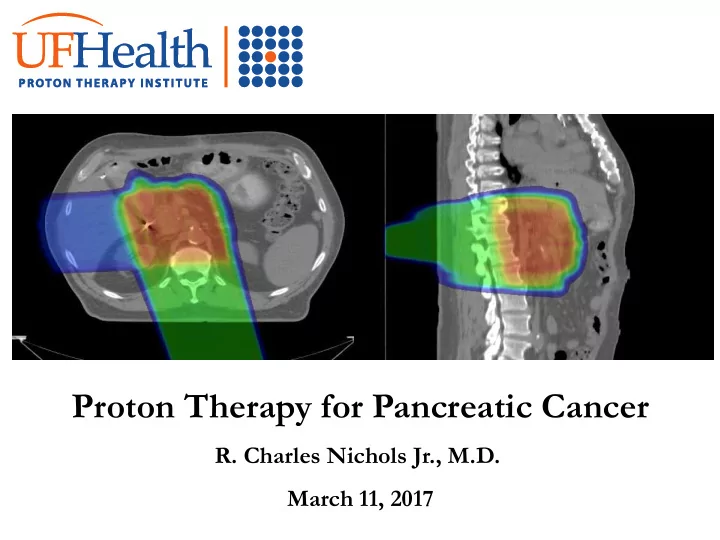
SLIDE 1 Proton Therapy for Pancreatic Cancer
- R. Charles Nichols Jr., M.D.
March 11, 2017
SLIDE 5 Photons (X-Rays)
Highest Dose is near the point of beam entry. Tumor Dose is less than the entry dose. Dose is also delivered beyond the tumor target.
SLIDE 6 Protons
Entry dose is low. Highest Dose is at the depth of the tumor target. There is NO exit dose beyond the target.
SLIDE 7 Statement:
- Proton therapy has the potential to
improve the therapeutic index over x-rays in the treatment of many malignancies.
SLIDE 8 Is proton therapy only...
- A more elegant form of radiotherapy?
- A more sophisticated form of radiotherapy
SLIDE 9
Gray A Gentler
SLIDE 10 Or...
- …does the improvement in the therapeutic
index with protons offer the potential to change the management paradigm of a particular malignancy?
SLIDE 11 Or...
- …does the improvement in the therapeutic
index with protons offer the potential to change the management paradigm of a particular malignancy?
- Resectable pancreatic cancer.
SLIDE 12 Pancreatic Cancer Facts...
– Perhaps 50% present with localized disease
- Perhaps 50% of these are “resectable” or “curable”
– And yet the “cure” rate is only about 20% for these “curable” patients.
SLIDE 13 More Facts
- Local control is a necessary condition for
cure.
- Surgery is a necessary condition for local
control.
- Surgery is rarely a sufficient condition for
local control.
SLIDE 15
The problem with the Pancreaticoduodenectomy...
…is that even with negative nodes and negative surgical margins, 50% to 80% of patients will suffer a local failure if they do not receive postoperative radiotherapy.
SLIDE 16 …is that so surprising?
Half of the involved
behind!
SLIDE 17 …is that so surprising?
Close retroperitoneal / vascular margins
SLIDE 18 Are you ready for the bad news?
– Pawlik TM, Surgery, 2007
- 905 Whipples from 1995 to 2005
– Node positivity was…79.3% – Margin positivity was …41.1%
SLIDE 19 Are you ready for more bad news?
– Winter JM, Annals of Surgical Oncology, 2012 – 625 resections from 2000 to 2009
- Margin positivity…16%
- Node positivity…70%
SLIDE 20
So what can be done to improve local and regional control?
SLIDE 21
Postoperative X-Rays?
SLIDE 22
Problems with postoperative radiotherapy…
SLIDE 23
Problems with postoperative radiotherapy…
1.) Long delay between surgery and radiotherapy.
SLIDE 24
Problems with postoperative radiotherapy…
1.) Long delay between surgery and radiotherapy. 2.) Bowel toxicity limits x-ray dose to +/-50Gy to a hypoxic tumor bed.
SLIDE 25
Problems with postoperative radiotherapy…
MGH data shows a 36% local/regional failure rate at 3 years after postoperative chemoradiation. RTOG 97-04 shows a 23% to 28% local failure rate.
SLIDE 26
Summarizing…
SLIDE 27
Summarizing…
1.) Surgery is necessary (but not sufficient) for cure.
SLIDE 28
Summarizing…
1.) Surgery is necessary (but not sufficient) for cure. 2.) Postoperative radiotherapy may not be effective. Too Late… Too Little…
SLIDE 29
Any suggestions?
SLIDE 30
Preoperative radiotherapy!
SLIDE 31
…not so fast
…50% of attendees surveyed at the 2012 international GI meeting in San Francisco would not recommend preoperative radiotherapy for a marginally resectable patient even after a non-response to first line chemotherapy.
SLIDE 32 The bottom line...
…Many pancreas surgeons are reluctant to
- perate on a previously irradiated patient.
SLIDE 33
Why?
SLIDE 34 Why?
Gastrojejunal Anastomosis Pancreaticojejunal Anastomosis Biliaryjejunal Anastomosis Postoperative Nutrition
Median duration of surgery is >400 minutes!
SLIDE 35
Are we at an impasse?
SLIDE 36
Maybe not...
What if we could convince you that preoperative radiotherapy could be delivered without the gastrointestinal toxicity of x-ray based therapy?
SLIDE 37
Does dosimetry suggest that protons improve the therapeutic index for pancreatic cancer?
SLIDE 38
SLIDE 39
Protons versus IMRT
Small Bowel V20 (15.4% vs. 47.0% p=0.03)
SLIDE 40
Protons versus IMRT
Gastric V20 (2.3% vs. 20.0% p=0.03)
SLIDE 41
Protons versus IMRT
Right Kidney V18 (27.3% vs. 50.5% p=0.02)
SLIDE 42
Does dosimetry suggest that protons improve the therapeutic index for pancreatic cancer?
SLIDE 43
Does dosimetry suggest that protons improve the therapeutic index for pancreatic cancer?
Yes.
SLIDE 44
Does this elegant dosimetry translate into reduced radiotherapy toxicity?
SLIDE 45
SLIDE 46 UF Experience: 3/09 to 4/12
- 20 evaluable patients
- Unresectable / Inoperable disease … 10
- Marginally resectable disease … 5
- Resected (postop RT) … 5
SLIDE 47 Proton Dose
– Unresectable / Inoperable …59.40CGE – Marginally resectable … 50.40CGE – Resected (postop) … 54.00CGE
- All patients received Capecitabine at 1000mg PO
BID during RT.
- 90% to 100% of prescribed doses taken
– Median 99%
SLIDE 48 Grade 3 acute toxicity
SLIDE 49 Grade 3 late toxicity
SLIDE 50 Grade 2 GI toxicity
– Vomiting … 3 – Diarrhea … 2
SLIDE 51
Field design (early)
SLIDE 52 Field design (current)
PAO:Rt.Lateral weighted 3:1
SLIDE 53 Grade 2 GI toxicity (current field arrangement)
SLIDE 54 Weight loss (17 patients -current field design)
- Median 1.1lbs
- Range +10.4 to -14.1lbs
SLIDE 55
Does this elegant dosimetry translate into reduced radiotherapy toxicity?
SLIDE 56
Does this elegant dosimetry translate into reduced radiotherapy toxicity?
Yes.
SLIDE 57
What about efficacy?
SLIDE 58 UFPTI PC01 Protocol
- 11 Patients analyzed.
- Celiac axis or SMA encasement,
- cclusion of the SMV, portal vein or
both confluences.
- 59.40Gy(RBE) in 33 fractions with
capecitabine (1000mg PO BID).
SLIDE 59 PC01 Protocol (continued)
- Median age 68 years (range 51 to 86)
- Median follow up for all patients … 14
months (range 5 to 25)
- 4 patients underwent attempted
resection after PT. 3 resections performed.
- No grade 2 or greater GI toxicity.
SLIDE 60
PC01 Protocol (continued)
Median Survival 18.4 months 2 Year Local Control 69% 2 Year Overall Survival 31%
SLIDE 61 What about surgery after proton therapy?*
- 5 resections performed after
59.40Gy(RBE) for patients with unresectable disease.
– One patient also received 50.40Gy(RBE) electively to the high risk nodal targets
*Nichols PTCOG-NA, 2014
SLIDE 62 Operations Performed ...
- 3 … laparoscopic standard
pancreaticoduodenectomy.
pancreaticoduodenectomy.
- 1 … open distal pancreatectomy with
IRE of the pancreatic head mass.
SLIDE 63 Outcomes (1)...
- 2 … R0 resections with minimal
residual tumor in specimen.
- 1 … after negative pancreatic head
biopsy, IRE followed by distal pancreatectomy with NTS in specimen
SLIDE 64 Outcomes (2)...
- Median OR Time …419 minutes
- Median EBL …850cc
- Median ICU stay…1 day(range 0 to 2)
- Median hosp. stay…10 days(5 to 14)
SLIDE 65 Outcomes (3)...
- No late complications or morbidity
attributable to proton therapy.
- Operative Time, EBL and LOS
comparable to published surgical series on unirradiated patients.
- Median survival 24 months (range 10
to 30)
SLIDE 66 Outcomes (4)...
– No complaints from the 5 surgeons who did the operations.
SLIDE 67 Summary #1
- Surgical outcome data demonstrates
a high rate of local failure which is
- nly marginally improved with
postoperative radiotherapy.
SLIDE 68 Summary #2
- Many surgeons are reluctant to
recommend preoperative radiotherapy for fear that it may complicate the surgery or the recovery period.
SLIDE 69 Summary #3
- Our experience suggests that these
fears are unjustified with proton therapy:
– Dosimetry – Lack of acute or late radiotherapy toxicity – Surgical experience showing no increase in complications for unresectable patients receiving high dose radiotherapy before surgery.
SLIDE 70 Summary #4
- The lack of toxicity associated with proton
radiotherapy may improve the willingness of surgeons to accept neoadjuvant (proton) radiotherapy for patients with operable disease.
SLIDE 71 Summary #5
- If this happens, proton therapy will change
the management paradigm for patients with resectable pancreatic cancer.
- Improve local/regional control rates
- …and perhaps improve the cure rate for
this lethal malignancy.
SLIDE 72 UFPTI protocols:
– PC01 … Unresectable disease … 59.40CGE with concomitant Capecitabine (closed) – PC02 ... Resectable and marginally resectable disease … 50.40CGE with concomitant Capecitabine. – PC03 … Postoperative adjuvant with weekly Gemcitabine
- 50.40CGE for R0 resections
- 54.00CGE for R1 resections
- 59.40CGE for R2 resections
SLIDE 73 UFPTI protocols:
– PC04 … “initally unresectable” disease… 63CGE in 28 fractions (mimics NRG 1201) with concomitant capecitabine.
- +/- equivalent of 70CGE at 2CGE per fraction
- Intensification for marginally resectable
patients based on MDACC data showing that
- nly 50% of marginally resectable patients
receiving preop chemoradiotherapy are converted to resectability.
SLIDE 74
SLIDE 75 Thanks...
- Soon Huh
- Meng Wei Ho
- Zuofeng Li
- Brad Hoppe
- Mike Rutenberg