SLIDE 1
Nemagenics
Proposal for a new COST Action:
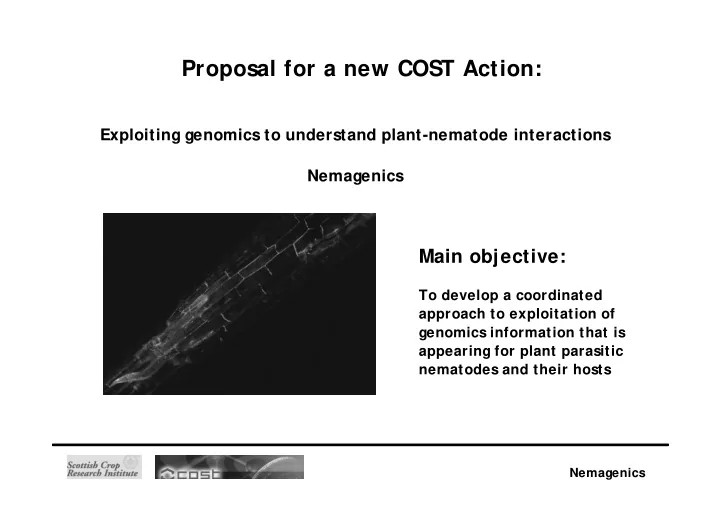
Exploiting genomics to understand plant-nematode interactions Nemagenics
Main objective:
To develop a coordinated approach to exploitation of genomics information that is appearing for plant parasitic nematodes and their hosts
SLIDE 2
Nemagenics
Plant parasitic nematodes
Damage Interactions with hosts State of the art
The need for a new COST Action
Genomics Scientific programme Integration of activities Benefits to Europe
Talk plan
SLIDE 3 Nemagenics Nematodes – damage & cont rol
Nematodes are damaging plant pathogens
Nematodes are significant pathogens
- n almost all important crops grown
worldwide
Cyst and root knot nemat odes are t he
most import ant pat hogens
Existing control strategies are not sufficient
Resist ance not always in
commercially viable cult ivars
Pressure t o reduce use of
“ nematicides”
SLIDE 4
Nemagenics Interactions with the host
Nematodes have complex interactions with plants - biotrophy
SLIDE 5
Nemagenics Interactions with the host
Nematodes induce complex feeding sites in plants Syncytium (Cyst nematodes) / Giant cell (Root-knot nematodes)
Enlarged Highly met abolically act ive Mult inucleat e Cell wall ingrowt hs adj oining vascular
tissue
Nemat odes depend on feeding sit e for
all nut rient s required t o develop t o adult st age
Nematode feeding site (NFS) induction involves profound changes in plant gene expression
Genes have been charact erised Source of promot ers for t ransgenic solut ions
SLIDE 6
Nemagenics Interactions with the host – st at e of t he art
Nematode secreted proteins are key to this process Produced in gland cells
2 subvent ral 1 dorsal
Secreted into the plant via the stylet
SLIDE 7
Nemagenics Interactions with the host – st at e of t he art
Enormous progress has been made in identifying and characterising nematode secreted proteins A range of genes have been identified
Plant cell wall degrading enzymes Candidat e defence prot eins Prot eins involved in feeding sit e
induct ion
Systems for functional analysis have been developed
Nemat ode gene knockout s: RNAi Het erologous expression in plant s
SLIDE 8
Nemagenics
Almost all major breakthroughs in this area have been made by EU groups during RTD programmes EU groups demonstrably ahead of competitors in US & Japan
Crit ical role for support from EU Example of how Lisbon goals can be achieved
First animal pectate lyase & expansin
Nat ure, 427, 30; Nat ure, 406, 36-37
RNAi of nematode pathogenicity genes
MPMI, 18, 621-625; MPMI, 18, 615-620
NFS and meristem formation share regulatory steps
EMBO Journal, 17, 6799-6811
Importance of cytoskelton & cell cycle progression in NFS development
Plant Cell, 11, 793-807; Plant Cell, 16, 2529-2540
Expression of dsRNA in plants leads to resistance
dsRNA Control
SLIDE 9
Nemagenics The need for a new COST Action
Genomics has completely changed the way in which biological problems are addressed Genomics
St udy of all t he genes in a species
A new approach to tackling biological problems
Priorit y lies wit h defining funct ion of genes Abilit y t o include all genes when seeking genes
associat ed wit h t rait s of int erest
Ident ificat ion of concert ed changes in gene
expression
Role of “ dry science” - bioinformat ics
Genomics is increasingly accessible to biologists
Cost s decreasing Number of species analysed increasing
SLIDE 10 Nemagenics The need for a new COST Action
Genomics information is becoming available for many important crops and nematodes Major challenge is the integration of activities to ensure effective exploitation of information Genomes
Crops – Tomat o, Pot at o, Rice Plant nemat odes – M. hapla, M. incognit a,
- H. glycines, (G. pallida)
Animal parasit ic & free living nemat odes
ESTs
Almost all maj or crop and nemat ode
species
Tools
Microarrays Comparat ive genomics soft ware Funct ional genomics
SLIDE 11
Nemagenics The need for a new COST Action – Work programme
3 main work areas proposed:
WG1: Functional genomics of plant parasitic nematodes WG2: Comparative genomics of nematodes WG3: Functional genomics of plant responses
SLIDE 12 Nemagenics The need for a new COST Action – Work programme
WG1: Functional genomics of plant parasitic nematodes
Development and application of tools for functional analysis
Outputs:
RNAi Cell biology Transcript ome monit oring Validat ed met hodology & t ools Funct ionally charact erised pat hogenicit y genes Target s for cont rol
SLIDE 13
Nemagenics The need for a new COST Action – Work programme
WG2: Comparative genomics of nematodes
Genome annotation Comparative genomics Exploitation of model systems Outputs
Genome sequences in a format accessible t o communit y t hat
needs t o exploit t hem
Genes specific t o plant parasit ic nemat odes, parasit ic nemat odes,
plant pat hogens
Different plant parasit ic nemat odes Plant parasit ic, animal parasit ic & free living nemat odes Plant parasit ic nemat odes & ot her plant pat hogens Nemat ode (C. elegans) and plant (Arabidopsis)
SLIDE 14
Nemagenics The need for a new COST Action – Work programme
WG3: Functional genomics of the plant response
Susceptible response Plant resistance Identification of nematode Avr genes Outputs
Key genes import ant for NFS format ion markers for R genes Funct ional screens based on Avr genes microarrays TILLING R genes & R gene evolut ion Defence response pat hways
SLIDE 15
Nemagenics The need for a new COST Action – Key Activities
Meetings/Workshops Short term exchange visits
How will a new COST Action help?
New skills need t o be shared t o opt imise progress and exploit opport unit ies Training of next generat ion of scient ist s Int eract ions & exchanges bet ween scient ist s working at bench Exchange of informat ion Co-ordinat ion of act ivit ies Building new collaborat ions Links bet ween academia & indust ry
Links between groups are needed more than ever before
New informat ion means co-ordinat ion of act ivit ies vit al Previously est ablished net works in danger of falling apart for lack of funds
Dissemination to end-users
SLIDE 16
Nemagenics The need for a new COST Action – Pract ical out put s (I)
Improved methods of nematode control are a priority for many growers
Pot ent ial wit hdrawal of aldicarb from EU Environment al harm of nemat icides Consumer pressure for no residues
A new COST Action will lead to significant practical benefits
Information to underpin new and durable GM strategies
RNAi mediat ed st rat egies Nemat ode or pat hogen specific t arget s
Information to guide development of new nematicides
Enzyme pat hways Nemat ode specific t arget s
SLIDE 17
Nemagenics The need for a new COST Action – Pract ical out put s (II)
A new COST Action will lead to significant practical benefits
Better understanding of interactions between nematodes and natural enemies
Biological cont rol Improved underst anding of nemat ode defences
against pat hogens
Understanding of interactions of nematodes with plant R genes
Underpin select ion of durable R genes Ident ificat ion of resist ance breaking
populations
Unanticipated benefits arise from genomics projects
e.g Erwinia as an opport unist pat hogen Abilit y t o exploit t hese opport unit ies
SLIDE 18
Nemagenics The need for a new COST Action - summary
Contribute to the EU science base and add value to planned
investments in the field
Provide training & education for young scientists in an emerging
field
Provide knowledge that underpins development & profitability
for world-leading companies in this area (based in the EU)
As shown by int erest from several companies in part icipat ing
Build on investment made through RTD programmes Build links that will allow participating scientists to exploit
genome sequences from around the world
Benefits to Europe The proposed COST Action will:
SLIDE 19
Nemagenics
Has the backing of a substantial group of dynamic, successful & enthusiastic scientists keen to participate
A new COST Action:
~ 200 research act ive
scient ist s (t o dat e!)