Proof Theory We will define : is provable from . A sequent is a - - PowerPoint PPT Presentation

proof theory
SMART_READER_LITE
LIVE PREVIEW

Proof Theory We will define : is provable from . A sequent is a - - PowerPoint PPT Presentation

Computational Logic, Spring 2006 Pete Manolios Proof Theory We will define : is provable from . A sequent is a nonempty list (sequence) of formulas. For example, 1 . . . n is a sequent. 1 . . . n is called the


slide-1
SLIDE 1

Computational Logic, Spring 2006 Pete Manolios

Proof Theory

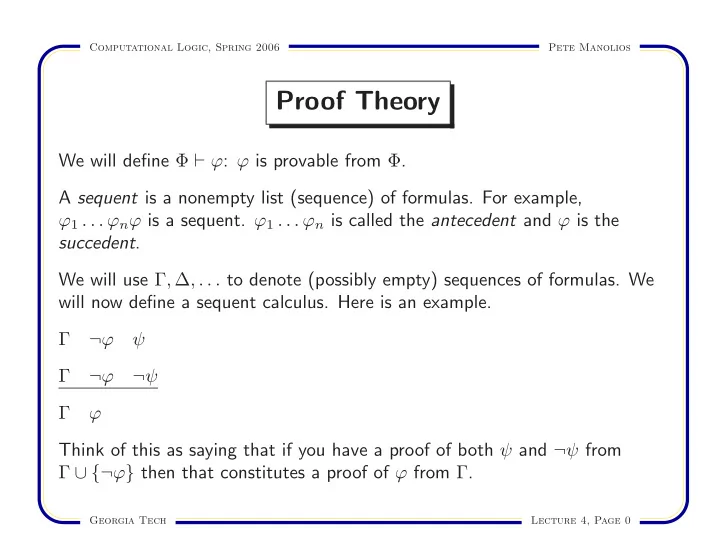
We will define Φ ⊢ ϕ: ϕ is provable from Φ. A sequent is a nonempty list (sequence) of formulas. For example, ϕ1 . . . ϕnϕ is a sequent. ϕ1 . . . ϕn is called the antecedent and ϕ is the succedent. We will use Γ, ∆, . . . to denote (possibly empty) sequences of formulas. We will now define a sequent calculus. Here is an example. Γ ¬ϕ ψ Γ ¬ϕ ¬ψ Γ ϕ Think of this as saying that if you have a proof of both ψ and ¬ψ from Γ ∪ {¬ϕ} then that constitutes a proof of ϕ from Γ.

Georgia Tech Lecture 4, Page 0

slide-2
SLIDE 2

Computational Logic, Spring 2006 Pete Manolios

Derivability

If there is a derivation of the sequent Γ ϕ, then we write ⊢ Γ ϕ and we say that Γ ϕ is derivable. Definition 1 A formula ϕ is formally provable or derivable from a set Φ

  • f formulas (written Φ ⊢ ϕ) iff there are finetely many formulas

ϕ1, . . . , ϕn in Φ such that ⊢ ϕ1 . . . ϕn ϕ. A sequent Γ ϕ is correct if Γ | = ϕ

Georgia Tech Lecture 4, Page 1

slide-3
SLIDE 3

Computational Logic, Spring 2006 Pete Manolios

Sequent Calculus

Antecedent Rule (Ant) Γ ϕ Γ′ ϕ if every member of Γ is also a member of Γ′. Assumption Rule (Assm) Γ ϕ if ϕ is a member of Γ Proof by Cases Rule (PC) Γ ψ ϕ Γ ¬ψ ϕ Γ ϕ

Georgia Tech Lecture 4, Page 2

slide-4
SLIDE 4

Computational Logic, Spring 2006 Pete Manolios

Sequent Calculus

Contradiction Rule (Ctr) Γ ¬ϕ ψ Γ ¬ϕ ¬ψ Γ ϕ ∨-Rule for the Antecedent (∨ A) Γ ϕ ξ Γ ψ ξ Γ (ϕ ∨ ψ) ξ ∨-Rule for the Succedent (∨ S) (a) Γ ϕ Γ (ϕ ∨ ψ) (b) Γ ϕ Γ (ψ ∨ ϕ)

Georgia Tech Lecture 4, Page 3

slide-5
SLIDE 5

Computational Logic, Spring 2006 Pete Manolios

Derived Rules

Using the existing rules, we can derive new sequents. Tertium non datur (Ctr) (ϕ ∨ ¬ϕ) Proof? We can prove it by assuming ϕ, getting ϕ ∨ ¬ϕ and repeat with ¬ϕ. Second Contradiction Rule (Ctr’) Γ ψ Γ ¬ψ Γ ϕ

Georgia Tech Lecture 4, Page 4

slide-6
SLIDE 6

Computational Logic, Spring 2006 Pete Manolios

More Derived Rules

Chain Rule (Ch) Γ ϕ Γ ϕ ψ Γ ψ Contraposition Rules (Cp) (a) Γ ϕ ψ Γ ¬ψ ¬ϕ (b) Γ ¬ϕ ¬ψ Γ ψ ϕ (c) Γ ¬ϕ ψ Γ ¬ψ ϕ (d) Γ ϕ ¬ψ Γ ψ ¬ϕ Modus ponens Γ (ϕ → ψ) Γ ϕ Γ ψ

Georgia Tech Lecture 4, Page 5

slide-7
SLIDE 7

Computational Logic, Spring 2006 Pete Manolios

Quantifier Rules

∃-Introduction in the Succedent (∃ S) Γ ϕ t

x

Γ ∃xϕ Proof The next rule corresponds to an often used argument used to prove that ψ follows from ∃xϕ. One assumes that for some new y, ϕy

x.

∃-Introduction in the Antecedent (∃ A) Γ ϕy

x

ψ Γ ∃xϕ ψ if y is not free in Γ ∃xϕ ψ. Proof

Georgia Tech Lecture 4, Page 6

slide-8
SLIDE 8

Computational Logic, Spring 2006 Pete Manolios

Equality Rules

Reflexivity Rule for Equality (≡) t ≡ t Substitution Rule for Equality (Sub) Γ ϕ t

x

Γ t ≡ t′ ϕt′

x

Georgia Tech Lecture 4, Page 7

slide-9
SLIDE 9

Computational Logic, Spring 2006 Pete Manolios

Soundness of the Sequent Calculus

Recall: a formula ϕ is derivable from Φ, written Φ ⊢ ϕ, iff there are formulas ϕ1, . . . , ϕn in Φ such that ⊢ ϕ1 . . . ϕnϕ. Lemma 1 For all Φ and ϕ, Φ ⊢ ϕ iff there is a finite subset Φ0 of Φ such that Φ0 ⊢ ϕ. We will prove a similar theorem, the compactness theorem, for | =. As a preview, once we prove the completeness theorem, namely that the notions | = and ⊢ are “equivalent” then we will be able to transfer results such as this one from one realm to the other. The beauty is that sometimes results are trivial to prove in one realm, but seem very deep in the other. Theorem 1 For all Φ and ϕ, if Φ ⊢ ϕ then Φ | = ϕ. Proof The proof is by induction on the structure of a derivation. This is one direction of the completeness theorem.

Georgia Tech Lecture 4, Page 8